Friday, 4 October 2019

Does Apple Cider Vinegar Help Weight Loss?

Few foods are as storied as the apple. Thanks to its widespread availability, it may not seem like a very exotic fruit, but it’s still significant to people and cultures all around the world -- not just as a healthy staple, but as a mythological symbol (and an icon of science, as well).((Alimentarium: The apple of discord and beauty))((Science Mag: How the apple conquered the world)) Part of the fruit’s fame lies in its versatility. From its sweet derivatives (like applesauce and apple juice) to the tangy (like apple cider vinegar), this gem of nature has a lot to offer in terms of health benefits. As for that vinegar? It might just be a little-known but vital way of peeling off the pounds.

Does Apple Cider Vinegar Help Weight Loss?

A lot of people want to know whether apple cider vinegar actually helps with weight loss. In a word, yes. Scientists have more than one theory about the underlying biological mechanisms, but the short answer is that it does make a difference. The knowledge we’ve gained from scientific inquiry goes a long way toward helping explain a part of apple history -- the fact that vinegar from apples has been used as a medicinal tonic across many cultures, dating back centuries. Studies using human subjects have shown that not only does apple cider vinegar help reduce weight, it also lowers body fat and serum triglyceride levels (triglycerides are the main constituent of the body’s fat cells).((Biosci Biotechnol Biochem: Vinegar intake reduces body weight, body fat mass, and serum triglyceride levels in obese Japanese subjects)) The research in question comes from a study of 144 Japanese adults suffering from obesity. They were split into three separate groups -- one group added a single tablespoon of apple cider vinegar to their daily intake; one added two tablespoons, and the third group consumed a daily placebo. The treatment took place over a 12-week period. Other than limiting how much alcohol they drank, participants were not asked to change anything else about their diet or exercise routines. The results were striking. On average, members of the group that drank one tablespoon of vinegar every day lost 2.6 pounds, experienced a 0.7 percent decrease in body fat, and dropped triglyceride levels by 26 percent -- no small feat. The group that consumed double the vinegar, however, saw even more impressive results -- in addition to the same 26 percent drop in triglycerides, those participants lost an average of 3.7 pounds and 0.9 percent of their body fat. As for those who only had a placebo, no weight loss occurred. In fact, those participants gained weight -- 0.9 pounds on average. One study is good, but science demands replication. Was the weight loss benefit from the Japanese study on obesity just a fluke? Not at all, based in part on the following: In terms of metabolism, humans and mice are quite similar, which is why the furry little guys play a big role in lots of nutritional studies. A separate, six-week-long experiment (also in Japan) showed that mice, too, experience weight-loss effects from adding apple cider vinegar to their diets. Actually, the results were remarkably similar to the human trial; mice who took a high dose of vinegar gained less weight than those who took a lower dose, and both groups gained less than those who took none at all. This is despite each group being fed the same high-fat, high-calorie diet.((J Agric Food Chem.: Acetic acid upregulates the expression of genes for fatty acid oxidation enzymes in liver to suppress body fat accumulation))

How Does This Happen?

Again, there’s some debate about this. In at least one study, researchers were able to demonstrate that acetic acid (apple cider vinegar’s main ingredient) may lower blood sugar levels by aiding the liver and muscles in absorbing glucose from the bloodstream. The lowered blood sugar and insulin reduction that goes along with it, may promote the body’s ability to burn fat. And the more fat you’re able to burn at rest, the better everything goes.((Br J Nutr. : Effect of acetic acid feeding on the circadian changes in glycogen and metabolites of glucose and lipid in liver and skeletal muscle of rats)) Acetic acid intake also correlates with levels of AMPK, an enzyme that contributes to cell homeostasis. The higher the AMPK availability, the greater the body’s fat-burning ability -- and the less sugar produced by the liver, two things that can contribute to the kinds of results seen in the apple cider vinegar studies.((Biochem Biophys Res Commun. : Acetic acid activates hepatic AMPK and reduces hyperglycemia in diabetic KK-A(y) mice)) Apparently, consuming extra acetic acid like that found in apple cider vinegar has an effect even on a genetic level -- an additional study that treated obese, diabetic rats with acetic acid heightened the expression of certain genes that govern the body’s likelihood of retaining belly and liver fat. In other words, when you’ve got extra acetic acid, your genes are likely to tell your body not to add belly fat to your body -- a welcome message.((Biosci Biotechnol Biochem.: Improvement of obesity and glucose tolerance by acetate in Type 2 diabetic Otsuka Long-Evans Tokushima Fatty (OLETF) rats)) Yet another study suggests that the whole thing could be as simple as the fact that acetate consumption reduces appetite. And when you eat less (even if it’s just a little bit less), you give your body a chance to adjust to a lower percentage body fat, etc. ((Source: The short-chain fatty acid acetate reduces appetite via a central homeostatic mechanism.))

Does Apple Cider Vinegar Alone Work for Weight Loss?

It’s easy to get caught up in the headlines and the idea that something as simple as tossing a bit of vinegar down the hatch can help us accomplish our biggest health goals, but we shouldn’t get ahead of ourselves. Apple cider vinegar can help with weight loss, but that doesn’t mean any of us should go out and stop exercising. Regular exercise, proper hydration, plenty of sleep, and a balanced diet are still crucial factors in both body mass measurements and overall wellbeing (which is something I can personally vouch for).((Dr. David Minkoff M.D.: At 70-years-old, here’s how I’ve competed in 42 Ironman races (and how you can, too)))

Additional Benefits of Apple Cider Vinegar

Apple cider vinegar isn’t just good for knocking inches off your waist, either; it’s got loads of other upsides for your health. For instance, it’s a probiotic, meaning it contains friendly bacteria that help support a healthy digestive ecosystem. On top of that, it’s got a decent amount of antioxidants, those helpful little molecules that negate free radical damage. And those lowered triglyceride levels do more than just help you retain a pretty shape -- they reduce your risk of heart disease and diabetes, too.

How to Reap Its Benefits

If you’re worried about the taste, it’s not as bad as you think. A tablespoon of apple cider vinegar mixed with water actually goes down quite nicely, especially when you add in a dash of honey. There are also plenty of other ways to incorporate it into your food, such as in a salad dressing, deviled eggs, or creamy vegan queso dip.((TheKitchn: 21 Recipes That Make Use of Apple Cider Vinegar)) Be mindful, though -- you can get too much of a good thing. Too large a dose of the tonic can burn your throat (ouch!) or give you a stomach ache, not to mention interfere with your bowel regularity. Also, be sure to brush your teeth shortly after drinking it. The primary ingredient is acid, which can wreak havoc on your tooth enamel. To be on the safe side, you can use a straw as an easy workaround for this. Safe consumption practices include splitting the dose into portions rather than swigging it all at once, and heavily diluting it no matter how much you take. This also helps prevent your throat from feeling raw afterwards. As far as the “right” dose, a review of apple cider vinegar’s therapeutic benefits found that 15 mL a day was enough to confer most of those. That’s about one tablespoon, or half of what was taken by the biggest losers in the Japanese weight-loss study.((ScienceDirect: Therapeutic effects of vinegar: a review))

Bottom Line

The bottom line is that apple cider vinegar is probably the least expensive yet most effective health supplement you can pick up from any basic grocery store. There’s plenty of reason to believe that it can help you shave off -- or keep off -- the pounds. An apple a day might not keep the doctor away, but based on all this evidence, a few tablespoons of apple cider vinegar just might.

More About Healthy Weight Loss


10 Ways to Boost Your Workout Motivation

You come in from a long day at the office, and you want to get a workout in, but you can’t find the motivation. Or maybe you think you have the motivation but “life” is getting in the way of your workout as you feel you have too much on your plate to fit it in. Making your workout a priority and finding ways to fit it into your schedule will offer you a host of health benefits and make you feel like you’ve got your mojo back. Working out will be a lot easier if you view it as a gift you give to yourself versus a distasteful activity you have to get through. Think about your health and vitality — by your working out, you are treating yourself as a priority. And coming from a place of self-love. Studies show that regular exercise changes the brain to improve memory and thinking skills.((Harvard Health Publishing: Regular Exercise Changes the Brain to Improve Memory, Thinking Skills)) So if you’re using the excuse that work is taking over too much for you to have time to work out, think of your workout as a part of your workday. You’re helping your brain be sharper at work.
“Healthy exercise is valuable not only for the maintenance of good physiologic function of the body, but also mental clarity, and the feeling of good health.” —Paul Dudley White, MD
Once you’re ready to make your workout a priority and give yourself that gift, how do you implement your workout goals into your daily life? Here are 10 ways to boost your workout motivation. These strategies will help you keep your fire for working out going strong.

1. Commit to Your Calendar

Say you want to work out 3 times a week. Look at your calendar for that week and see where those spots will fit in the best. Then, make a commitment to sticking to those times. One exercise study showed that a big obstacle to maintaining regular exercise is being able to fit it into a person’s schedule.((Cbc: Working Out Is Hard)) Make these appointments with yourself unbreakable. Maybe you can handle variety, so one day a week you might have an early morning workout. Another day that week, you might fit it in after work.

2. Start Your Day with 20 Minutes for Yourself and Your Workout

You may have great intentions for working out after work or during lunch hour, but inevitably other commitments might encroach into that time. If you get on up and knock out your workout first thing, you reap the benefits all day long of that energy boost. This workout could be a morning walk or hitting the yoga mat right when you get out of bed.

3. Expand Your Horizons and Seek out Variety

Our brains crave variety. If you are stuck in the rut of the same old workout, it might be time to stretch yourself. Brainstorm some wild ideas that sound appealing to you. Fencing? Look for classes in your area. Kayaking? See if there’s a place near you where you can rent kayaks and look for some local outdoor clubs where you could go with others. Even if the new thing you try is challenging, give yourself some time to stick with it enough to see if it might be for you.

4. Combine Social Time with Your Friends into Your Workout

Having a hard time fitting in a workout because of your social life? Instead of only getting together with your friends at the wine bar, see if you can schedule a hike in the park with them. Or you could join a rec league like kickball. You could talk a friend into joining with you, or you could sign up by yourself and meet some new pals. Some exercise research reported that competition was a key motivator for exercise, and you can use that to your advantage in one of these leagues.((Psychology Today: Study Identifies No. 1 Source of Motivation to Exercise More)) Other opportunities include playing basketball or tennis at local parks, gyms, or fitness centers. Scope out some ways to make your workout more social or combine fitness activities into your social life.

5. Use Music to Inspire You

Is your playlist stale? Spend some time creating a great workout playlist. Search Spotify or create some motivating stations on Pandora. Think about what songs make you move. If you hear that song, you just can’t sit still. Use those. Even the theme song from Rocky might be a good motivator for you. You can create multiple theme playlists to spark more creativity and fun in your workout. How about making a playlist of Best All-Time Roller Skating Songs? Or Best Heavy Metal Workout Songs? Best 80’s Workout Playlist (maybe it includes Let’s Get Physical).

6. If Music Is Not Your Thing, Find Some Cool Podcasts

Download podcasts or audiobooks that interest you. Getting lost in a good podcast or audiobook can make the time fly by on your workout. And if you get the satisfaction of “multi-tasking” — you’re getting your exercise in while reading a book or staying up to date on a podcast.

7. Update Your Gear

Maybe you’re not up for working out because your workout gear is from the dark ages. If you go to pull out a tee shirt for your workout, and it’s full of holes or from a college party, it’s time to re-do your workout wardrobe. Think of getting new workout gear as investing in yourself. How often do we make sure our living rooms or kitchens are state of the art, but we don’t put any time, energy, or money into our personal effects? It could be as simple as a getting a new water bottle. Making sure you have supportive and properly fitting shoes is key to achieving your workout goals. And if you get a new workout tee or tights, it can make you more motivated to get moving.

8. Just like You Get Organized at Work, Get Organized for Your Workout

Set out what you need as motivation for your workout. If you are going on a morning run, lay out your workout clothes the night before. Fill your water bottle and set it on the counter. For the after-work exercisers, pack your bag of clothes to take with you to work so you have no excuse not to go onto the gym. Or, if you are coming home after work, set your clothes out so that when you come home; they will be a not-so-gentle reminder to you saying, “hey, pal! It’s time to go on your walk!”

9. Use Alarms as Nudging Reminders

So you’re not a morning person. If you think getting up earlier to squeeze a workout in before work is just not going to happen for you, then set an alarm for the time you need to start preparing for your workout in the afternoon/evening. If you want to go on a walk at 6pm, set an alarm for 5:30pm as a reminder. When you hear the alarm, it’s like a nudge saying, “it’s time to get dressed for your walk.” You don’t want to shirk on yourself.

10. Trade Exercise for That Afterwork Happy Hour Drink

Maybe you are skipping some workouts to meet co-workers at happy hour. Or you come in from a long day at work and have a glass of wine first thing to alleviate the stress of the day. While it’s sometimes nice to unwind with a glass of wine, doing so after work could be a habit. And you can replace that habit with exercise. By cutting out alcohol right after work, it gives you more time in the day to get a workout in. So try to go straight from work to your workout, or put your exercise clothes on the minute you get home and head back out the door for your run or walk. Whatever it is, think of that happy hour as a new kind of "happy hour time" for your to treat yourself and your body to your workout. Exercise can help stave off anxiety and depression, so if your post-work drink is to alleviate post-work stress and anxiety, give a neighborhood walk a whirl instead.((Europe PMC: Exercise for Mental Health))

Time to Get Moving!

Life sometimes gets in the way of our best-laid plans, including our plans to work out. But by maintaining the attitude of self-love, and giving yourself the gift of time to exercise, you can use the above tips to help you stay on track with your workout regimen. By using some organizational tricks as well as remembering your reasons for making your workout a priority, you'll not only find the time to fit it in but feel good about doing so. Now, which strategies of these are you going to implement this week?

How to Be More Self-Aware and Strive to Be a Better Person

On a scale of 1-10, how self-aware do you think you are? If you don't know how to answer this question, you aren't alone. One study estimates that only 10-15% of people are truly self-aware.((HubSpot: The True Meaning of Self-Awareness (& How to Tell If You're Actually Self-Aware)) If self-awareness is so important, why do so many people struggle with it, let alone understand what it means? A big reason is because we live in a world where we are conditioned to operate on autopilot. This busy mindset doesn't leave room for much self-reflection and introspection. By not taking the time to connect with ourselves, we stop paying attention to what is going on internally. As you can imagine, this can be a recipe for an emotional disaster.

What is Self-Awareness?

Self-awareness is the foundation for personal growth. It involves understanding your own needs, desires, failings, habits, and everything else that makes you tick.((Lifehacker: The Importance of Self-Awareness and How To Become Self-Aware)) If you want to strive to be a better person, you need to get intimate with yourself, meaning you've got to know who you are and who you are not. Moreover, you've got to be able to accurately monitor your inner world, as well as accept who you are with an open heart. This is where a lot of people get stuck. It takes courage to go deep with yourself and look at messy emotions that you don't necessarily want to acknowledge, let alone work on. Let's face it... growth isn't always pretty. In fact, it sometimes feels like an uphill climb. However, it is the one thing that is required if you want to level up your life and become more of who you want to be.
"Self-awareness gives you the capacity to learn from your mistakes as well as your successes. It enables you to keep growing." -- Lawrence Bossidy
The benefits of self-awareness are far-reaching, some of which include, greater empathy and listening skills, improved critical-thinking skills and decision making, strengthened relationships, and enhanced leadership capabilities and capacity.((Institute for Public Relations: Know Thyself: Examining The Benefits of Self-Reflection))

How Do You Know If You Are Self-Aware?

Many people think that self-awareness is this grandiose skill that only super smart people understand. This is far from true. If you have fallen victim to this type of thinking, I want to share some signs that you may be more self-aware than you actually think you are.

You're Unapologetically Yourself

If you aren't afraid to speak your truth, for fear that others won't accept you for who you are, the chances are you've got a high level of self-awareness. Self-aware people live from a place of integrity. They are unapologetically themselves, in the sense that they don't allow the noise of others' judgments to veer them off track. In other words, they know how to stay in their own lane.

You're a Master of Your Emotions

When life doesn't go your way, self-aware people don't react and throw in the towel. They understand that irrational behaviors only make you spiral into a negative hole. Hence, they stop and think before they respond to challenges. They know that if they don't master their emotions, their emotions will master them. By becoming aware of their emotions, they are able to maintain a sense of clarity and peace of mind, no matter what is going on in their environment.

You Listen to Yourself

Self-aware individuals pride themselves on their ability to pay attention and tune into what is happening inside of them. Your intuition rarely ever lies. I have yet to meet anyone who has said to me, "My gut is a liar." Self-aware people listen to what their gut tells them. When something doesn't feel right, it probably isn't. By trusting the messages or feelings that they are receiving, self-aware people are better able to make decisions that positively influence their lives.

You've Got Strong Boundaries

Self-aware people don't let others walk all over them. They know that they can't be all things for all people, which is why they establish strong boundaries with others. Setting a boundary is the ability to recognize the need for a healthy separation between your thoughts and feelings and the thoughts and feelings of others.((HuffPost:10 Great Things That Happen When You Set Boundaries)) By taking care of their emotional needs first, self-aware people are better able to take care of themselves.

How to Become Self-Aware

Becoming self-aware is the first step in the creation of your ideal future. It's the personal commitment to yourself that you are ready and willing to upgrade your current reality. Once you are more aware of your thoughts, emotions and behaviors, you become empowered to make changes that serve your highest self.

1. Keep a Journal

One of the most powerful tools for building self-awareness is through journaling. This is a great way to get to connect with your inner world on a deeper level and communicate with any subconscious feelings you might be overlooking. The act of writing provides a space for unexpressed feelings to be acknowledged. The question is.... what do you write about? I would suggest that you focus on one area of your life where you currently feel stuck. At the beginning of each day, do a brain dump and express, in writing, all of the random things that you've been thinking about. This approach has the potential for getting your creative juices flowing and reduces the influence of your rational thoughts.((Life Skills That Matter: The #1 Self-Awareness Habit))

2. Practice Mindfulness

Practicing mindfulness on a daily basis can help you fully experience the totality of your emotions. When you are mindful, you have greater control over your emotional self. In turn, you will feel more calm and less stress. This quiet time is a perfect opportunity to reflect on your feelings in the present moment. Increased mindfulness influences our ability to think about our choices, as well as our ability to experience pleasure, reduce emotional reactivity and increase attention.((Presenting Yourself: Use Mindfulness To Increase Your Self-Awareness and Effectiveness)) Your body is always communicating with you. The question is, are you listening to it? A lot of people are too stuck in their heads, which in turn, disconnects them from their bodies. A great self-awareness practice for getting more in touch with yourself is by doing a body scan. Take some time every day to close your eyes and notice how each area of your body feels. By connecting with your body intelligence, you will feel more grounded overall.

3. Ask for Feedback from Others

In my opinion, honest and constructive feedback is the most valuable way to develop a greater level of self-awareness. We all have blind spots. What are yours? If you don't know, it's time to ask someone! Feedback is a great way to discover your strengths and weaknesses so you can figure out how to harness and or improve them.((Lifehacker: Asking for Regular Feedback Can Boost Your Self-Awareness)) This will require that you get humble and drop you ego. By asking others for their input about how they perceive you and your actions, you will feel empowered to change those parts of yourself that may be holding you back from becoming the person whom you aspire to be.

4. Challenge Yourself

A great way to practice self-awareness and work on becoming a better person is to undertake something significant. True growth comes from stepping outside of your comfort zone and taking risks. That is when your figure out who you truly are as a person. All of this is easier said than done. Change can be hard, especially if you have behaved one way for most of your life. This is why staying in your comfort zone feels so good. It is a space where your activities and behaviors fit a routine and pattern that minimizes stress and risk. Security is "nice" but it will kill your productivity. Challenging yourself and putting everything on the line helps propel you forward and fuels your personal growth. If you want to be your best self, you've got to be willing to test your limits and free yourself from who people think you "should" be so that you can figure out who you were meant to be.

Final Thoughts

Self-awareness is the key to self-mastery. By making the commitment to discover new truths about yourself, you will grow and improve every area of your life. When you know who you are, there is nothing you cannot do. You cannot improve yourself if you are not self-aware. In the words of Eckhart Tolle,
"Awareness is the greatest agent for change."
What actions will you take today to grow your self-awareness muscle and change your life for the better?

More About Self-Mastery


Thursday, 3 October 2019

When You Never Stop Learning, These 5 Amazing Things Happen

Imagine if what you've been told about learning is a myth. For example, many people believe that learning ends when you leave college, or that you need to have a high IQ to be able to learn easily. And it's also a common belief that only young people can learn new things. Now, not only are all these beliefs completely wrong — but they're also incredibly harmful to people who buy into them. The truth is that the ability to learn is available to everyone, including yourself. You just need to find the desire, motivation and purpose to get the 'learning habit'. That's what this article is all about. I'm going to show you the incredible benefits of lifelong learning. And I'm going to inspire you to start traveling down this glorious road so you can transform your life. Ready to get started? Then read on as I reveal five amazing things that will happen when you never stop learning.

1. You Have a Sharper Mind

Continuous learning helps to keep your mind fresh and your memory sharp. In fact, research has shown that learning in general has beneficial effects on the brain, including lessening your risk of dementia.((Research Gate: Benefits of Lifelong Learning)) To give you an example of this in action, let me tell you about one of my life coaching clients. He initially came to me as he felt like he had lost his way in life (he was in his mid-40s at the time). Upon speaking with him, it became obvious to me that not only was he directionless, but he also lacked the spark of life. You know what I mean, that drive and energy that you get once you're excited about something. During the course of several one-to-one sessions with him, I was able to help him find out what he wanted to do in his life, and I also instilled in him the power of continuous learning. I did this by asking him to learn at least one new thing a day. After doing this for a month, he called me up to say that he was feeling enthusiastic about life again. He'd fallen in love with being curious about things and was learning new stuff everyday. He also told me that his mind and memory had never been sharper.

2. Your Confidence Is Boosted

If — like the person I mentioned above — you feel you've lost your way in life, then I'm guessing that your confidence has taken a knock too. This is where learning new things and taking on new challenges can really help. For example, imagine that you made the decision today to learn how to rock climb (even though you're afraid of heights!). You might initially read a book on the topic, or watch a few videos on YouTube. After that, you'd probably want to enroll in a professional rock climbing group. That way, you could learn to gradually overcome your fear of heights, while at the same time learning the essential techniques of rock climbing. Within a few weeks, you could be climbing to new heights!

3. Your Interpersonal Skills Are Improved

When you become an active learner, it's almost inevitable that you'll widen your social circle and improve your interpersonal skills. Let's say you decided to learn how to play chess... At first, you might learn the rules and some of the basic moves by playing against a computerized opponent. But keep doing this often enough, and eventually you'll want to test out your skills against a human opponent. This might be a friend, family member or colleague. But whoever it is, your mental battle with them will mean that you share a common experience. One that you're sure to talk about often. And if chess eventually becomes a favorite hobby of yours, you might well join a local chess club. This would allow you to meet lots of new people — all who love the game as much as you. This type of learning can extend your social circle, attract new friends, and enhance your relationships.

4. You Adapt Change a Lot Better

Greek philosopher Heraclitus revealed a timeless truth: "Change is the only constant in life." I'm sure you've experienced this in your life. However hard you try to avoid change; there's no holding this force back. Once you know this, though, then the secret to success is to be able to adapt to the changes that come your way. Learning can definitely help you do this. That's because through the learning process (say learning how to drive a car), you develop skills such as persistence, understanding and resilience. All key skills that can help you deal with any changes in your life that you're forced to encounter. Learners are strivers. And strivers know how to turn challenges into opportunities, and adversities into blessings.

5. You Open Up New Career Opportunities

If you want to climb the career ladder or start your own business, then it's vital that you're constantly learning. But not just random stuff. To be effective, your learning should be primarily focused on your career goals. For instance, if you wanted to set yourself up as a freelance business consultant, then I'd recommend that you did your research first:
  • Who are your likely customers?
  • What can you offer them?
  • How much should you charge them?
  • Can you secure enough work to pay your bills?
To find these answers, you probably need to read books and watch videos related to business consulting. But you'd also want to speak to likely customers, to see if and how you could be of help to them. These customers would also be able to give you an idea of how much they would be willing to pay for your services. If you decided to go ahead with pursuing this career, then the above research will be a good start. But you should keep learning how to improve your skills (including communication and marketing skills), and you should also seek feedback from all your clients — as this will be sure to reveal your strengths and weaknesses. When it comes to your career, the bottom line is this: By continually learning relevant, new information, you'll keep yourself ahead of your competitors. And you'll also keep yourself in demand from your clients.

Final Thoughts

So, as you can hopefully see from the above, a commitment to lifelong learning will turbocharge your health, happiness and success. And of course, there are more benefits to learning than the ones I've listed above. For instance, you're likely to earn more, you'll rekindle your zest for life — and you'll have fun! In my experience of managing dozens of staff and working with hundreds of life coaching clients, I've noticed that those people who have a love for learning, also have a love for life. They're naturally curious about everything. And this curiosity drives them to seek out new knowledge and skills. They're also unfazed by change (some of them actually thrive in these circumstances). If you feel that you've lost the 'learning bug', then please don't give up! Reignite your passion for learning through reading self-improvement books, watching inspiring movies, and most importantly... by learning new things! When you learn how to learn again, your life will be filled with progression and excitement.

More About Learning


How to Do Transcendental Meditation (Step-by-Step Guide)

Maybe you already know how to meditate but do you know how to do transcendental meditation? Meditation was first developed in India many years ago (around 5000-3500 BCE). It took quite some time to become popular in the western world, but today it is celebrated as a therapeutic tool to ease stress, anxiety,((Social Cognitive and Affective Neuroscience: Neural correlates of mindfulness meditation-related anxiety relief )) depression,((Translational Psychiatry: MAP training: combining meditation and aerobic exercise reduces depression and rumination while enhancing synchronized brain activity)) and addictions.((Science Direct: Mindfulness meditation improves emotion regulation and reduces drug abuse)) In the past years, it has also become recognized to improve mental performance, and it consequently became a multi-billion dollar business. When we think about meditation, we usually think about what's called “mindfulness meditation,” but there are seven different kinds of meditation that are being practiced all over the world:
  1. Loving-kindness meditation
  2. Body scan or progressive relaxation
  3. Mindfulness meditation
  4. Breath awareness meditation
  5. Kundalini yoga
  6. Zen meditation
  7. Transcendental meditation
Over the past decade, Transcendental Meditation® (aka TM® or T.M. Meditation®) has become extremely popular, scoring a staggering 5 million followers that practice it every day. You may have heard about the benefits of T.M. and wondered what it was all about. T.M. is a type of mantra meditation that has been introduced to the Western world in 1950 by Maharishi Mahesh Yogi.((Biography: Maharishi Mahesh Yogi)) He taught the practice all over the world for 40 years to spread its movement, touching anyone from politicians to The Beatles. Today, many celebrities such as Jerry Seinfeld, Hugh Jackman, Ellen Degeneres, and Howard Stern publicly stated that T.M. changed their lives.((Transcendental Meditation: Famous people who meditate, from A to Z)) The popular movie director David Lynch even created a foundation to help spread transcendental meditation around the world. These big names certainly contributed to the success of this practice (together with the large body of studies proving its benefits),((HuffPost: Evidence Shows Transcendental Meditation Has Real Health Benefits)) but the main reason for the popularity of T.M. is its simplicity. If you've tried to meditate in the past, but you couldn't stick to it long enough to experience its benefits, keep reading. In this article, I will highlight the main differences between mindfulness meditation and transcendental meditation, and why some people like one type better than the other. I will explain how the T.M. organization teaches it to their students, and I will also give you a step-by-step guide on how to do T.M. on your own.

Transcendental Meditation vs Mindfulness Meditation

To understand why T.M. is unique, we need to take a step back and examine how mindfulness meditation work. All the other types of meditation use a similar mechanism to the mindfulness one except for T.M, so I'm going to describe only the difference between those two types for the sake of simplicity. Mindfulness, in current popular culture, encourages the cultivation of nonjudgmental, moment-to-moment awareness both during the practice and in everyday life. We all experience a multitude of thoughts that distract us from what's in front of our eyes. Maybe we're thinking about our to-do list, or simply hearing the sound of a song brings back an old memory; in any case, we tend to spend more time in our heads than in the present moment. With mindfulness meditation, by repeatedly returning our conscious awareness to the present moment (for example focusing on the breath, body parts or an object) we are able to observe our anxious or depressive thought patterns. In simple words, this means noticing your thoughts and learning to let go of them by shifting the mental focus from that thought to something like the movement of your breath. The act of actively observing thoughts without judgment, and the effort of letting go of those thoughts by focusing on the body, acts as a sort of brain-training exercise. The more successfully we do that (both during our meditation and in normal life), the more we empower ourselves to make conscious choices rather than being mindlessly controlled by our negative thoughts. To better understand this concept, you can imagine your mind being like an Ocean. On the surface, you have waves of any height and shape, but deep down, there is nothing but complete calm and stillness. Your thoughts are the waves. In normal life, you would swim around the waves of your mind, trying to face them head-on. Sometimes you can climb them and swim through, sometimes you feel overwhelmed by their power and end up drowning or feeling beaten up by their strength. Mindfulness meditation is like having a surfboard that allows you to ride those waves effortlessly. The more you practice, the better you get at surfing, and the easier it becomes to manage your thoughts. Sometimes, while going through this process, people may eventually get to a state of complete mental stillness. This state is "the second state of meditation" or transcendence. Note that the goal of mindfulness meditation is not to reach this state. Instead, its goal is to actively train your mind in letting go of thoughts and develop the ability to make mindful choices in everyday life. I have personally practiced thousands of hours of mindfulness meditation and taught it to many of my clients with fantastic results. What I've noticed though, is that some people are simply not able to stick to it and enjoy its brain training process. Usually, these people have a very active and buzzing mind, and not being able to "shut their thoughts" with the mindfulness technique drives them crazy. For those people, transcendental meditation works magic because of its totally different method.

How Is Transcendental Meditation Different?

Coming back to the example of your mind being like an ocean, imagine having a submarine instead of a surfboard. T.M., just like a submarine, can safely take you to the deepest depths of your mind, where it's calm and peaceful. Now that I've got you curious, let's explore how transcendental meditation work. If the goal of mindfulness is to train the brain in conscious awareness, the goal of T.M. is to go beyond the thinking process. If done properly, this can be a simple, automatic continuation of the flow of mindfulness meditation. The vehicle T.M. uses to reach this state is the mantra. (I'll explain in depth how it works later.) If we come back to the example of the ocean, now that we have our submarine (the mantra), we are able to slowly reach the depths of the ocean, where there's nothing but calm and stillness. In there, there is a state of restful awareness, where you can tap into the source of energy, thoughts, and creativity (also called collective unconscious by Carl Jung).((Encyclopedia Britannica: Collective unconscious)) When we get to these depths, we experience a profound state of rest and let go of even the deepest stresses. The beneficial effects of T.M. happen spontaneously (not consciously) when you are able to reach the state of transcendence.((Transcendental Meditation: Transcendental Meditation, the evidence based technique for wellness and inner peace)) Those who regularly practice T.M. report an increase in mindfulness and a very deep relief in stress. T.M. teachers emphasize the fact that the mind has a natural tendency of going into this tranquil state. Unfortunately, the mind also has a tendency to always look for what's interesting around us. This is why, with mindfulness meditation, having its focus on actively observing thoughts, it is harder to lean on this tendency of the brain to settle into deep tranquility. The question now is: "how do I get to this state of transcendence?" The answer is way simpler than you may think: By chanting a mantra.

What Doing T.M. Looks Like

Before we get into what exactly a mantra is and how it works, I want you to get an idea of what a standard transcendental meditation practice looks like. All that is required to practice T.M. is to sit and have your eyes closed; that's it. You don't need any particular pose or posture. Surely being alone, in a quiet room with a comfortable chair, will help facilitate the process but once you get a grip of it, you could do it anywhere, even while sitting at your desk or in a bus. All you need to do is to keep your eyes closed and silently chant your mantra. The general advice is to chant for 20 minutes, twice a day. This is partly due to the natural clock of our body (circadian rhythm) but also to the fact that the more you get into the habit of blocking time to meditate, the more likely you are to make it a habit. Despite this advice, there are no set-in-stone rules on how often and how long you should do your T.M. session. Everyone is different and has a different schedule, so whatever fits in your diary should be your choice. Now, let's get down to business and let's talk mantras.

What Is a Mantra?

A mantra is nothing but a meaningless sound. There is no real secret behind the mantra except for the fact that it should have no meaning, and it should "sound positive." People tend to get too caught up in what type of mantra is right for them. I have interviewed several seasoned T.M. teachers, and they all stated that "the more we don't know about our mantra, the better." This goes back to the fact that our mind is always making mental connections. If we try to chant a word that sounds too much like a word that we know the meaning of, we will automatically connect that word to images, sounds, smells, and memories. If we're chanting a totally meaningless word, it's easier to lean on the tendency of our mind to get into a tranquil state. You can imagine a mantra being like a seed. If you want to grow a plant, you won't look for "the perfect seed." You would simply pick one, plant it, water it and see it germinate. Getting caught up in "picking the right seed (mantra)," won't do you any good. At this point, if you are like me, you would think "OK, but I still need to know what a mantra looks like and sounds like," and that's why I'm going to give you a few examples of mantras to chant.

Examples of Personal Mantras

The most common mantra is the Homm. Teachers tend not to use this mantra because of the wholeness of this sound. In Hinduism, the sound Homm reflects the sound of all vibrations combined, both positive and negative. The Homm mantra seems to be mainly practiced by monks, and every teacher I've interviewed said that "apart from that, any other mantra can work well." Other examples of mantra could be:
  • Kirim
  • Shirim
  • Inga
  • Aema
  • Etc. (no this isn't a mantra)
Chanting a mantra sounds something like this:
  • Kiiiiiiririmmmm Kiiiiiiririmmmm
  • Shiririiiiim Shiiiiririnnnn
  • Iiiiiingaaaa Iiiiingaaaa
  • Aaaaaenma Aaaaaaaenmaa
You should vary the length and tone of each letter of your mantra while you're chanting, so that it would be easier to induce this "trance" effect on your mind. Once again, how you do that doesn't matter. As long as you chant it for the whole length of your session, it should work.

Should You Try Different Mantras?

Most teachers told me that both they and their students have been using the same mantra they've been given on their first T.M. sessions for their whole life. Once again, the point of the practice isn't to find the best possible sound for you but, to develop the habit of melting the stress in your mind by chanting a meaningless sound. On the flip side, if you're trying to do T.M. on your own and you notice that the mantra you choose reminds you too much of a real word, go pick another one that is totally meaningless. People that speak several languages may find this a bit harder than people that only speak their mother tongue, but it is still quite easy to find a meaningless sound. If you learn T.M. from a teacher, they will choose the mantra for you on your first meeting after you fill a questionnaire. After that, you'll chant it with them and progress into a personal, silent meditation practice. During the practice, the teacher will give some feedback and let you experience the mechanics of T.M. on the spot. This process is followed by another meeting with the teacher and two group meditations.

Can You Teach Yourself Transcendental Meditation?

The teachers themselves openly state that you can do T.M. on your own. The rules are simple, and all it takes is some practice and being consistent with it. What a T.M. course gives you (that you can't get on your own) is the accountability of a teacher and the support of a group of like-minded people. Most people that pay for a T.M. course are not simply looking to learn a system. They usually look for support in their healing journey to fight stress, insomnia, addictions, or relationship problems. If you tried mindfulness meditation, and simply want to try T.M. to experience first hand the difference between the two, there is no need to take a course. A very good way to go about could be simply this:
  • Look up on YouTube under "transcendental meditation mantras," pick one and see how it's chanted.
  • Play the track and try to chant it as they do it in the video.
  • Stop the track, sit, close your eyes, and silently chant the same mantra for 20 minutes.
  • Repeat this process, twice a day, for a week or so
If you find that T.M. makes you feel better than when you're doing mindfulness meditation, and you want to learn more about it, you can then decide to invest in it and take the T.M. course.

So, Is T.M. the Right Fit for You?

Nobody can tell if T.M. is better than any other type of meditation. Everything works differently for each individual, and it's our duty to try and discover new things before judging them. If you're into meditation, I highly suggest you try T.M. on your own or with a teacher to broaden your mind. The same goes for the people that are new to meditation, but, in this case, I would recommend starting from mindfulness meditation with an App like Headspace. T.M. can be quite tricky for a beginner without having the proper guidance, and the course itself is quite expensive (from 250 to 1000 dollars or even more depending on your income). Whatever the type of meditation you decide to try, I encourage you to commit to a minimum of 30 daily practices. Doing this will give you the time to start experiencing some tangible benefits in your day-to-day life. Learning about your mind is truly a delightful experience. The more you learn about the mechanics of your brain, the more you can experience personal growth and happiness.

More About Meditation


7 Beginner Yoga Exercises for Men to Increase Mobility

Isn't amazing how the culture of the (physical Yoga) Hatha Yoga evolved mostly among women? Are we men ashamed to practice this body-mind-spirit wisdom because it became a women’s thing, or discriminative of the idea that we men are tough enough and don’t need this kind of “activity”? We know that the practice of Hatha Yoga was brought to our western culture in the 20th century by masculine Yoga masters, and that mostly men are the creators of the original Yoga Sutra of Patanjali approx. 200 B.C.E - 200 C.E., known also as Raja Yoga or King’s Yoga – the basis of all other Yoga forms practiced around the world.((Internet Encyclopedia of Philosophy: The Yoga Sutras of Patanjali)) Keep in mind that Yoga goes much deeper than the physical posture and breathing, yet they are the start and the basis for the inward journey of self-inquiry and self-discovery. The deeper you immerse in the practice, the more you’ll happen to find out about it. An Asana - aasana((Wikipedia: Asana)) or Yoga posture is practiced with a purpose to mobilize the body and mind for achieving mental skills. This tells us that Yoga indeed is great for men. Not long ago, when I invited a friend of mine to a Yoga Asana session I was teaching, he looked at me discouraged with a shy smile on his face, saying “Really, Yoga for men? I don’t know about that. Me, with this belly, tense as I am, it would be an embarrassment to show myself in front of the other more flexible people, let alone perform postures.” I smiled back, and with encouraging voice told him "You always talk about getting in shape! Just come over please and see how simple yoga exercises can change the way you feel about yourself!" With the 7 exercises that follow, in just an hour, we succeeded to remove his misconceptions he had about yoga for men, and changed his attitude positively. Although he was never fond of practicing in groups, he got hooked up - he liked all the beginner postures and started practicing at home regularly and diligently. The most important and ideal Yoga posture are: “sthirasukhamaasanam” – steady and comfortable posture. Sthira meaning steady, stable and strong and sukham meaning comfortable, easy and peaceful, and aasana meaning body posture or pose. This is the entire instruction from the whole Yoga Sutra (YS, 2.46-2.48) on how a Yoga posture ought to be performed. As long as you apply the elements of stability and comfort to your body posture and align it with your breath (YS, 2.47), you perform the aasana correctly. Every man who wants to gain control over his physical and mental well-being and achieve a healthier lifestyle has the reason to get into Yoga. And here is the deal, in the next seven Yoga exercises you’ll see how to get into Yoga safely and successfully. Get ready and get healthier now!

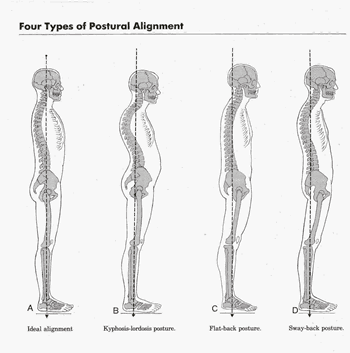
1. Tadaasana – The Mountain Pose (Variation A - Ideal Alignment)

  1. Stand up on your feet (see type A), preferably bare feet so you can connect to the ground. Breathe deeply and slowly.
  2. Feet aligned with the hips.
  3. Kneecaps and thigh muscles slightly contracted.
  4. Pelvis leveled horizontally.
  5. Chest open.
  6. Shoulder blades relaxed.
  7. Connect the tip of the thumb with the tip of the index finger - energy re-circulation.
  8. Face muscles relaxed (eyes slightly closed, mouth slightly open).
  9. Breathe gently in this position.
  10. On inhalation, your head is pulling (cranially) upwards, lengthening the spine.
  11. Create a virtual thread inside your body from the heels up to the crown - tip of your head.
  12. Breathe gently, make sure your whole body is aligned as instructed.
  13. Connect to the thread and notice its movement.
  14. Stay in this position for 12 breaths – 4 sec. inhale and 6 sec. exhale - approx. 2 minutes according to the deep breathing exercise no. 1 in my previous post.
When practicing physical Yoga, we are counting breaths instead measuring time. Aligning the breath with the body posture is an element for the connection with your inner clock – a closer look on what’s going on inside you – inner awareness. The goal of the Mountain Pose is:
  • Stabilizing the nervous system through breathing.
  • Building energy and releasing tension.
  • Stabilizing the movement of the thread (inner stability) through the help of breathing.
  • Developing inner awareness.
  • Awareness of inner movement of body’s stability (the strength) and comfort (the easiness and lightness).
  • Creating a rhythmical breathing.
  • Improving focus, concentration and observation.

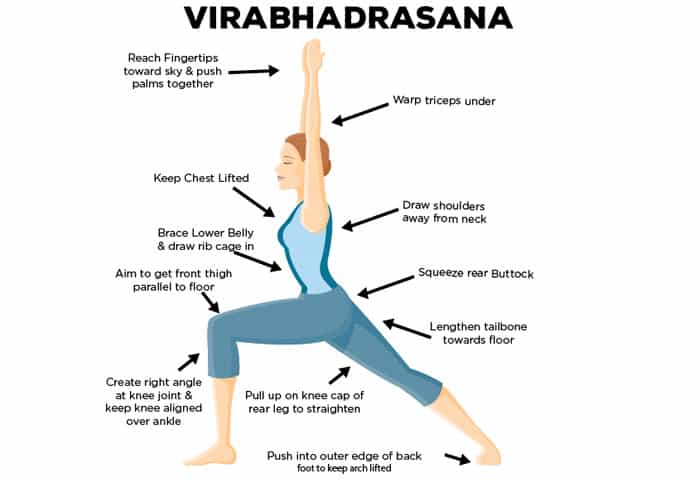
2. Virabhadraasana – The Warrior Pose (Variation)

  1. From Mountain pose exhale gently make a step forward (approx. 3 feet) with your right foot (see picture above) and slowly bend you right knee so your pelvis sinks (only as far as it is comfortable) towards the floor. Tip: Place left knee on the mat or a pillow if your muscles can’t support this posture.
  2. Make sure your body weight is balanced 50/50 on both legs.
  3. Inhale gently, reach fingertips towards the sky - push palms together, chest is open, shoulder blades relaxed – go down.
  4. Breathe consciously, deeply and rhythmically (abdomens relaxed). Be aware of the expansion of your groin area as you inhale.
  5. Focus your gaze on one point and remain in this position for five slow, deep breaths (or for as many as it feels right for you).
  6. Concentrate completely on the contractions of your thigh muscles and the pressure on your hip joints. Balance your weight 50/50 on both feet.
  7. Build energy with each inhalation!
  8. Release tension with each exhalation!
  9. Don’t let the muscle contraction intensify too much and disturb your breathing rhythm. Float the pelvis up and down to balance the intensity of the muscle contraction.
  10. Do the same with your arms. The moment you feel that the muscle contraction of your shoulders disturb you breathing, spread and lower the arms.
  11. Exhaling, make a step back, lower your arms and come back to Mountain pose.
  12. Have a break with one long, deep breath.
  13. Repeat the same (step 1 to 11) with the left foot.
Make three rounds (3 x right foot, 3x left foot). The goal of the Warrior Pose is:
  • Building energy and releasing tension.
  • Stretching and strengthening thigh and gluteus muscles.
  • Stretching hips (groin muscles) and mobilizing hip joints.
  • Strengthening back muscles.

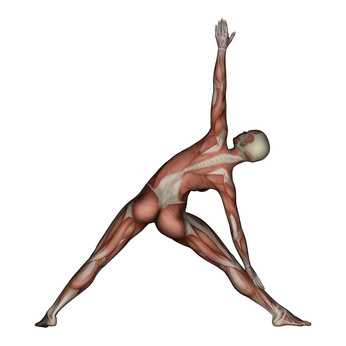
3. Trikonaasana – The Triangle Pose (Variation)

  1. From Mountain pose, spread your feet approx. 2-3 feet laterally. Left foot 0°, right foot 90° to the right (adjust the degree of your feet as you see fit. Tip: For better alignment and results do this pose against a wall and adjust your posture with the hands).
  2. Inhale gently, spread your arms at the height of your shoulders (palms facing forward).
  3. Further slow, deep inhalation lengthens the spine upwards.
  4. Slowly exhale and from the lowest vertebra begin to bend to the right (vertebra for vertebra, from the lowest upwards). The left hip goes lightly to the outside. Slowly! When bending you must feel firm and comfortable. Your right palm lays on your right kneecap (or lower, if you are more flexible). Your left hand stretches up vertically following the bending of your spine.
  5. Focus your gaze on one point and remain in this position for five slow, deep breaths (or for as many as it feels right for you). Feel the flexibility of your spine and any tensions in the back, legs or pelvic area.
  6. With each inhalation build up energy and with each exhalation release tension. Slowly adjust your pelvis, torso, neck, etc. if necessary during your rhythmical breathing.
  7. With an exhalation, slowly, come back into position no. 3.
  8. Have a break with one long, deep breath.
  9. Repeat the same (step 1 to 8) going to the left.
Make three rounds (left and right). The goal of the Triangle Pose is:
  • Building energy and releasing tension.
  • Mobilization of spine, pelvis area and groin muscles.
  • Mobilization of lower back (lumbar spine) and shoulders.
  • Strengthening superficial and core back muscles.

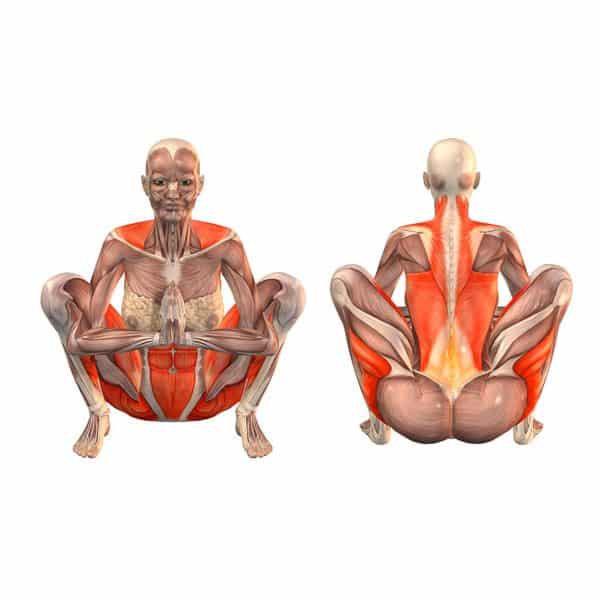
4. Malasana – The Squat Pose

  1. From Triangle pose come into Mountain pose and for a five deep gentle breaths, rotate the pelvis (in both sides) to align your muscles, tendons and ligaments.
  2. Spread your feet approx. 2-3 feet laterally, open both feet approx. 45° outwards.
  3. Inhale gently extending the whole body upwards, palms together pushed to the chest.
  4. Exhale gently, go into squat lowering your pelvis – keep your back straight as you go down. Your upper body leans slightly forward and your elbows touch the inner side of your knees. Tip: Lower slowly only as much as you feel comfortable. If you have to inhale on your way down, just do it only to be able to exhale lowering further. The goal is to squat so your buttocks touch your heels, but you go only as much as your posture feels steady and comfortable.
  5. Find your optimal position and stay there for five gentle breaths (or for as many as it feels right for you). Chest remains open at all times, push your elbows gently against your knees so you stretch the groin muscles.
  6. Do gentle moves in this posture so you align your hips, thigh muscles and lower back optimally.
  7. Use your thigh muscles to come up to Mountain Pose, but only after you have exhaled 50% of your air volume (don’t stand up while your lungs are under pressure full of air).
Repeat this five times (adjust repetition as you see fit, if you feel comfortable and energetic do more than five, if not, do less). The goal of the Squat Pose is:
  • Building energy and releasing tension.
  • More flexibility in groin muscles.
  • Stretching and strengthening lower back muscles.
  • Mobilization of hip joints.
  • Strengthening thigh muscles and knees.

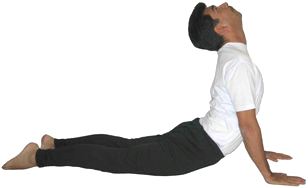
5. Bhujangasana – The Cobra Pose (Variation)

  1. From Mountain Pose exhale gently and lower down to Squat Pose, place your palms and knees on the floor and gently stretch your body onto the floor. Your forehead touches the floor, your palms are placed right next to your chest - below your shoulders.
  2. Relax your whole body, have a gentle deep breath, feel the connection of your whole body with the floor. Put a light pressure on your palms, as preparing for a push-up.
  3. Inhaling gently, slowly lift up your head and neck and feel the pressure 50/50 on your hands and pelvis area.
  4. Using the strength of your arms come up vertebra for vertebra beginning from the lowest one. The upper back, neck and head are straight, chin muscles relaxed, mouth slightly open. As you’re half way through, inhale further to open up the chest maximally and erect your upper body (only as much as possible). Remember, the posture must be firm and comfortable.
  5. Exhale through your mouth and let the weight of your upper body hang on your shoulders. There should be light pressure on the lower back. Adjust the position of your hands on the floor so your shoulders support the weight of your upper body optimally.
  6. Take five slow deep breaths in this position and feel the pressure (or relieve) on different parts of your body.
  7. Experiment - adjust the position of your torso moving it, especially paying attention to your lower back.
Repeat five times. The goal of the Cobra Pose is:
  • Building energy and releasing tension.
  • Mobilizing each spine vertebra.
  • Strengthening arm, shoulder and back muscles.
  • Stretching groin muscles.

6. Chaturanga Dandaasana - The Four-Limbed Staff Pose (Variation)

  1. From the cobra pose - body and forehead on the floor, inhale deeply - put your palms close to the chest, put your toes on the floor, preparing for push-up.
  2. Exhale, lift up your head, tighten your abdomen muscles, use the strength of your arms and lift up your body just a few inches.
  3. You are in four-limbed staff pose, take five gentle, deep breaths (adjust body height accordingly, if necessary put your knees on the floor as support).
  4. Exhale, come back to the floor - relax the whole body placing the forehead on the floor.
Repeat this exercise three times. The goal of the four-limbed staff pose is:
  • Building energy and releasing tension.
  • Stabilizing all muscles involved.
  • Strengthening back muscles, anterior shoulder muscles, chest and arm muscles.
  • Strengthening thigh and gluteus muscles.

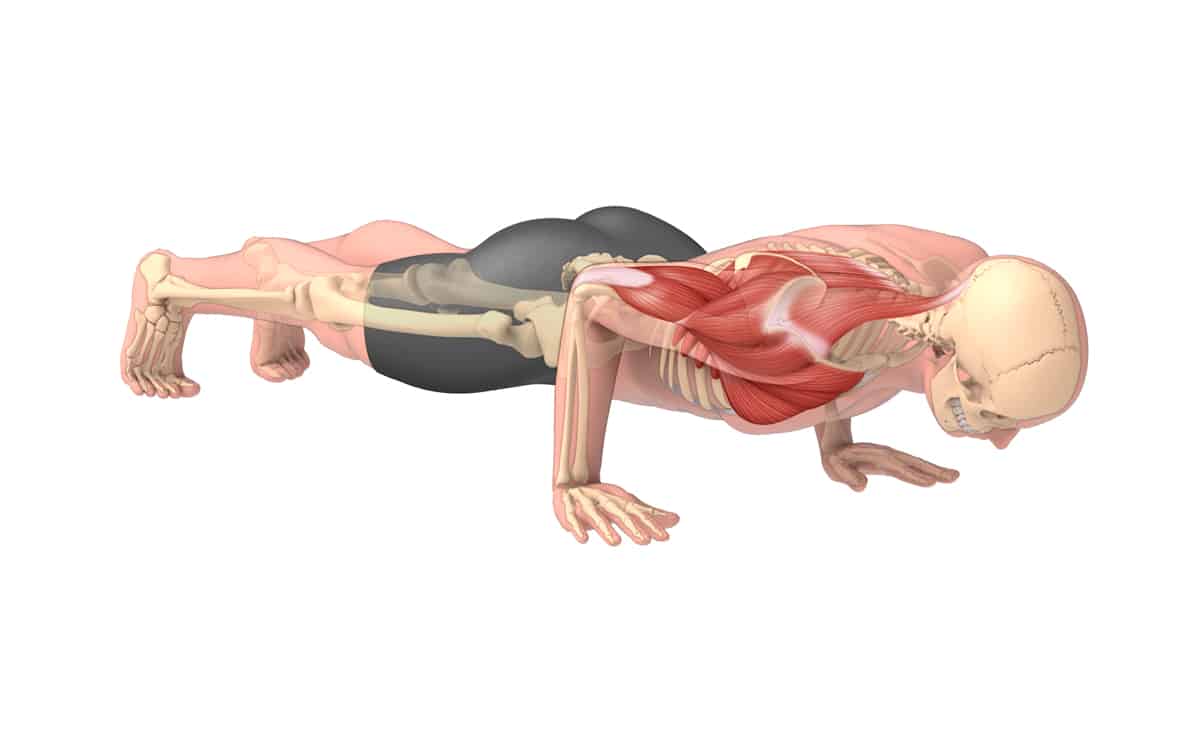
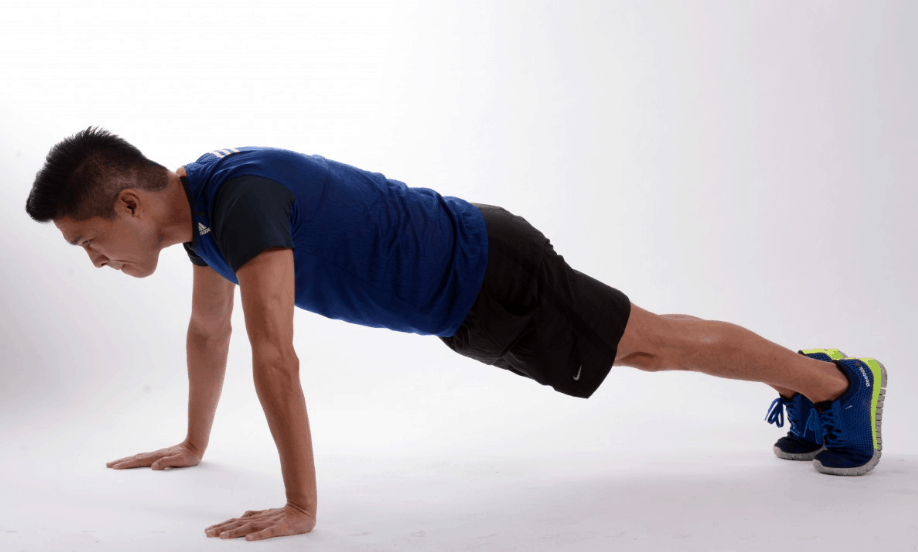
7. Phalakaasana – The Plank Pose (Variation)

  1. From your relaxed position on the floor, inhale deeply, place your palms close to the chest, lift up your head, put your toes on the floor, preparing for push-up.
  2. Exhale through your teeth, tighten your abdomen muscles, use the strength of your arms, and push-up your body to come into a plank pose.
  3. Adjust your palms or feet to find the ideal position and stay in for five slow deep breaths. Tip: To mobilize (strengthen and flex) your body, do variations of this exercise by slowly lowering the pelvis (when exhaling) - the knees touch the floor and balance the pressure between the arms and knees.
  4. Exhale, come down to the floor and relax your body. Inhale - feel the energy coming in, exhale - feel the tension leaving your body.
Repeat this exercise three times. The goal of the plank pose is:
  • Building energy and releasing tension.
  • Strengthening chest, arm, and shoulder muscles.
  • Strengthening overall back muscles and lumbar spine area.
  • Strengthening thigh and cough muscles.
  • Building endurance and flexibility.
Your Yoga Session is finished. Spend a moment lying on the floor breathing gently and deeply, and store all the movements and experiences you have undergone in this practice. Now having more strength and vitality, take this experience and apply it constructively in your daily life. Know that you will come a step further in your next practice and experience a new insight.

Final Thoughts

The practice of these Yoga exercises should take some 45-50 minutes, however you can change the repetitions and number of breaths according to your physical and mental fitness. Looking at all these simple yet highly beneficial postures, we can conclude that apart from the physiological benefits as mobilizing and strengthening the body, more important benefits out of these exercises are:
  • The development of mental skills such as focus, motivation, observation, confidence, concentration by turning inwards through the focus on gentle breathing.
  • The regaining of vitality and building of stamina and resilience through the repetition of movement.
  • The reduction of stress and neuroticism ((NCBI: Neuroticism)) as a result of the above two.
The benefits mentioned above are perceptible when a balanced flow between breath and body movement is created. Yoga can take you to a new beginning for a prosperous change that sets new goals with great motive for improvement. Let these 7 Yoga Exercises be your goal. Make a routine (in your own rhythm - harmonically) by practicing these exercises every single day. You will see positive physical and mental changes in a matter of weeks. And if you choose to be a part of a yoga class don’t worry about how you look, and what you’re going to wear as long as your clothes are comfortable. Stay focused on what you want to achieve on a physical, mental and spiritual level. Keep in mind that everything you need for that new change in your life is sitting right here within you. Start to practice and the process of achievement will unfold! I salute the spirit in you!

More About Yoga


Wednesday, 2 October 2019

How to Learn to Be Alone and Happy About It

Consider yourself lucky if you can balance being social and spending time by yourself. After all, your parents didn’t intentionally raise you to be a loner, learn to be alone, or take time for you. If anything, you learned various social skills for your relationships. There may be days when you decide to not answer a text, respond to a phone call and snuggle with your dog on the couch to binge-watch Netflix. Choosing to retreat gives your friends the impression that you are anti-social, which can bring pressures and difficulties. In these moments, you learn to be alone. However, it is harder to learn to be alone in the midst of people you’re supposed to interact with daily. In the mind's of people, it is the norm for everyone to be socially active; seeking to reach out for various reasons. When you learn to be alone and be happy about it, another layer of self-care and self-improvement evolves. You open yourself to better understand new aspects of who you are, which in turn strengthens your relationships. In reality, adulting comes with tons of responsibilities, constant break-up's, friendship losses, and social misunderstandings--all of which can be draining. You can begin to strategize how you will learn to be alone, be happy about it, and keep amazing relationships going without losing unnecessary energy. Research shows that only fifteen percent of the 82 million Gen Xers in the U.S. have no friends. This doesn't mean they are loners or uninterested in interacting. These individuals just enjoy time alone every once in a while. To learn to be alone is a healthy choice. So, when you do find yourself without company at any time, you won't view it as a terrible fate, but as moments worth spending time with yourself.

Is It Healthy To Be Alone?

Spending quality time with yourself helps you enhance your psychological development, and experience. On the flip side, excessively spending time alone can negatively impact your mental and physical health. It would keep you at the mercy of your inner critics, lead to depression, painful loneliness, and can ultimately lead to the deterioration of your health. Consequently, you pretty much have to strike a balance between the two extremes. That said, these are the health benefits of being alone.

Spending Time Alone With Yourself Increases Productivity.

How quickly do you get a job done when you have family and friends chatting away around you? Your goal may be to complete things around the house, run errands, finish a school assignment, or meet a deadline for work. Even a ping from your phone when a chat or mail comes in can make you lose concentration on a task. The brain is naturally programmed to be more productive when there are little to no distractions. So, if you desire to be more productive, spend time alone.

It Fosters Better Relationships With Others.

Being an extrovert is amazing. However, sometimes being an introvert is good, too. Research has it that introverts are more in touch with themselves, better express self-awareness and empathy. This makes it possible for them to understand individuals around them and better manage relationships. What's more, studies show that relationships thrive when the individuals involved can take a step back and keep a level of independence. When they do reunite, the spark is incredibly amazing and refreshing.

It Allows You To Revitalize Your Mind.

Being the life of occasions and mingling with friends can be fun, and can help with some aspects of brain activity. However, what happens when your brain begins to lose creativity or, starts to yearn for some break away from the hype and action of your social life? In such times, being alone would be healthy. Spending some time alone with yourself helps your mind to process previous activities, unwind, and recharge. Additionally, when your brain is relaxed, a lot of things would begin to make sense and come together beautifully.

It Boosts Your Creativity.

The mind comes up with the best ideas when it is left alone in perfect solitude. It generates amazing plans, weighs the pros against the cons, and just creates beautiful creative stories. So, when you feel the pressure to be creative, and you can't deal with the noise of brainstorming, you can simply separate yourself from the crowd, and give your mind some time to think and come up with a great idea.

10 Ways to Learn to Be Happy Being Alone

Here are some steps you can take to learn to be alone and be happy about it.

1. Be Your Primary Source of Validation

Having friends and family call and show you major attention sure feels great. However, what happens when they are caught up with other things and don't have that much time to text or call? In such times, getting disappointed about not being contacted won't help you, and sure would tell that you are far from being your source of validation. So, what you can do is to deliberately train yourself to get used to the absence of people. Take some time off from the noise of social life, and indulge in your hobbies like reading, writing, or seeing some great movies on Netflix. What's more, you can try meditating or yoga. This would clear your mind, and keep you in tune with yourself.

2. Learn To Feel And Be Self-Aware

So, first off, you can take a person out of psychology, but you can't take psychology out of a person. This means that the person that can reach into your emotions, and channel those emotions so you can be happy, alone and single, is you. Learn to spend time with yourself, practice self-awareness, and keep in touch with your feelings. That way, you will truly be happy. Identify your goals, dreams, and setbacks. Know the things that make you tick, and do those things.

3. Spend Some Time with Nature

There's nothing quite as soothing as bonding with nature. You can simply spend time in a garden, where you can watch the flowers bloom with your favorite book in hand. Or you can listen to the chirping of the birds, lie under the skies, and watch the shapes of the clouds and the brightness of the stars, and fall in love with yourself all over again. If you have some energy and stamina in you, and you are a lover of outdoor activities like hiking, then put on those hiking boots, grab your backpack, and head to the nearest mountain around you.

4. Work on Your Self-Improvement

Remember those amazing self-improvement things that you have on your bucket list, but have somehow managed to miss doing them? Bring those goals into actualization. You can create some alone time and work on them. Learn to play that musical equipment, author that book, strategize on how you will start that company, learn a new skill, or a new language. Just improve yourself.

5. Deliberately Ease into the Pleasure of Relaxation

The moment you go for a massage, treat yourself to a bubble bath with red wine in hand or stay home to watch Netflix with popcorn. Then you will begin to love spending time by yourself. The cares of the world would be non-existent for that duration.

6. Take a Trip to a Dream Location Alone

You might ask yourself where the fun is in traveling alone. Be that as it may if you can get beyond the feeling of weirdness that accompanies taking a trip by yourself, just do it. Just pack up your bags, and visit that location that you heard is a tourist attraction, or simply go for a weekend getaway in an amazing resort. Then in no time, you will begin to feel the hang of being alone and happy.

7. Step Out to Town Alone

Perhaps you thought that to learn to be alone means camping at home and shutting the world out. However, that's not the case. You can indeed have beautiful time with yourself by going out to town to do activities like reading in a park, grabbing a coffee, and going to the seaside where you can feel the wind on your face, watch the sea waves come and go, and just gather your thoughts.

8. Stay Away from Your Phone

If you're going to learn to be alone, then you might as well go all the way. This would mean staying away from your phone and the distractions that come with it. When the phone is out of the way, you can do whatever you desire, such as snack away on whatever you crave for, or jam to your best music.

9. Feel Free to Be Weird

Okay, you might think that you're an adult, so you just can't go about being weird. In truth, who cares? Being grown does not stop you from playing your favorite song at home and dancing to it in your underwear, or bingeing on your favorite ice-cream or meal. Nothing stops you from doing crazy activities like sky diving, that will send some adrenaline shooting through your body. And nothing stops you from participating in karaoke, even when you don't have a voice worthy of applause. The main thing is to be weird and to own your weirdness.

10. Guiltlessly Make Mistakes, And Own Them

At this point in your life, you should understand that making mistakes is part of the cycle of life. I'm not saying that you should go about being the king or queen of errors. Rather, you should not beat up yourself when you unknowingly make a wrong move or a wrong decision. In essence, own your mistakes, learn from them, and move on feeling better, and stronger.

Final Thoughts

Finally, the one thing you should convince yourself of is that, it is normal for you to live your life the way you have chosen. There is no need trying to convince anyone that what you are doing is in the right interest of you. There is no need working yourself up to prove to anyone that choosing to learn to be alone is right for you. You have decided to be happy and have found the best way to be healthy. Instead of getting heartaches from your relationships, you have decided to sideline yourself and you are doing just fine. Laugh. Live. Be happy alone. You'll soon discover that this is the greatest decision ever.

More About Being Alone and Happy