Wednesday, 5 February 2020

20 Examples of Personal SMART Goals To Improve Your Life

All our lives are directed towards achieving some goals, whether we are thinking about them carefully or not. To be more proactive and productive, we have to learn how to set specific personal goals that we can use to measure our personal growth and progress. In order words, our goals have to be SMART. To guide you on setting achievable goals for yourself, I have provided in this article, some examples of personal SMART goals that you can set to improve your life.

What are Personal Goals?

Personal goals are the expressions of the things you want to achieve for yourself in life. When you think about what you want to achieve in life and set goals towards achieving them, you will become more self-motivated and positive-minded. Your personal goals can be in the form of short term goals or long term goals. They can provide you with long term direction and short term motivation.((SkillsYouNeed: Setting Personal Goals)) Below are some examples of personal goals:
  • Learn something new every week
  • Work out every morning
  • Keep a daily journal
  • Volunteer at a non-profit every month

What are S.M.A.R.T Goals?

S.M.A.R.T. Goals are goals written to conform to the following criteria: Specific, Measurable, Achievable (or Attainable), Realistic (or Relevant), and Time-bound. The S.M.A.R.T. process was originally a management concept that was presented as a SMART way to write management goals and objectives. It was written in the following manner:
  • Specific – target a specific area for improvement.
  • Measurable – quantify or at least suggest an indicator of progress.
  • Assignable – specify who will do it.
  • Realistic – state what results can realistically be achieved, given available resources.
  • Time-related – specify when the result(s) can be achieved.
Without making your goals SMART, they would be vague goals or just mere resolutions. The S.M.A.R.T. Goal setting process will help you think through your goals carefully so that you can give your goals structures that can be easily tracked and implemented. This also brings your goals closer to reality from the point of setting them.

20 Examples of Personal SMART Goals

The following are 20 examples of Personal SMART Goals that you can set to improve your life. They cut across different areas of life. Some of them are daily and weekly habits while some can take a longer time to achieve.

1. Walk 30 minutes a day, 5 days a week

Health is wealth, exercising for a recommended 150 minutes a week can reduce your risk of having heart disease, obesity, diabetes, high blood pressure, depression, etc.((Mayo Clinic: 10,000 steps a day: Too low? Too high?)) You can achieve this goal by brisk walking for 30 minutes a day on Mondays - Fridays. You may further break it down to 15 minutes each for morning and evening.

2. Improve your listening skills

Whether it is discussing with a spouse, a colleague at work or a casual friend, most people are swift to talk but poor at listening. You can know whether you are improving in your listening skills by asking for feedback after you have made your contributions. For example, ask questions like "Has my answer addressed your concerns?", "Is there anything else I can help with?", "Do you have anything else in mind you want me to know?" You need to listen more to let people know that their opinions really matter to you.

3. Speak up to increase visibility

Are you one of those that hide in the crowd and barely talk in meetings? Setting a goal to increase your visibility is something worth considering. Plan ahead before each meeting to consider the agenda and prepare to make thoughtful and meaningful contributions.

4. Improve presentation/public speaking Skills

With thorough research, adequate preparations and rehearsals, you can make effective PowerPoint presentations, and deliver great speeches. Set a goal to always research your topics thoroughly, and get to rehearse before each presentation.

5. Improve your Emotional Intelligence

You can set a goal to become less reactive to issues and pay attention to finding out the underlying emotions and motivations behind the actions of others. Learn to connect with people at their own level. Learn more in this article: What Is Emotional Intelligence (And How to Develop It)

6. Start networking

Networking is important for personal and career development. Set a goal to attend three networking events quarterly to connect with old colleagues and meet new people. Try these 5 Steps to Master Networking Skills and Perfect Your Personal Branding.

7. Volunteer regularly

Contribute two volunteering hours weekly for community service. It could be teaching your favorite subject at a nearby high school, coaching kids in basketball or serving food at a restaurant for the homeless.

8. Improve your time management skills

Be more focused on achieving daily tasks. Minimize distractions and increase productivity by, say 40% over the next 3 months. Check out these 7 Effective Time Management Tips To Maximize Your Productivity.

9. Wake up early

Ever thought of not having enough time to do the things you really love doing? Try waking up early. Set a goal to wake up as early as 5:00 am every day; you'll have at least an hour extra to do the things you love before the day's work begin.

10. Learn one new thing every week

There is no end to learning. Set a goal to add to something new to your knowledge and skill base every week. Get some ideas here: How to Learn Something New Every Day and Stay Smart

11. Learn a foreign language

There are many benefits to learning a foreign language. You will be able to expand your career opportunities, find more clients, expand your business, make more friends and make more money. You might attain conversational fluency in a foreign language if you commit an hour daily to learning it over a period of one year.((Verbalicity: How Long Does It Take To Learn Spanish)) Here's How to Learn a Language in Just 30 Minutes a Day.

12. Overcome social media addiction

If you want to increase your productivity, you have to learn to manage or beat your social media addiction. This can be achieved in a couple of days, weeks or months depending on how strong your resolution is.

13. Increase typing speed to 60 WPM in three months

A slow typing speed slows down productivity. It is said that you can save 21 days a year by typing fast. You can set a goal to boost your typing speed and accuracy in a matter of three months. Some tips for you: How to Type Faster: 12 Typing Tips and Techniques

14. Keep a journal of key events

Practices like keeping a journal to record key events in your life can help you keep track of your progress. Such journals can help you regain motivation whenever you are facing a difficult situation. This is Why You Should Keep A Journal And How To Get Started.

15. Attend college alumni reunion this year

Connect with old friends and relive memories by setting a goal to attend your high school reunion this year. Maybe you will connect with people who can inspire your life or help with your career! It's also a good opportunity to practice your networking skills.

16. Organize a family reunion bi-annually

With everyone pursuing their own dreams, keeping the bond of family strong might require deliberately planning a family reunion. Bringing everyone together annually or at most once in two years won't be a bad idea.

17. Learn a programming language

The world is getting more 'techy' by the day and everyone needs some sort of programming knowledge. Make it a goal to learn the basics of a programming language annually and if you really get fascinated about one, why not create additional time to become a pro in it?

18. Clear all outstanding debts in 6 months

Living in debt can bring a lot of stress into your life. You can set a goal to clear all your debts in six months. This can be achieved by learning ways to become debt-free quickly: How to Pay off Debt Fast Using the Stack Method (A Step-By-Step Guide)

19. Increase spirituality

Spirituality means different things to different people. Whatever it means to you, you can set a goal to be more devoted and spend more time enriching that part of you.

20. Reconnect with "foes"

It is normal in life that people get to annoy you to the point that you block them out of your life. This happens a lot on social media. Set a goal to let go of the past and look at these people you have barred with new perspectives. These people might have turned a new leaf and you might be surprised to find them valuable once more.

Final Thoughts

Your Personal SMART Goals can be just about anything. You will only have to be sure that you can muscle the discipline, resources, and requirements you will need to achieve them. You may not achieve 100% of your goals all the time but it's worth it; knowing that you are making progress with your life.

More Tips on Goal Setting


Tuesday, 4 February 2020

How to Use the Wheel of Life to Live the Life You Want

It’s crazy to think about how busy our lives have become in recent years. In our fast-paced society, it’s easy to lose the balance that we crave in life. As a result, it’s easy to neglect important areas in our lives that bring us meaning and fulfillment... This is where the Wheel of Life can help us out.

What Is the Wheel of Life?

The truth is that without learning how to mindfully monitor our daily lives, we can end up focusing all our time and energy on a single area and forget about and neglect other important parts. This is when we need to take a long hard look at our lives in order to bring things back into balance. This is where the Wheel of Life can serve as a highly useful and informative resource. It helps us to look at each of these different domains in our life and then identify which areas are doing and well and which areas we need to allocate more attention to. It does this by graphically representing the different areas of our life as they are now, compared to how we would ideally like them to be. Then we can identify gaps between where these different domains of our lives currently are and where we would like them to be. This allows us to visualize which areas of our lives require our attention. Through understanding this, we can then identify what steps we need to take in order to live a life of happiness and success.

How Does the Wheel of Life Work?

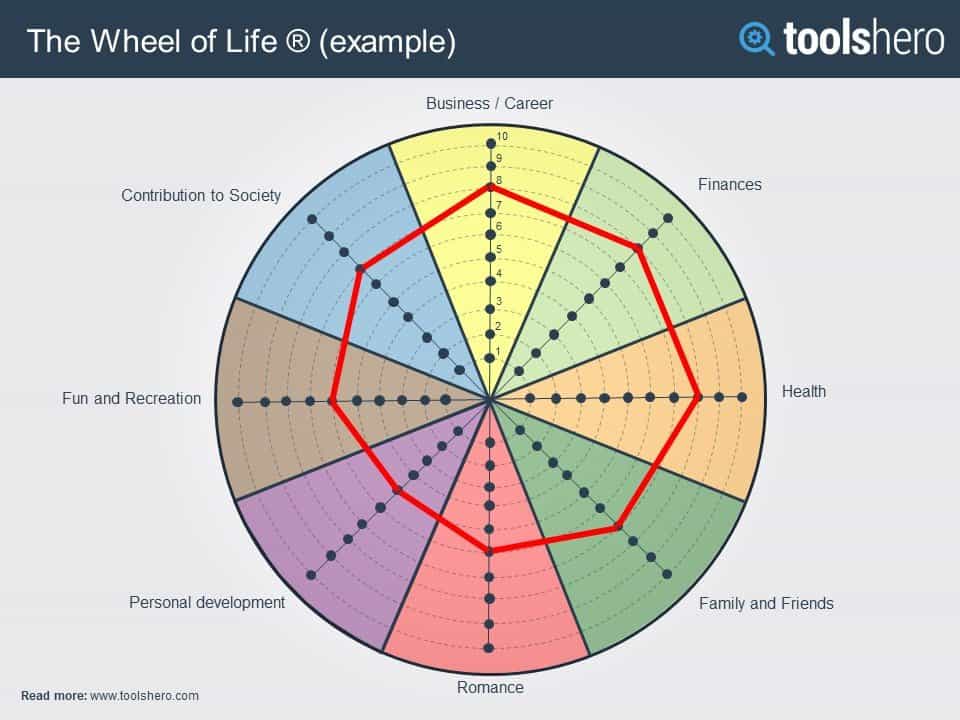
Every “slice” of the Wheel of Life represents a category for a different area of your life. Each of these categories is rated by you on a scale of 1 to 10, with 1 representing a poor score and 10 representing an excellent score. Once you’re done rating where you feel each of the different categories are right now, you’ll be left with a diagram with a mosaic-like wheel appearance. This will allow you to visualize which areas of your life you’re currently lacking in right now. Here's an example of the Wheel of Life:((Toolshero: Wheel of Life)) Then you can go around the Wheel of Life again and indicate where you would ideally like each of these categories to be. This will then allow you to visualize which areas of your life require the most effort and attention from you at this moment. Remember, that every aspect of the Wheel of Life has an important influence in some respect over your life. Your goal here should not be to have a perfect wheel. Your goal should be to answer the questions as honestly as possible as you go about establishing your personal Wheel of Life diagram. This will provide you with the most accurate representation and useful information for your current life.

Wheel of Life Categories

Here there is some variation. No life is exactly identical to someone else’s. As such, it’s possible that different categories of living will be included in the Wheel of Life diagram for different individuals. What’s important is that the categories you choose to include provide an accurate representation of the important areas of your life. That being said, there are some common ones:

Health

In this category, you aim to rate how physically and mentally healthy you are. So you can ask yourself questions like how do you feel? How regularly are you exercising? What is your diet like? Are there any changes that you’d like to make to live a healthier lifestyle?

Career

In this Wheel of Life category, you are beginning to think about the job you’re currently working and rating how satisfied you are with it. Are you happy where you are or would you rather be working a different job potentially in a different field? Does the career path you’re currently on bring you happiness? Can it support the lifestyle you desire?

Personal Development

This category looks at how you are investing in your personal growth. Are you pursuing opportunities that open you up to new experiences and opportunities? Are you eager to learn new things? What are you doing to evolve and develop into the person you hope to be one day?

Finance

The financial category on the Wheel of Life encourages you to reflect on whether or not your current income supports not only your basic needs but, does it support the lifestyle that you are hoping to live? Are you going to be happy with the progression of your income over the next 5 years or are you going to have to make changes? Yes, money is not the only thing that influences our happiness, but it’s certainly one of the key players.

Life Enjoyment

Here, think about what kind of activities you engage in to bring yourself life satisfaction and a sense of life enjoyment. Whether that’s sports, reading, writing, or any other hobby doesn’t really matter. What matters is that you are engaging in some things that bring you happiness on a regular basis. All work and no play makes for a dull day, and eventually a dull and unsatisfactory life.

Societal Contribution

This Wheel of Life category asks you to reflect on what is it that you are giving back to others. How are you giving back to the people around you or the communities that you are a part of? Do you volunteer? Do you help out with local sports or clubs? Are you engaged in political issues to make your community a healthier and safer place for everyone?

Relationships

Now you’re going to evaluate your relationships with other people. As you do this ask yourself whether you feel these relationships are built on a good foundation or not? Do you trust the other person in the relationship? Do you each support one another? Can you build forward from the relationship that is currently established in a positive way? Are these relationships having a positive influence on your daily life?

Romance

Now you’re going to ask yourself a few questions about a specific relationship, the one you have with your partner. In the Wheel of Life, this is one of our most important relationships. The most important question that you can ask yourself here is do you have a partner who is committed to you and who you can build an amazing relationship with? Are you supporting each other's growth? Do your values align? Are you able to make each other laugh? It’s very rare to find all these things in another person, so if you find someone who checks a lot of these boxes you’ve probably found a special someone worth keeping around.

Reflecting on Your Results

Once you’ve completed your Wheel of Life and accurately and honestly identified the current and ideal scores for each category, you can move forward with these understandings and insights in order to improve your life. You might ask yourself questions like:
  • Why do you currently have a low/high score in a given category?
  • Which categories have the largest gaps between their current position and your ideal score?
  • What can you do in order to move the category score from it’s current position to where you would ideally like it to be?
  • Which categories on your Wheel of Life are the most important to you?
  • Which categories are currently having the biggest impact on your life?
  • Are there categories that you would like to dedicate more attention to?
  • Are there categories that you would like to dedicate less attention to?
These are all important questions which you can answer to provide yourself with useful information moving forward as you improve your life. By taking a look at your entire life like this, you can begin also making connections between different areas. For example, how is your career impacting your personal development, or how are your relationships impacting your finances and life enjoyment? These are all things that the Wheel of Life makes easier to visualize.

Applying the Wheel of Life to Your Life

Remember, we are always capable of change and improvement. So if you aren’t satisfied with certain categories on your Wheel of Life or the entire wheel in general, then get motivated to makes changes! These things won’t work unless you do! So start to think about what plans, strategies, and steps you can begin taking in order to get where you what your wheel to be, and where you want your life to be. Something that I know has helped many people is keeping track of their progress. Through these actions, they can begin to understand what works for them and what doesn’t. Then over time, they can tweak how they are pursuing their goals and increase the frequency of their successes.

Create Your Wheel of Life

If this article has been interesting to you and you feel like you would now go and create your own Wheel of Life that you can use in order to improve your own life, then check out this Wheel of Life resource. This is a free tool that asks you to provide your current and ideal category scores and then creates your Wheel of Life for you. It’s free and only takes a few minutes to complete. It’s as simple as that!

Final Thoughts

The main take away from this article is that you should do your best to think of your life in terms of the big picture so that you can come to understand how the different aspects of your life reciprocally influence each other, and impact the overall quality of your life. By understanding the big picture, you can then take action towards bringing the life you’ve always wanted into reality!

More on Living Life to the Fullest


6 Ways to Take Good Notes at Work

Author Tim Ferriss has his entire shelves containing nothing but notebooks filled with his daily scribblings. Not one to mince words, the self-optimization guru once wrote:((The Tim Ferriss Show: How to Take Notes Like an Alpha-Geek ))
“I take notes like some people take drugs.”
Virgin Group founder Richard Branson is another avid note-taker:((Virgin: Take note, it’s time to take notes ))
“Some of Virgin’s most successful companies have been born from random moments – if we hadn't opened our notebooks, they would never have happened.”
In college, there was such a strong emphasis on effective note-taking — I still have a few stacks of my own spiral notebooks, filled with furiously scribbled lecture notes. Once we embark on our professional careers, however, many of us lose that habit. But keeping a written log of all new content — during meetings, brainstorms and while reading — remains an essential productivity and learning tool. As CEO of my own company, I’m seldom caught without a notepad. Time is my most precious resource and note-taking lets me extract the most value from how I choose to spend mine. It also signals to my employees to do the same. If you’re wondering how to optimize this simple habit, here are some expert-backed tips on how to take good notes.

1. Be Old-School — and Use Your Own Words

Like the chicken or the egg, it’s a fundamental question: should I use a paper notebook or a digital note-taking app? Writing for the Harvard Business Review, Alexandra Samuel strongly advocates for digital note-taking. She argues that taking notes with an app like Evernote is the most efficient use of time and makes later retrieval quick and easy.((Harvard Business Review: Dear Colleague, Put the Notebook Down )) Not everyone agrees though. According to Maggy McGloin, another Harvard Business Review contributor, research has found that analog note-taking has concrete benefits. In one study, researchers found that digital note-takers took lengthier “transcription-like” notes, as compared to hand-writers, and did significantly worse on later conceptual questions.((Harvard Business Review: What You Miss When You Take Notes on Your Laptop)) Even when participants were explicitly instructed to not take notes verbatim, typers continued to write in a “transcription-like” manner. While typing encourages mindless transcription, handwriting pushes us to create more succinct notes and distill information for increased comprehension. Using a laptop or tablet opens you up to more distractions, too, like checking your Twitter feed or seeing what’s new on Facebook. Surprisingly, one person’s web browsing can negatively affect the learning of her neighbors. In one study, student participants who could see the screen of a multitasker’s laptop — in this case, looking up movie times — scored 17 percent lower on comprehension tests than students who had no such distraction.((Harvard GSE: For Note Taking, Low-Tech Is Often Best)) Personally, I’m an analog notebook user — I find it much easier to focus and it forces me to translate information into my own shorthand. Other old-school note-takers include Bill Gates, who prefers a yellow notebook, and George Lucas, who carries a pocket notebook. But even if you can’t part with your laptop or tablet, avoid transcribing verbatim. Practice not just listening, but processing what’s being said and using your own words.

2. Be Meticulous with Structure

Another matter to consider before you jot anything down: how to structure your notes. Utilizing a consistent organization method is key for referring back to your notes later. The Journal of Reading compared different methods and found that the most rigorously structured notes — with hierarchal ordering and numbered subsections — scored highest in terms of quality and accuracy. The second best was a two-column method, wherein writers used the left column for new information and the right column for follow-up points and key themes.((The Atlantic: How to Become a Masterful Note-Taker: 8 Lessons From Research )) Tim Ferriss swears by indexing, which involves manually numbering the pages of a book or notebook and creating a quick and easy-to-scan index of topics inside the front or back cover. Maria Popova, creator of the hugely popular Brainpickings.org, tears through many books each week and incorporates her learning into daily blog posts. She’s able to grasp the concept of an entire book at breakneck speed using an indexing method. As explained to Tim Ferriss, Popova creates an alternate index on the (typically blank) last page, where she notes important ideas as she reads. Next to those ideas, she’ll list the pages where they pop up. Then, Popova uses these analog notes, based on ideas rather than keywords, to synthesize a book once she’s ready to write about it.((The Tim Ferriss Show: Maria Popova on Writing, Workflow, and Workarounds)) I use as many organizational techniques as I can — indexing, headlines, numbering and bulleting. I also leave a margin for my questions, observations and action steps — which leads to my next strategy.

3. Jot Down Your Questions and Insights

Whichever structure you choose, always leave room for your personal reflections. Global CEO Coach Sabina Nawaz recommends using wide margins, where you can jot down “your ideas, judgments, rebuttals, and questions to each of the points you’ve written down.” Nawaz explains,((Harvard Business Review: Become a Better Listener by Taking Notes ))
“By marking them to the side, you separate your own thoughts from what others say.”
This technique not only forces you to continually engage with and analyze the information you’re receiving — assisting with learning and comprehension, rather than rote transcription — it also enables you to organize future follow-up questions and courses of action. As soon as I finish a meeting or conference, I review my margins and email myself a list of any next steps — like an email to draft, an appointment to make or inspiration for an article to write. That way I make sure I’m translating new ideas into actionable plans.

4. Record Non-Verbal Behavior

A colleague tells you: “We’re ready to share our new product with the company next week.” But his body language — nervous fidgeting and a worried look — isn’t communicating much confidence. In that situation, note your observations and make a point to bring them up later. “Hey Neil, you said you were ready earlier, but I was wondering if you’d like to run the presentation by me and iron out any kinks.” We communicate a great deal with non-verbal behaviors, including our body language, demeanor, and affect. According to Patti Wood, a body language expert and author of Snap: Making the Most of First Impressions, Body Language, and Charisma, in a face-to-face interaction with just one person, you can exchange up to 10,000 nonverbal cues in less than a minute — probably more than our words alone.((Forbes: 10 Nonverbal Cues That Convey Confidence At Work )) Sometimes, what’s not said is just as valuable as what is. For example, if I give a presentation and get crickets when I ask for questions, that might signal that I’ve done a bang-up job. But it also could mean that my colleagues are unwilling to challenge my perspective. And as I’ve written before, healthy conflict is essential for an organization’s growth and innovation. Non-verbal behavior can reveal an issue that needs to be addressed immediately. Investing a bit more to record and address these observations can save time down the line.

5. Review Later

Taking notes serves two functions: to organize and store new content and cognitively encode that content. In other words, it’s a means of storing and learning new information.((Harvard GSE: For Note Taking, Low-Tech Is Often Best )) That physical storage function is useless unless you actually review your notes later and reflect on what you’ve written. Research on student test performance highlights the importance of reviewing. One study from the 80s that was published in the Teaching of Psychology Journal found that students made mistakes on exams not because they'd taken bad notes, but because they weren't re-reading them beforehand.((The Atlantic: How to Become a Masterful Note-Taker: 8 Lessons From Research )) Though you’re probably beyond the days of cramming for exams, recalling what you learn is just as, if not more important, to your career — because it no longer pays to forget new information the moment we’re done being tested on it. As Richard Branson writes:((Virgin: Take note, it’s time to take notes ))
“Don’t just take notes for the sake of taking notes, go through your ideas and turn them into actionable and measurable goals.”
That’s why I block out time on my calendar at least once a week to read through my notes — from meetings, conferences, calls, you name it. As CEO, there’s rarely a moment in my day that hasn’t resulted in a few ideas jotted down.

6. Prepare Notes Before Meetings, Too

One final piece of advice: never walk into a meeting empty-handed. To maximize efficiency, always prepare notes ahead of time, including material to cover, questions and action items. No one exemplifies this better than Facebook COO Sheryl Sandberg. In a profile for Fortune, Miguel Helft writes:((Fortune: Sheryl Sandberg: The Real Story ))
“Her days are a flurry of meetings that she runs with the help of a decidedly undigital spiral-bound notebook. On it, she keeps lists of discussion points and action items. She crosses them off one by one, and once every item on a page is checked, she rips the page off and moves to the next. If every item is done 10 minutes into an hourlong meeting, the meeting is over.”
These might be the only kind of notes that you don’t need to keep for later review (unless you record more notes on the same page). Together, these note-taking strategies can help you organize meetings and streamline your workday.

More Note-Taking Tips


The 16 Habits Of Mind That Make You Smarter

In most learning situations, we see three elements at work: We're given objectives, we get instructed on how to achieve those objectives, and the learning stems from the results that we obtain. Growing up, this was the learning structure that we had at the core, but there were many others that grew around that time. The only problem was they weren't common practice and still aren't. I've covered others before through self-taught learning and deliberate practice. But one other I haven't covered is habits of mind. These habits are powerful like most of non-traditional learning methods. For this one, in particular, it can lead to great success and could change your life forever.

What Are "Habits of Mind"?

The habits themselves are nothing new or revolutionary. Developed by Art Costa and Bena Kallick, the two authors of Learning and Leading with Habits of Mind: 16 Essential Characteristics for Successbelieve these habits are less on behavior but more on intent. The pair writes:
A “Habit of Mind” means having a disposition toward behaving intelligently when confronted with problems, the answers to which are not immediately known. When humans experience dichotomies, are confused by dilemmas, or come face to face with uncertainties–our most effective actions require drawing forth certain patterns of intellectual behavior. When we draw upon these intellectual resources, the results that are produced through are more powerful, of higher quality and greater significance than if we fail to employ those patterns of intellectual behaviors.
Another way to look at this is that the habits of mind push us to look at problems from different angles. Not only that, but it can be challenging to achieve this as successfully using these habits of mind requires skill, and experience. So don't think you'll achieve mastery of these over a short period of time.

The 16 Habits of Mind

But don't get your hopes down because it'll be challenging. As I said above, these habits are nothing complicated or new. Chances are you've got some of these habits. The challenge is using those habits in a learning situation to develop yourself further. With that said, here is a rundown of the habits.
  1. Persisting
  2. Managing Impulsivity
  3. Listening with Understanding and Empathy
  4. Thinking Flexibly
  5. Thinking about Thinking
  6. Striving for Accuracy
  7. Questioning and Posing Problems
  8. Applying Past Knowledge to New Situations
  9. Thinking and Communicating with Clarity & Precision
  10. Gathering Data Through All Senses
  11. Creating, Imagining, Innovating
  12. Responding with Wonderment and Awe
  13. Taking Responsible Risks
  14. Finding Humor
  15. Thinking Interdependently
  16. Remaining Open to Continuous Learning
While knowing the habits is one thing, it's another to apply them in a learning environment. Below are some examples of each of the habits of mind can be used.

1. Persisting

Persistence is all about not giving up and achieving whatever your goal is. Over the years, there have been several examples of this. When it comes to developing this skill, the best thing to do in this scenario is to pull from these examples. How this helps with learning is that it encourages us to continue learning and working towards our goals.

2. Managing Impulsivity

Remember that habits of mind are designed to find problems that people wouldn't find on the first go. This is key because whenever we see problems, we are quick to act on impulse. We don't bother to think about other options. This habit of mind helps us to hesitate, but only to consider other possible scenarios. In other words, you want to be practicing patience when coming up with solutions and deciding how to act. How this helps in a learning situation is it pushes us to weigh our options when presented with a problem.

3. Listening with Understanding and Empathy

Many of us listen in order to reply rather than listen to understand and relate to the person. In conversations, we can find ourselves comparing, judging, placating or offering advice rather than listening and understanding a message. To improve those skills, catch yourself whenever you do those sorts of things. This can also help in learning because when we are listening to understand, we have a deeper grasp of concepts, and the problems.

4. Thinking Flexibly

We all have opinions and perspectives of reality and that bias seeps into everything that we see and what we read and learn. For this specific habit of mind, developing this requires us to look at things from a different angle. That's not to say to look at everything with skepticism, but rather to use a different perspective than our own or the original speakers. Place yourself in different shoes and walk around in them as they say. How this applies to learning environments is that when we use different angles, there's a deeper understanding. Knowing one side of a problem is good, but knowing where both parties are coming from is even better.

5. Metacognition

Otherwise known as thinking about thinking, developing this habit comes down to that. It's important that you're aware of your thinking process. How you do that comes down to charting a map. A good example is drawing up a diagram of relationships. It's a map that details the relationship between a want and a need as well as a gesture and a need to gesture.

6. Striving for Accuracy

This habit of mind is ensuring that what you are doing is accurate. How would you know if you're doing it right without someone telling you it's correct? While you don't want to be reliant on people's opinions, it is still helpful to get others to check what you're doing is proper and that you are making progress. This is why it helps to have at least two or three people review your work before it moves on. Provided that reviewing is possible.

7. Questioning and Posing Problems

Learning stems from presenting problems and asking questions. For some generations, this is second nature as many aren't afraid to go to google and figure things out. Developing this habit stems from this as well. That or if you are in the middle of something, you could write questions down on post-it notes.

8. Applying Past Knowledge to New Situations

Another part of the habits of mind is that these develop through experiences. These experiences can be recent or they can stem from the past. Recalling previous knowledge and applying it to new situations can have it's merits. By no means is it always the best solution on the table, but knowing what was done in the past can add a deeper understanding. Either way pulling from an area you're already comfortable in can improve learning.

9. Thinking and Communicating with Clarity & Precision

This one goes hand in hand with listening with understanding and empathy. The idea behind this habit of mind is to speak directly to people and avoid being vague, abstract or using imprecisions. Examples of these words are always, all, everybody, celebrities, technology. It's not that using these words is bad or improper. Being able to speak directly and to think with a narrow focus helps in approaching a problem. Just because one piece of technology is faulty, doesn't make all technology faulty. When addressing a problem and communicating, we need to focus on the specific point first.

10. Gathering Data Through All Senses

What this means is looking at various sources when it comes to learning. Of course, the quality of the source is important but pulling from sources like sensory data, blogs, and other third-party sources can have its merits.

11. Creating, Imagining, Innovating

Learning can be pulled from all kinds of different methods. It's also good for you to be keeping the creative side of ourselves active as well seeing as it can provide opportunities for us to think of new solutions. Similar to being flexible with our thinking, tapping into other regions that we may not excel in can help.

12. Responding with Wonderment and Awe

If you see learning as a chore, chances are you won't be retaining any information. It's important that we have a passion for the subject and that we're eager to learn and indulge in the topic. Responding with awe and wonderment is one of the side effects when we are interested in a topic.

13. Taking Responsible Risks

For this habit of mind, this prioritizes how we see failure and when to take risks. It's important to see failure as an improvement to grow rather than something to get punished for.

14. Finding Humor

Humor can bring things back to reality as we find all kinds of things funny. While what you are learning could be serious, tying it into stories that cause positive emotions will help in making it stick.

15. Thinking Interdependently

Today this is easier to achieve thanks in part to social media. Because we are all connected, it's easy for us to connect our thoughts with other people. Every single day, more content is published and shared and consuming that can help us in this area.

16. Remaining Open to Continuous Learning

The last of the habits of mind is learning continuously. As the habit suggests, learning is constant and old ideas need to be revised. After all, we know how problematic it can be when methods or views are dated. The world is on the move to growing and improving day after day -- online and offline. It's up to us to stay up to speed by developing ourselves too: How to Create a Habit of Continuous Learning for a Better You

Final Thoughts

The habits of mind focus heavily on our own experiences and skills in the world. The more we get out to experience life, the more that we will learn and hone these 16 skills. By taking these skills to heart and applying them in learning, we can begin to change our lives as the knowledge we gain can be applied in many facets of our lives. The habits of mind are indeed the keys to our success and growth.

More on Boosting Brain Power


Monday, 3 February 2020

9 Types of Goals to Help Get Your Life on Track

Goals can be about anything in life, as long as it is something you set to achieve within a timeframe. There are different types of goals you can set to make your life better. For example, you can set a goal to improve your vocabulary by reading 30 books in a year. To achieve this goal, you’ll probably have to set smaller goals like reading 30 minutes a day or 4hours a week and reading up 3 books every month. While at it, you may discover that your family and relationship needs more attention as does your business. You might also find that you need to raise the bar of your income to meet surging expenses. Moreover, you also do not want to keep your health in the danger zone while pursuing your wildest dreams. In order to put things in shape and keep your life on track, the following are the types of goals you should focus on setting. They will help you to increase your productivity, achieve tremendous success, and live a balanced life.

Time-Based Goals

Popular author and International Bestseller, Stephen R. Covey said:
“The key is not spending time but investing it.”
Nothing else helps you to invest your time wisely more than time-based goals. These can be in the form of short term, long term or lifetime goals.

1. Short Term Goals

Short term goals are the goals you set to accomplish in the immediate future. These goals help you to think about what you can do right now and up to a year to achieve your dreams. You can think of short term goals as smaller units of larger goals - the smaller steps that connect you to your bigger dreams. For example, if your long term goal is to buy a house in 5 years, your short term goal might be to save a certain amount of your monthly income to be able to buy the house in the set time. Here are more examples of short term goals:
  • Lose 10 pounds of weight in one month
  • Increase income by 40% over the next six months.
  • Take 5 online mini-courses in 2 months
  • Save up some money to enjoy a vacation later in the year
  • Read a book every month
Setting short term goals will keep you motivated. That feeling that comes with getting something done and checking them off your list keeps you motivated to want to achieve more.

2. Long Term Goals

A long term goal is something you want to accomplish in the future but have to take steps towards achieving now. They usually require a broader scope and more time to achieve. Long term goals can be about the things you want to achieve for yourself, family, career, business, or health, etc. Here are examples of long term goals:
  • Obtain a doctoral degree
  • Found a non-profit
  • Land your dream job
  • Buy your own house
  • Save for retirement
  • Learn to speak another language fluently
  • Move to another country
Long term goals connect you to your bigger purpose and give you a sense of direction. Achieving long term goals also brings lasting results. Imagine being able to buy your dream home, you will enjoy it for as long as you want.

3. Lifetime Goals

Lifetime goals are the big goals that you intend to achieve in your lifetime. They essentially connect with your life dream, vision, and purpose, and can occur at any point in life - early adult life, middle-age, or old age. There is no limit to what you can set to achieve in your lifetime. For example, you can set a life goal to have your own family and raise 3 children, own a private jet at 40 or retire at 50. Another lifetime goal can be to feed 2 million destitute children with your resources before you die. A faith-based preacher was credited to ‘winning’ 79 million souls before he died at 79. ((CFAN: Reinhard Bonnke: Biography)). That’s just an example to show that lifetime goals can be just about anything and can be achieved. More examples of lifetime goals:
  • Become country President at 40
  • Become a TV Host, host the top hierarchy in the world of Politics, Business, Sports and Entertainment before turning 35
  • Climb Mount Everest at 65
  • Travel to all countries of the world before age 55
  • Buy and develop a 100 hectares of land in Africa as retirement home and farm
  • Stay fit and run the marathon at 80
Setting your life goals should not be a difficult task. If you are unsure of what goals you should set for your life, look toward your values and passions for direction.((LiveBoldandBloom: The Ultimate List Of 100 Life Goals To Achieve Before You Die ))

Life-Based Goals

In order to live a balanced life and achieve all-round success, there is a need to set specific goals for different areas of your life. Setting goals in these key areas will help you to take control of your entire life and achieve more as you think steps ahead.

4. Health and Fitness Goals

Before anything else, your most important goal in life should be to stay alive and healthy. When you are fit physically and mentally, you will find it easier to function well in other areas. Here are some health goals you can set for yourself:
  • Walk for 30 minutes a day
  • Avoid foods with high cholesterol
  • Keep a regular bedtime
  • Quit smoking
  • Drink at least 2 litres of water a day

5. Career Goals

Career goals are the roadmaps that help you to achieve a more productive and progressive professional life. Irrespective of the stage you are currently in your career, you need to continually set goals to grow and achieve more. Your career goals should reflect your professional vision, and you should also think carefully about what you want to accomplish. ((CareerAddict: 13 Examples of Achievable Career Goals)) Below are some career goals examples:
  • Earn a higher Degree or Executive Certification
  • Become a Consultant in your field
  • Rise to top management cadre within 5 years
  • Increase your job performance metrics
  • Find a job with better staff welfare package
Take a look at this article and find out more about career goals: How to Set Ambitious Career Goals (With Examples)

6. Financial Goals

Most of us are making less than we could and spending more than we should. Setting financial goals will help you take control of your finances. To set financial goals, you have to be able to figure out what is important to you and what you can afford in the short and long term. Here are some financial goal examples:
  • Prepare and stick to a monthly spending plan
  • Save a certain amount monthly
  • Develop alternative income sources
  • Grow income by 50%
  • Pay off debt

7. Business Goals

Growing and keeping your business on the right track requires setting the right set of business goals. To achieve this, you have to determine your long term vision and mission for your business and also create measurable short term objectives. Below are some examples of business goals:
  • Reduce overhead by 30%
  • Acquire new clients
  • Enter a new market
  • Create a new product
  • Increase your market share
Here're even more examples: 10 Simple Yet Powerful Business Goals to Set This Year

8. Personal Goals

Personal goals are the goals that you set to have a better version of yourself in the near or distant future. These goals include activities and plans that are geared towards personal development. Examples of personal goals include:
  • Read a book per month, commit to lifelong learning
  • Develop a habit of gratitude
  • Stop procrastinating
  • Wake up early
  • Develop emotional intelligence
Find more personal goals examples here: 14 Personal Goals for a Better You Next Year

9. Family Goals

The home front is crucial to experiencing balance and well-being. Setting family goals will help you to keep your family in order and experience happy moments with the people you love most. Examples of family goals include:
  • Eat more veggies to have a healthy family
  • Create a weekly/monthly time out
  • Have a daily family devotion/meditation
  • Volunteer to do some chores for your spouse
  • Save up for a Disney Cruise
In addition to family goals, you may want to consider setting marriage goals too: How to Set Marriage Goals That Make Your Relationship Stronger

Making Your Goals S.M.A.R.T

To make your goals workable and achievable, there are some things you have to consider in the goal planning process. The S.M.A.R.T framework is one of the goal frameworks that you can use to put your goals in the proper perspective. S.M.A.R.T is an acronym used to represent Specific, Measurable, Achievable, Realistic and Time-bound (or Time-related). A goal that is not SMART is nothing but a vague goal and such can be hardly achieved. Setting SMART goals begin with knowing what you want to achieve and what it takes to achieve them. Taking your goals through the SMART process can help you refine your ideas and redefine your goals. If you want to learn more about setting SMART goals, don't miss these tips: How to Write SMART Goals (With SMART Goals Templates)

Final Thoughts

Never let a moment pass in your life without setting a goal or working to achieve the ones you have set. Find out what you can do from now up to six months time to contribute to your progress in life. Don't forget to plan for the long term either. You have only one life to live, therefore set the goals you wish to accomplish in your lifetime. Every area of your life is important and you don't want to neglect any of them. You only become truly successful when your life is in shape. Setting goals will be a futile activity if the goals are not SMART. Make your goals SMART and you will find that achieving goals is not as difficult as they seem.

More About Goal Setting


How to Achieve the Career Success That You Want

Everybody wants to enjoy at least some aspect of the work they do. It could be the customers and colleagues you work with, the visible changes you see from the job, or the actual work itself. If there isn’t some aspect of satisfaction though, the chances of sticking with a particular job or career for long aren’t very good. A sense of satisfaction is crucial to building career success. Here’s the thing when it comes to career success -- there’s no clear-cut definition. Now, of course, there are ideas of what career success looks like, but these are largely driven by our peers, family members, those within our chosen industry, and society at large. Because of this, it’s not uncommon for people to lack clarity when reaching for a definition of what career success looks like and how it aligns with their personal values. Maybe that means a certain number of zeros on their paycheck, or perhaps it means making a living that’s comfortable but allows more room for time with family or hobbies. Those ideas are rather vague and really only scratch the surface. Achieving the level of career success that you want really boils down to two simple things: defining what it looks like for you and forging a path to get there. There are obviously other factors that come into play, but those two things are paramount.

Define Your Idea of Career Success

We all need a purpose. It’s one of the characteristics that define us as human beings and without it, a person is at risk of aimlessly wandering through life depressed and very possibly broke. Sorry to sound like a downer here, but what I’m getting at is that purpose is a huge part in defining and then achieving career success. If you were to ask the world’s top 50 CEOs what their purpose was, it’s a guarantee that they would each have precise answer, and their answers would likely be very different. In order to define what success looks like to you, it’s a good idea to step back and cast aside what others have told you success is. This is the part where a lot of people make the mistake of listing off accomplishments they want to hit such as making X amount of money or having X title beside their name on their resume. Accomplishments are great, but make no mistake, they don’t necessarily equal a lasting feeling of satisfaction and success. Famed LA Lakers coach Pat Riley, a man who won five NBA championship titles, but said he was still never satisfied and called this the “disease of more.” Psychologists have long argued that it’s all too common for people to put too much of their self-worth on their accomplishments. At best, those accomplishments leave them with a fleeting sense of satisfaction that only results. I’m going to get a little bit Zen on you here. When you attempt to define your idea of what career success looks like, include those goals you want to reach, but also ask why you want to achieve them. Perhaps it’s important to you that you make a lasting impact in your career field or carve out a career that continually presents new and exciting challenges. Maybe you want to achieve a level of success that combines both of those factors and allows you to work at your own set schedule. Don’t be afraid to spend some time digging down asking yourself how the accomplishments you want to achieve align with your personal values and outlook on life. You’ll probably find that your idea of career success changes at different points in your life. It’s learning how to clearly define what that success looks, though, that will always be a key component to finding it.

Is Satisfaction a Part of Your Job?

According to a 2019 survey, a third of American workers thought about turning in their job resignation over the last year. Among that group, 57% said that they were “somewhat” or “very well paid” -- meaning money wasn’t the issue.((Access Perks: Employee Benefits and Perks Statistics - The Ultimate Collection)) The problem was that these people weren’t getting the level of satisfaction in their job that they needed. If you’re not satisfied with the work you’re doing or the job you’re at, then guess what, you’re probably not going to feel like you’re hitting it out of the park in terms of career success. As for why a person may not feel a level of satisfaction, that could be a whole host of reasons ranging from unchallenging work to little room for job growth or simply an unpleasant office environment. The more aware of what your personal idea of career success is, then the more adept you’ll be at analyzing how your job satisfaction plays into it. Truly successful professionals strive to make it a habit of looking for the best aspects of each job role they possess. Most of us aren’t lucky enough to land our dream job with our very first job, and even if the planets do align for you, there’s a good chance your idea of a dream job will change. With every job you take on, however, you should be consciously looking for the aspects of it that you find the most rewarding. A person may take a job simply because the pay was decent and it aligned with their skill set, but surprise themselves to discover that the highest level of satisfaction resulted from the relationships built with customers. By taking an inner look at what is satisfying or unsatisfying about a particular job, you're better prepared for taking the next step that leads you to the dream job and building your definition of a successful career.

Finding Career Success Involves Risk and Strategy

So you’ve blocked out what outside influences have told you career success looks like and carved out what it means to you. Fantastic! You’ve made a habit of recognizing what areas of job satisfaction are important. Great! Now comes the hard part -- taking some risks and blazing your path to career success. Whatever your particular idea of career success looks like is, it’s not going to happen by accident. Successful careers are forged through a number of ways, but a certain amount of strategy is always going to factor in with a lot of hard work. Some form of risk is almost always going to be involved in achieving your career success. This could be anything from moving to a new city for a job or taking a lower-paying position because it puts you on the right path to where you want to go. You must overcome the fear of getting out of your comfort zone and embarking on a new challenge if you hope to find satisfaction and ultimately career success. The good news to that discomfort is that more often than not, the benefit of doing so is greater than the risk of failure. Furthermore, taking those chances will give you some incredible insight into what you’re really made of. Keep in mind that never stepping out is far worse than falling down. As far as creating some strategy for taking those risks and building a successful career, there are numerous ways of applying strategy to success:

1. Look at Those Whose Career You Want to Emulate

Doing this can provide some valuable knowledge on what to do and what not do as well as help you recognize what your own version of what career success looks like.

2. Be Around the Right People

This doesn’t mean trying to suck up to the boss simply in hopes of getting something either. What I’m talking about here is putting yourself around people who have a positive outlook and can teach you, or at the very least encourage you. Fashion designer Tommy Hilfiger once told CNBC:
“I’ve always surrounded myself with the right people and people who are very bright, passionate and hard-working.”
For Hilfiger, this meant building up a strong circle of friends and mentors such as Terrence Lundgren, the CEO of Macy’s, who he could turn to for support and insight. Get some inspirations from this article: The Hidden Power of Every Single Person Around You

Are You Ready?

Building a successful career you want is never going to be easy. Not everybody is going to have what it takes and a certain amount of mental fortitude is required. This isn’t meant to be discouraging but it’s simply a reality of life. With the right mindset, however, and some strategy and sweat, you can carve out a personally rewarding successful career and find a deep level of purpose and satisfaction. Keep in mind on your own journey what career success looks like for you and don’t be afraid to regularly ask yourself -- are you’re making the moves and taking the risks necessary in order to find it?

More Tips on Career Success


12 Mindset Books To Grow Your Mindset And Change Your Life

When you first dive into self-improvement or brain development, you might get suggestions to read a mindset book. Or maybe someone will quote a particular book. Whatever the case may be, one good decision we can make in our lives is deciding to take up reading in order to improve ourselves. Over the years, there have been numerous authors who have written powerful and inspiring books. These have pushed people to new heights in the development of their mindset. Both young and older alike. But because there are so many books to choose from, I want to provide you with a comprehensive list of books. These are books that I find powerful and have shaped my life over the years. And I believe they can do the same for you. Before diving into the list, it's important to cover why bother reading in the first place. Just because I've read plenty of books doesn't mean others are going to get the exact same experience as myself. While every person's experience in reading a book is different, every book has a base value for people. Not only are we improving our reading and comprehension skills, but these books provide extensive knowledge. We have no idea what is going to resonate with us and help us see things from a new perspective. But all the same, that can change our lives around as we will see our problems differently. As I said, there are numerous books with vast knowledge for us. Regardless of when the book was published, many mindset books are still appropriate in today's society. Most - if not all - mindset books are evergreen after all. Below are some of my top picks for books to consider. They're not in any particular order so pick the ones that strike your fancy.

1. The Power Of Habit

The first I want to cover is The Power of Habit by Charles Duhigg. After that book, he also published Smarter Faster Better which is another I'd recommend. But getting back to Power of Habit, Duhigg argues in the book that 40% of our daily activities stem from the habits that we form. In order to prove this theory, Duhigg worked with neurological researchers and conducted studies where people broke several bad habits and tested to see if brain activity changed as a result. What they found was interesting and led to one clear message: No matter how many bad habits that you have, you can change them all if you focus on breaking one of them. Duhigg then translates that into practical uses people can use in business and society. Check out the book here!

2. The Happiness Project

For those of us looking for more balance, this is a mindset book you want to pick up. In the book, author Gretchen Rubin conducted a self-experiment for a year. In it, Rubin broke happiness into 12 sub-categories and every month she focused on one of those aspects. The insights and the stories that she provided are insightful and inspiring and in the end, it looks like she achieved her balance. Check out the book here!

3. Search Inside Yourself

A book written by Chade-Meng Tan, Tan works at Google to this day. He started off as a software engineer but changed roles later on. He's now a personal growth coach with a focus on mindfulness. The book focuses a lot on the subject. Specifically, he focuses on emotional intelligence. To Tan, mastering this intelligence is the key to higher productivity, health, and peace. Check out the book here!

4. Don't Sweat The Small Stuff

Written by Richard Carlson, this is an older book but still a great one. In many cases of mindset books, it sometimes pays to have books serve as reminders for things we already know. In this case, this book reminds us that the small challenges and frustrations do build up. And the best way to remove them is to not worry so much about the small stuff. Check out the book here!

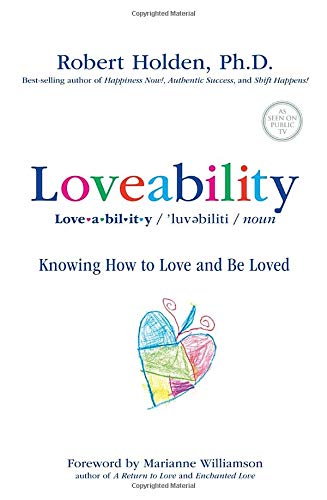
5. Loveability

Written by Richard Holden, Ph. D., this is a mindset book that touches on advice for giving and receiving love -- both internally and externally. This book also explores broader definitions of love that we tend to forget. Holden believes that love is everywhere, even in relationships we're not fond of. To him, the absence of love is fear rather than hate. Because of this, he offers unique positions to offer love at all levels. Check out the book here!

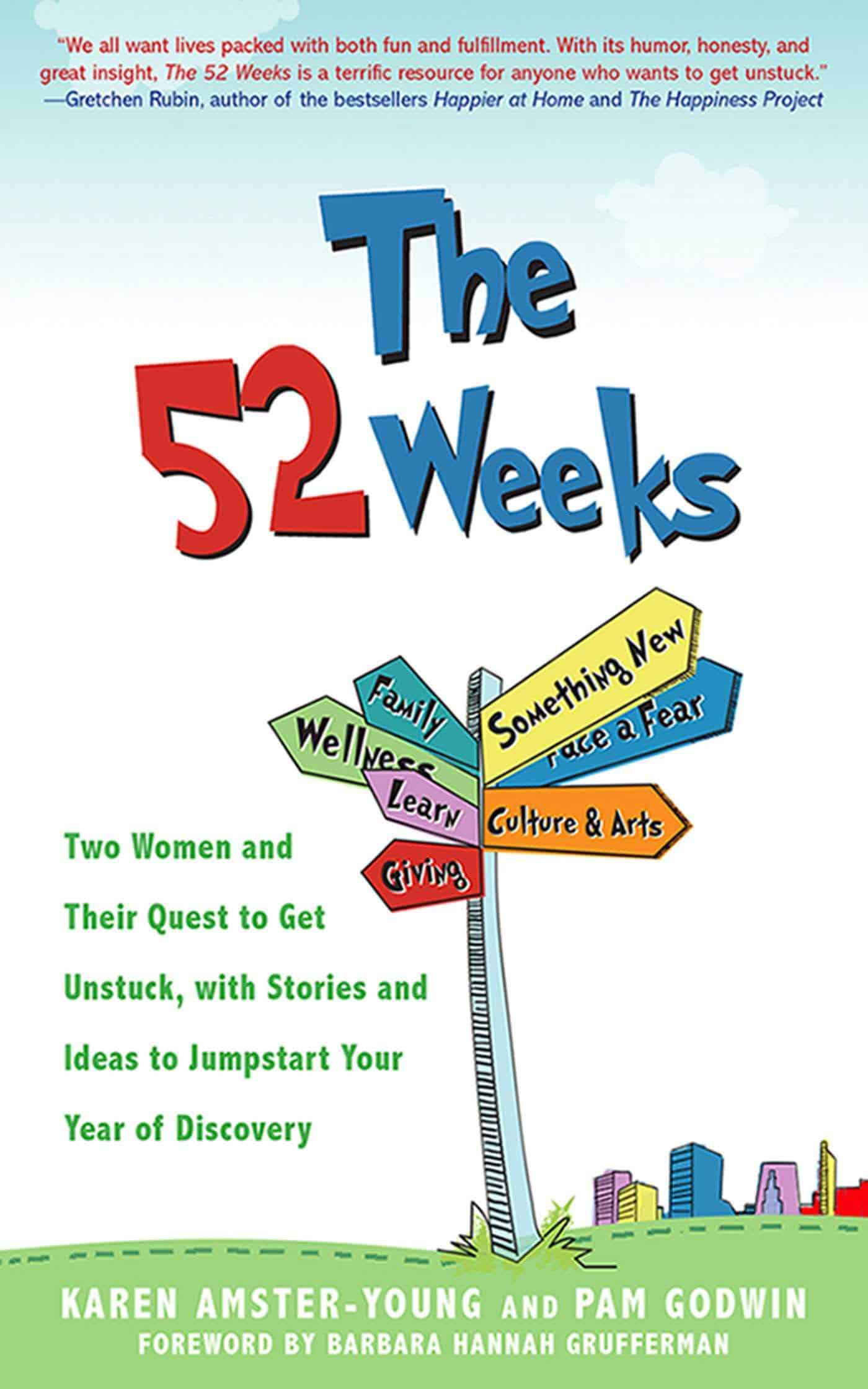
6. The 52 Weeks: Two Women and Their Quest to Get Unstuck, with Stories and Ideas to Jumpstart Your Year of Discovery

Written by Karen Young and Pam Godwin, this can look like a chick non-fiction book but there are some powerful insights for everyone. The idea with this book is two authors set off to go on one new adventure every week for a year. Each new activity was a small goal, but each one achieved brought the two to realize something: It was that life is all about learning, experiencing and growing. This book also covers advice from psychologists and life coaches which is practical and sound too. Check out the book here!

7. Prisons We Choose To Live Inside

Written by Doris Lessing, this is a book published in the 80's that is still relevant today. It's not so much a book but rather a series of essays based on what Lessing gave back then. This book goes into explaining how societal groups shape our own perception of reality. From church to politics and government, these groups teach us to define who is good and bad. From those beliefs, we insist that we are right and that our actions are justified whenever we try to "fix" people or treat others poorly. All in all this book challenges our own perceptions of the world. Check out the book here!

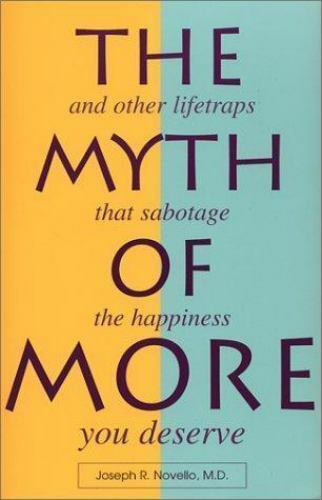
8. The Myth of More

In this book, Joseph Novello challenges the belief that happiness brings us pleasure. When we buy a new home, get a promotion or a new car, we are happier. Novello spends his time digging into these ideas and why these things will never make us happy. Instead, he pushes us to find pleasure in seeking. This book may come off a bit dry, but there are strong stories, good humour and enough poignancy to keep peoples attention. Check out the book here!

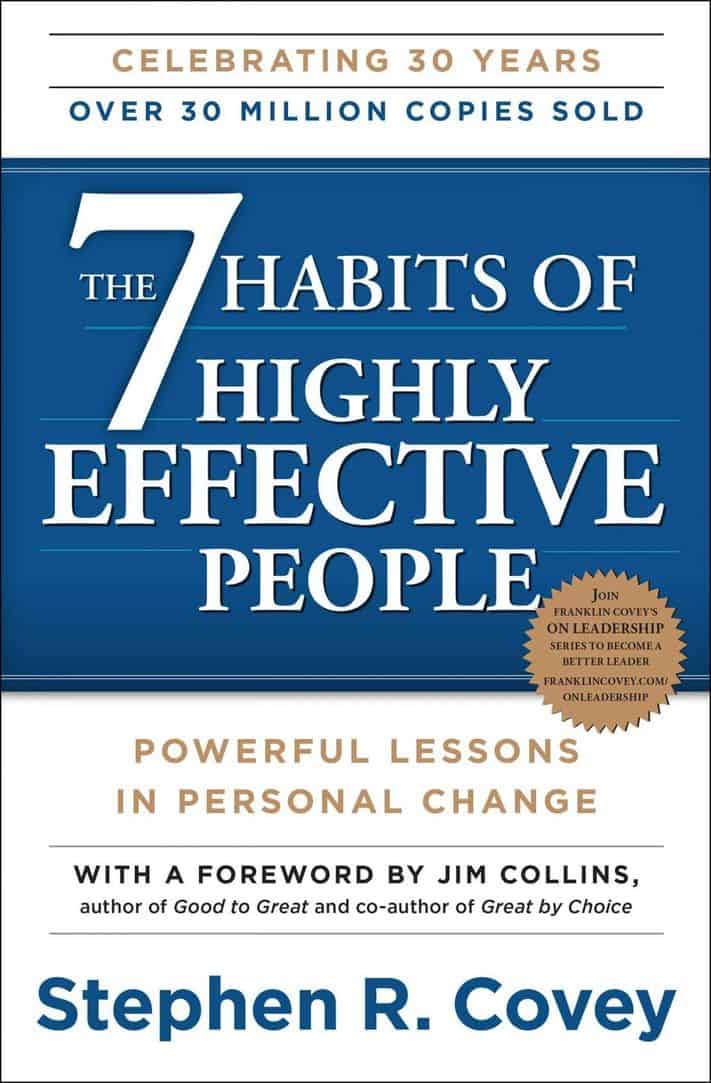
9. 7 Habits Of Highly Effective People

As I suggested above, a shift in habits can change your life around. While it's smart to replace those bad habits with something better, there are other habits that we could adopt. My suggestion is the habits that are outlined in this book. Written by Stephen R Covey, this book takes the habits from the best leaders around and stuffed them into a single book. But what's nice about this is that Covey spends time in the book talking about mindset too. He challenges the reader to change their approach to productivity, time management, and positive thinking. All aspects that fuel a mindset. Check out the book here!

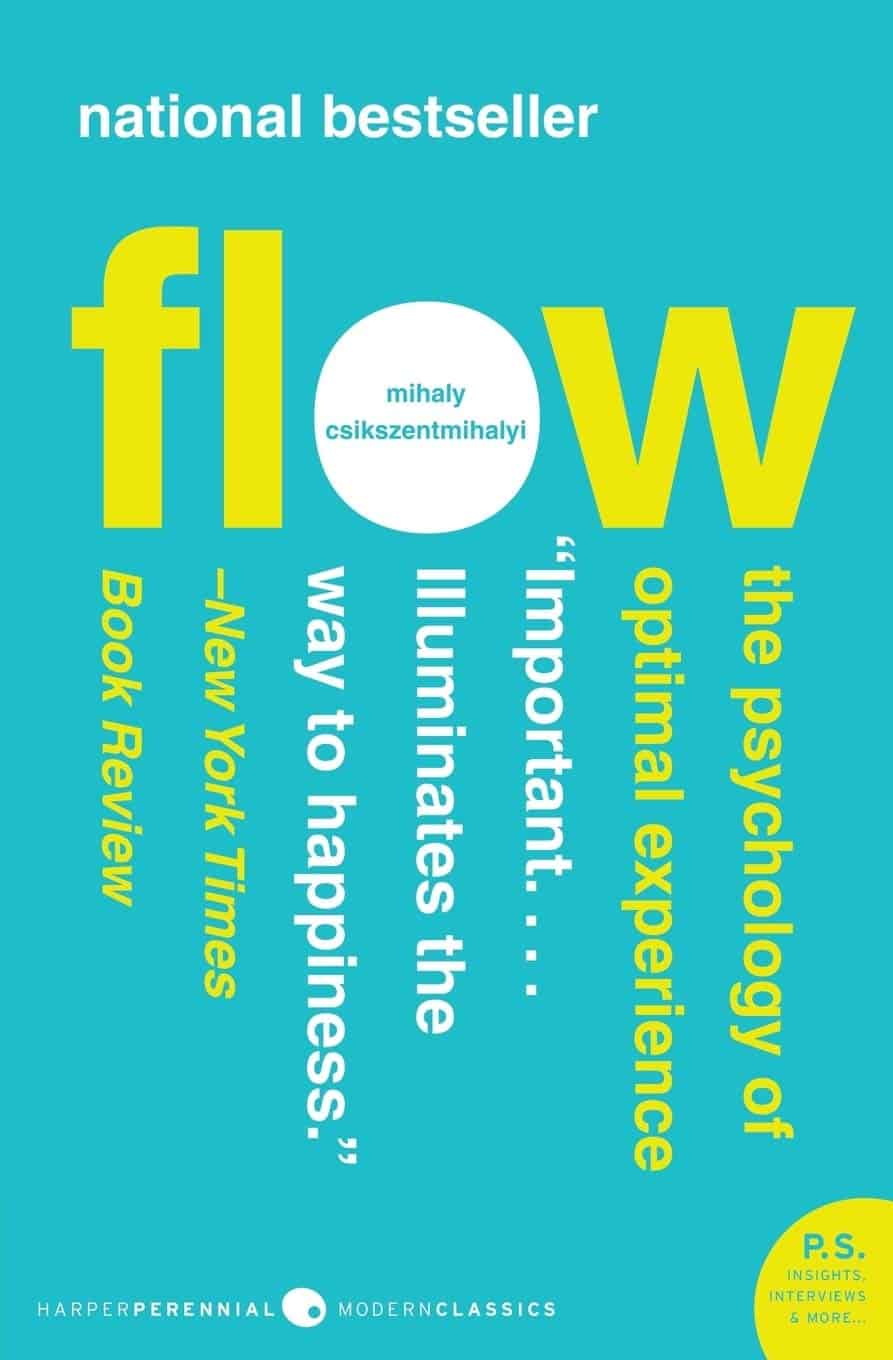
10. Flow: The Psychology of Optimal Experience

The premise of this book is to challenge your thought process on experiences. For many of us, our fondest memories are vacation trips we took or a memorable dinner with family. What this book does is shakes those memories and challenges us to have a fondness for other things. Like times we put in more effort at work to achieve a goal. The book expands on those points and shows us how we can bring flow into our life and use that to achieve great things. Check out the book here!

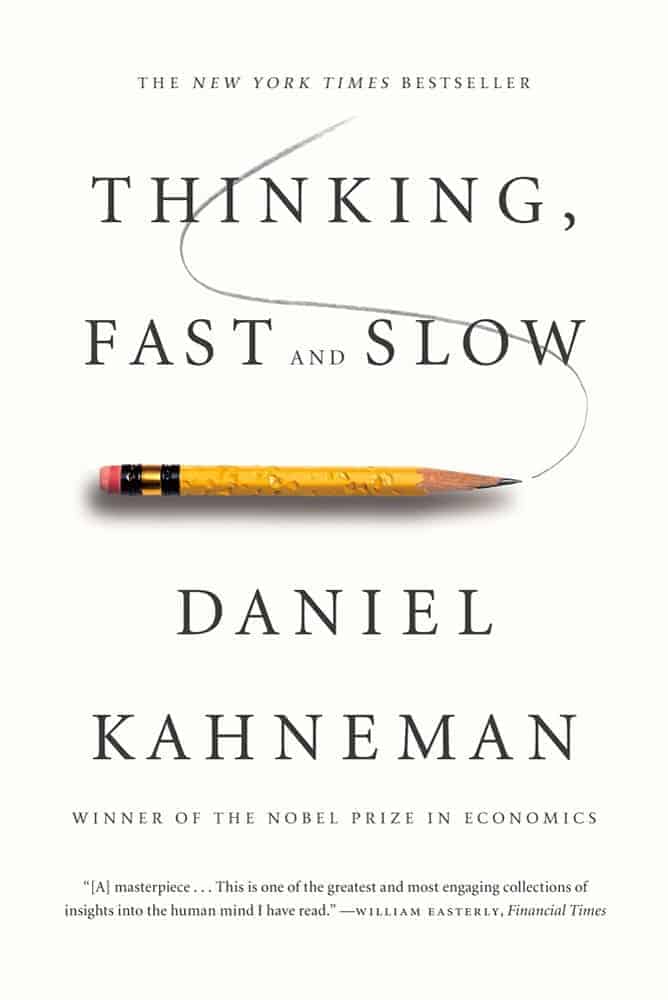
11. Thinking Fast And Slow

Another solid pick is Thinking Fast and Slow by Daniel Kahneman. Kahneman digs into psychology to help us unlock the code of how we come to the decisions that we make. He starts by breaking down our thought process into two systems and highlighting how each system influences our decision-making. Regardless of what industry your in or how complicated your decisions have to be, this book will provide help in understanding how we think. This can lead to us making better and smarter decisions. Check out the book here!

12. Awaken the Giant Within

The final book I'll cover is one written by Tony Robbins. He's a famous speaker and has published several books. For this book, in particular, Robbins provides actionable steps and strategies to help us regain control of our emotional self. The theory of this book is that when we have control internally, we'll be able to steer ourselves externally. It's an interesting read and it challenges you about your own perception of yourself. Check out the book here!

Final Thoughts

The list of mindset books to try out is extensive but each one is well thought out. There is a reason why these books take up such a large section in book stores after all. People are always looking for ways to optimize their life. For many, we feel like we are lacking in some areas and these books can provide the key. And based on the fact that many of these authors have spent years through self-experimentation and/or research, they're providing great advice!

More Inspirational Books