Wednesday, 5 August 2020

How to Change Your Self-Perception and Untap Your Hidden Potential

If your current self-perception is not serving you in ways that allow you to be your best self and achieve the goals you’re aiming for, it’s time to transform it into a force for good. Those harsh evaluations from your inner critic speaking sourly of unworthiness have had enough airplay. You no longer want to allow features of imposter syndrome immobilize you nor deflate any balloon of excitement and hope you had toward achieving your goals: “Who are you to think you can do this? Who are you to think you even deserve this?” Your self-perception is about the relationship you have with yourself. The great news is that because you hold this self-perception, you are the best and most powerful agent capable of transforming it. Here are 7 tips on how to change your self-perception and unleash your potential.

1. Learn to Detach From Others’ Projections

Simply cutting ties with anyone who drops negative criticisms that leave you feeling you are a lesser human being would lead to an incredibly lonely existence. What can better serve you is recognizing when someone might actually be projecting their self-image upon you. Projections are often an unconscious way we defend ourselves to feel better emotionally and mentally about those aspects of ourselves we consider to be flawed.((Psychology Today: Is Projection the Most Powerful Defense Mechanism?)) We attribute the things we don’t like about ourselves to someone else because the pain and discomfort of confessing our own inadequacies are just too great. Think of the friend at dinner who dominates the conversation and commonly speaks over others yet tells you you’re rude when you interrupt them. Think of the associate who claims to be a perfectionist and always struggles to meet deadlines but says your work will never be as good because you prioritize meeting targets over doing better quality work. When you are on the receiving end of sharp, unsavory criticism, there’s a high chance that another person may be projecting. They are unwittingly showing you how they see the world and the flaws they see. However, this does not mean their assertions are true or valid. If anything, it’s simply a matter of opinion and everyone is entitled to that.

2. Recognize How Others Have Shaped Your Self-Perception

During her earlier research, Carol Dweck discovered children’s motivation and performance was highly influenced by how parents and authority figures encouraged them. Her research offers guidance that could also influence a child’s esteem, self-efficacy, and self-perception as they grew through adolescence and into adulthood.((Stanford University: Carol Dweck: Praising Intelligence: Costs to Children’s Self-Esteem and Motivation))
  • Teach children how their effort can influence outcomes and their performance as opposed to labeling them according to the results they might achieve (i.e. a good artist, a genius, gifted).
  • As opposed to telling children they were good or bad, loved or not loved depending upon their behavior and results of performance, praise their efforts despite the results
  • Make space for children’s positive and negative emotions as opposed to only being loving, affectionate, and supportive when they are well-behaved or performing to a certain level.
Dweck’s research has shone a light on likely sources of many imprisoning self-perceptions we develop as adults. As adults, we can see how and why we came to think about ourselves in the ways we do. Now, this is not a green light to unleash all blame on your parents and teachers but rather to recognize that you might be carrying the full weight of unhelpful self-perceptions you aren’t fully accounted for. You can also recognize and choose to do something about those self-perceptions that don’t benefit you. Ask yourself: “Does how I see myself make me feel better or worse about myself?” “Does how I see myself create obstacles between where I am, what I am feeling, where I want to be, and how I want to feel?” Continue to practice your awareness of how you see yourself in the present, consider how this impacts you, and start exploring how to put yourself in the greatest position of power to change this.

3. Learn How Even Negative Self-Perceptions Serve a Purpose

World-renowned psychotherapist Richard Schwartz coined an incredible therapeutic framework called Internal Family Systems through hearing how clients would talk about inner ‘parts’ of themselves.((Good Therapy: Internal Family Systems (IFS))) Similar to how different members of our families have different roles by birthright, different personality traits, and characteristics, Schwartz proposes that we all have an internal system consisting of sub-personas or ‘parts’ within our psyche. Have you ever thought that you should decide one way but another voice inside you says to do the opposite? An inner critic? If so, this framework can help you not only tame the unhelpful voices and self-perceptions but also discover others that can help you untap your hidden potential. Schwartz coined three main types of sub-personas:
  • Exiles are those who often hold the emotional pain from abandonment, rejection, being exploited, and negatively judged by other individuals or other parts within our internal system.
  • Managers are those who are directive and controlling to help us avoid situations and interactions which might further hurt the exile part/s. These parts of us are often highly intellectual and good at problem-solving but push emotions away. In women, the manager-like parts often believe ‘she’ must be perfect and please everyone, otherwise she will be abandoned and hurt. In men, manager parts often possess competitive and entitled features, encouraging him to get or do whatever he wants regardless of who gets hurt
  • Firefighters are those parts of us that spring into action in emergencies when we’re caught off guard. When the exile parts of us have been triggered, these firefighting parts can jump into soothing and placate their emotional expression. Emotional eating or splurging our savings on clothes to make ourselves feel better are examples of ways we look to put out the emotional fire that is blazing.
Regardless of the different characteristics of these parts we have within us, they all serve a primary purpose but in different ways: to protect us and keep us safe. When we learn to see how they do and why they do this, we dissolve our need to fight our self-perceptions. We no longer have to fight against the negative voices in our heads. We can now guide and use them to our advantage to help us get to where we now want to go.

4. Reframe Your Language to Practice Healthy Detachment

You don’t need to undergo intensive therapy to benefit from some simple language re-framing techniques. When you change a few words in your self-labeling narrative, you can drastically change the impact that narrative can have on you. When you look at the following four sentences, you have a sense of which one feels the most self-deprecating and which one feels the least:
  • “No one loves me. I’m simply not attractive.”
  • “I feel that no one loves me. I don’t feel attractive.”
  • “I often feel that no one loves me. At times I don’t feel attractive.”
  • “Right now, I feel that no one loves me. At the moment, I don’t feel attractive.”
Which statement feels the heaviest? Did you notice the changes in the sentences? Self-perceptions we make tend to be purely black and white. We also tend to inaccurately and blanketly apply them to cover all contexts and situations, particularly when our emotions are the most intense. Reframing your self-narrative is easier than trying to eliminate it in one fell swoop. Recognize that your self-perception is but a reflection of transient feelings you are feeling at particular moments in time and you'll become better at preserving your self-worth.

5. Forget Positive Affirmations and Practice Truthful Self-Perceptions

As a coach and a consultant, I have often had clients come to me wanting to instantly silence any negative self-talk they express toward themselves. It is true our subconscious develops healthier inner dialogue over time with the regular and frequent practice of feeding it better mental nutrition. However, no amount of positive self-talk can transform negative self-perceptions if we don’t believe they could be true. If you have a poor body image, you can tell yourself until you’re blue in the face that you have nothing to be concerned about when you look in the mirror. You’re still going to be free from the mental and emotional shackles that such self-perception holds. You’ll be pleased to know the answer isn’t in endless journaling nor writing out positive affirmations hundreds of times a day. There’s a faster and more effective way! Develop phrases which you actually believe that guide you to look in the direction of how you want to see yourself: “I’m working towards improving how I see and/or feel about myself.” “I’m learning and practicing how to adjust this aspect of myself so it better serves me.” Notice how there is no mention of looking to improve or delete an aspect of your personality in either of these statements? Also, notice the absence of the word ‘improve’. Using that word ‘improve’ might imply that you’ve bought into accepting there is something wrong with you, to begin with. You’re changing your self-perception of you. You’re not needing to change you. Your subconscious will be more on board with you using the phraseology above because you’re emotionally more receptive to it. It feels safe. It feels honest. It feels true. Practice more language and phrases like these above and you will grow incredible self-perception that will take you beyond what you originally felt you were worthy of aiming for.

6. Combine a Growth Mindset and Imagery to Untap Your Potential

The use of imagery is an incredibly powerful mental tool to help you develop more helpful self-perceptions that will serve you moving toward your initial goals. Combine this with simple growth mindset questions and you’ll be well on your way to unleashing your potential. Using an example, let’s say you don’t feel you don’t have what it takes to apply for a certain job or pass a particularly difficult exam. The first part of the exercise is to playfully develop the growth and expansive mindset questions and entertain the answers to them:
  1. What if I did have enough skill, expertise, knowledge, and confidence?
  2. How would I approach applying for the job? How would I go about preparing for the exam?
  3. How would I be feeling as I applied for the job? How would I feel as I sat the exam?
  4. How would I feel upon submitting my application? What if I got an interview?
  5. What if I took the exam and passed?
The second part now is to bring those potential answers to life. Breathe life into a mini-movie scene of these possibilities you create in your imagination. Imagine the environment you surround yourself in as you prepare your job application. Can you imagine feeling calm, centered, focused, and ready as you start your exam? Practice being in allowance of feeling excited. When you engage your five physical senses during imagery, you can ignite physical and emotional responses that signal to your brain what you are focusing on is important. The more you practice the imagery in which you paint a healthier and helpful self-perception, the more your reticular activating system will look for opportunities for this to come to fruition in reality.

7. Deliberately Practice Healthier Self-Perceptions

Our hidden potential remains untapped when we aren’t moving toward clearly defined goals. From recognizing our unhelpful self-perceptions, we can start to shape those which aren’t just healthier for us but also strategically helpful for us in moving toward what we want to experience, do, and have. When you next look at a particular goal, ask yourself the following questions:
  1. What qualities do I already have that could and would help to meet that goal?
  2. What do I already know that could help me meet this goal?
  3. How can I position myself to gain the skills and knowledge that would help me achieve this goal?
  4. What choice/s along the way would give me opportunities to experience satisfaction, happiness, and fulfillment in ways that matter to me?
  5. Even if I don’t meet this goal, will I still feel good about myself throughout the efforts I make to do so?
These questions are not only strengths-based. They also guide you to make choices and create opportunities that help you feel higher and healthier levels of fulfillment which matter to you. Meeting the goal may or may not happen. Regardless, your self-perception is sure to undergo powerful, positive transformations on many levels.

Final Thoughts

These 7 tips will help you realize your potential and change your self-perception positively. Through learning how to practice acceptance and compassion toward yourself and how to have a better relationship with yourself, you can develop self-concepts that help you untap your hidden potential. You’ll be radiating a healthy glow that’s almost palpable and the envy of others with a powerful sense of self that will take you wherever you want to go!

More Tips on Improving Your Self-Perception


Fail Forward: How Setbacks Can Fuel Future Success

A reporter once asked Thomas Edison how he felt failing one thousand times. He replied,
"I didn't fail one thousand times. The light bulb is an invention that requires 1000 steps. I have learned 1000 ways how not to make a light bulb."
Thomas Edison must have mastered the art of failing forward. Here's something crucial to note about failure! It is the learning when you fail that deserves celebration, not the failure itself. Failure without lessons learned is a failure. Failure is not a joke; it is expensive to fail. It's not fashionable as well. The truth is people who shun failure deny themselves the opportunity to reinvent and innovate. Let's face it, we must have failed at one point in life, but we chose to stay down or fail forward.

Can Setbacks Fuel Future Success?

In our article, "6 Reasons Why Embracing Failure Helps You Succeed," we reiterated that failure is an incredible driver to success.

1. Failure Teaches Better Than the Best Teacher

"The bigger your failure, the bigger your chance of achieving success." What's the rationale behind this fact? It's because with every failure comes life lessons that you may never learn from the world's best university. Failure helps you prioritize what you normally ignore. Perhaps you have been ignoring some bad habits because they are not big red flags yet. Failure will enable you to confront your fears and tendencies in a way you wouldn't have if you had not failed. Here's another quick one! If you have not failed before, you definitely missed the opportunities to reflect and figure out your motivations.

2. Failure Makes You Strong and Wise

The wisdom and strength that you exude when you share what life has taught are what I'm talking about here. The lessons become a significant part of your journey and success. It's like the making of a movie. Sometimes, you miss the line while acting the script, and you rehearse. Every rehearsal is an opportunity to become better. Likewise, each setback is an opportunity to develop the courage to fail forward.

3. Failure Makes Your Story Compelling

Your obstacles produce the most incredible story ever told—stories of how you surmount your challenges and achieve the success you desire. These kinds of stories impact and give others hope. It would be uninteresting to reflect at the end of life and realize you have never failed. It would most likely depict a life of mediocrity and complacency. Without failure, you cannot tell compelling stories or record noteworthy feats.

4. Failure Sharpens You and Causes You to Grow

It's like an iron that has not been sharpened by iron (challenges). Setback signals the need to grow. This is because failure can shape and mold you to fit the personality that matches your destiny. Why not look beyond your present predicament and focus on the person of your dream?

5. Failure Makes You Fit to Pursue Your Goals

Failing forward despite setbacks means you believe you can. It means you can move on despite obstacles. This resolution helps you always to stay fit to pursue your goals. The judgment and opinions of others can no longer sway you. You are more resolute and committed to seeing your goals come to reality.

9 Tips to Fail Forward

You can leverage failure to fuel your growth in any aspect of your life. Here are 9 proven tips to fail forward.

1. Determine the Possible Challenges

Begin by determining the exact stumbling blocks between you and your success. When you think about your success, negativity becomes a challenge that can assault your mind. What if I fail? What if I don't make it to the end? Go ahead and list all the factors that could cause you to fail. Write them in your journal. When you are done, you have a list of potential limitations to your success. Now, take them one after the other and reflect the best ways to overcome them. Activate your action plan. Attack each limitation until you clear all and achieve your next level of success.

2. Develop a Strategy

When you keep aiming at a goal and you keep failing, refuse self-degenerating thoughts. Instead, assess and change your strategy. You don't have to change your goals as long as they are SMART GOALS; you only need to change your approach. Figure out what you're missing and design a system to avoid future mistakes. Find an accountability partner or a mentor to share input and ideas on your strategy. Commit at least 10-15 hours refining your strategy. Keep positive people around you and think positively.

3. Educate Yourself

It will be great if you can research about what lies ahead of you. Find out if someone has passed through it and learn from their experience. Thomas Edison made 1000 attempts; how did he manage the failure? What can I do to overcome anxiety and depression that comes with failing? Equip yourself to surmount challenges when they arise.

4. Seek Advice

Isolation is a killer of success. Don't isolate yourself from people that can help you. Talk to someone either your mentor or an accountability partner about the circumstances. If you had the opportunity to meet Abraham Lincoln or Thomas Edison, what questions would you ask? Perhaps, how Lincoln led the nation through one of the most significant moments in the history of the United States despite his inner troubles. How Edison failed forward until his dream of a light bulb for humanity came to reality. Ask your contacts to point out limitations and the mistakes they made. Leverage this experience to shorten your learning curves. You can also enroll in courses designed to help you overcome obstacles.

5. Reflect on Your WHYs

We wrote in detail on how to utilize the 5 WHYs to get to unravel the possible cause of your obstacles. It's time to put this knowledge to practice. Someone once said if your WHY is big enough, the HOW will show up. Take some minutes to write and reflect on why you want to overcome obstacles and achieve your next level of success. Think yourself into the new feeling, esteem, and lifestyle you desire. This is called visualization!

6. Live Life With No Regrets

It will be worse to live this cosmos, regretting you didn't give it your best shot. You will die someday. Why not die empty? The global average lifespan is 72 years. That means you have, on average, about 26,280 days to live. Value each day and refuse to live your life by default, but by design. Manage your time effectively and live every second of your life deliberately. Pursue your goals. Take calculated risks, and know that every risk comes with failure. However, you cannot become successful without taking risks.

7. Celebrate Your Small Wins

Every achievement takes you one step closer to your success. While waiting for the final day, take out time to celebrate those small victories. Perhaps you have completed your weekly to-do list; you can pamper yourself. You may visit the cinema, attend a yoga class or visit the spa. That way, you will generate momentum to surmount the next obstacles.

8. Learn From Each Day

Every day is an opportunity to show up in the school of life. Show up to learn from life's instructor—failure. Open yourself to events and experiences as they present you the opportunity to learn. Your greatest teacher in life is 'failure.' The more you fail, the less you become afraid of failing as you would have transcended your setbacks and emerged stronger and fit.

9. Accept Reality

When you fail, admit! Admit that there's nothing you can do about the failure. Accept that life must continue, and that's what failing forward is all about. Acceptance helps you to make progress. It helps you to gain liberty so you can figure out the next step to take.

Final Thoughts

Above all, maintain a positive attitude. Your attitude is fundamental to your outcome. Always preempt obstacles, and don't let life happen to you. Refuse to live your life by default, but by design. Seek counsel from past overcomers and learn from their experience. Keep moving. Don't stop, and celebrate every little achievement. Fail forward, and fail fast!

More Tips on How to Fail Forward


6 Strategies for Overcoming Obstacles That Hold You Back from Success

Stephen King famously threw his first novel in the bin after being rejected for the 30th time, and it was only because his wife got it out of the trash that he persevered and went on to be one of the most successful authors internationally with over 50 books((CBS News: Celebs who went from failures to success stories))! Clearly, overcoming obstacles came naturally to King. Mary Anning((Natural History Museum: Mary Anning: the unsung hero of fossil discovery)) was one of only 2 children to survive of her 15 siblings when sheltering under tress in a rainstorm—lightening killed all but Mary. Her parents' little house by the sea was flooded, she couldn't afford to go to school to learn to read and write, and yet she became one of the most renowned fossil finders of her era, influencing the science of paleontology at a time when women weren't even allowed to go to university. A client described the huge obstacle they faced: “Mandie, I feel like I’m looking at a huge wall and no matter what I do I can never get over it.” In less than two hours, we reduced that wall to rubble and that person is now achieving the things they didn’t think were possible. In this article we will explore how you also can start overcoming obstacles you face to get what you want in life. Whatever you want to be or achieve, you're going to need to find the obstacles in your way and get rid of them. If you don’t, you are at risk of:
  • Constant frustration that success always feels elusive or gets delivered to someone else (less deserving than you).
  • Guilt that you should have achieved more, but you just don’t have the skills, intelligence, confidence or ability–that’s not your fault, right?
  • Sadness and overwhelming thoughts that say you can’t do it, which means you stop trying and fail.
  • Repetitive conversations that run in your head over and over again as you wish you could tell people what you really think and want to achieve.
  • Anger as everyone is more important than you and getting what you want out of life.
  • Stress that impacts your physical, emotional, and mental health as you never get where you want to go.
These are just a few ways that not dealing with the obstacles in your life can have a long-lasting, detrimental effect. Let's give you 6 highly successful strategies to overcome your obstacles in life and get the success you want (and deserve!).

1. Listen Very Carefully

We rarely listen carefully to other people, and we are even worse at listening to ourselves. Clients will often tell me how they are horrible at something, but rarely are they hearing what they know about themselves. They are choosing to only concentrate on the critical repetitive thought rather than everything else they know about themselves. Before you start believing the good stuff, you’ve got to really understand what you tell yourself. And rarely do obstacles come with a neon sign saying “Obstacle here!” So how can you fix something that hides under another name or thought? Here are some common thoughts that people believe that tell us obstacles exist in their life:
  • It’s just the way it is.
  • I’m not clever enough.
  • I can’t speak up to get what I want; it’s just not the done thing.
  • I’m not good enough to achieve what I want.
  • I don’t have enough hours to do it all.
  • I don’t know where to start, so I end up doing nothing.
  • I would never know what to say.
  • I’m not the kind of person that could achieve that.
Take a minute to think about the thoughts that are free falling through your mind that are less than positive. How do they make you feel? What does it cause you to believe is true? (In my experience, what we hear and believe is often the root cause of stopping you from achieving more and overcome adversity and obstacles that life throws at you.) What results do you feel are associated with these thoughts? (These will fit nicely into the acronym F.E.A.R – F – feeling, E – Emotion, A – Actions, and R – Results.) If you follow the flow of your feelings, emotions, actions, and results, you can see the true damage your thoughts are having and how they impact on the obstacles in your life. Remember, your ability to make good decisions, your health, your productivity, creativity and even your ability to make money can be impacted by negative thoughts. The Navy Seals ensure the first thing they do in a crisis is...breathe((Time: The Breathing Technique a Navy SEAL Uses to Stay Calm and Focused)). Not action. Breathe, because it puts you in a calm state. A calm mindset is essential for overcoming adversity.

2. Decide If It's a Perceived or Real Obstacle

Some obstacles take time, perseverance, new skills, determination, and discipline to overcome, and others can be removed in one hour! I’ve seen many clients in tears who felt the obstacles were too big to overcome, only to leave at the end of our session with a completely different attitude, mindset, and belief about the obstacle that was insurmountable an hour ago. How is this possible? When something feels big, we believe what it tells us.
  • If we think we don't deserve that pay raise, the world will reassure us we are right.
  • If we think it’s wrong to speak up, then we will get reinforcement that this is true.
  • If we feel under-skilled, we won’t need to work hard to find the proof we are right.
Our minds like to prove us right. When we are proved wrong, it's challenging in our head and can cause pain, anguish, and worry as we try to understand what this challenging thought means for the human we are:
  • How will it impact our actions and results?
  • Our conversations?
  • Our relationships?
  • Our careers?
  • Our ability to make money and live the life we want?
Changing a perception can be easier than we think. Ask yourself, “What proof do I have this is true?” This will help you start to see that some obstacles are actually a lot smaller when you challenge them.

3. Change Your Perceptions

If you want to change your perception of an obstacle, start with you.

What Do You Believe to Be True About Yourself?

Are you talented? Clever? Kind? Successful? Hard-working? Dedicated? Caring? What words would you use to describe yourself? Write them down right now.

Analyze and Review the List

Tick any words that are positive, and cross out any words that are negative. What are you left with? A page of positive reinforcement or a page of battering the human you are?

Another Viewpoint

Now ask friends, colleagues, family, and even social media friends – how would you describe me?

Compare Your List With the Words Given

Does it match up? At this stage if you lack confidence, you will be able to justify your hard-held view that you’re right and “people were just being nice.” Trust me, they weren’t; you really are a good person that people like. The disparity between what is known about you and what you believe to be true is one of the first tools to fight your obstacles. If you want to fight the things that hold you back, build your confidence. A good level of confidence will help you overcome any obstacle, real or perceived.

4. Create New Beliefs

Whether you call them mantras, beliefs, mindsets, or attitudes, you need to ensure you have a powerful saying in your head that honors your new perceptions of who you are and what you are capable of before you decide to act. If you want to overcome an obstacle and fight the difficulties in your life, and you only believe bad things about yourself, how likely are you to succeed? It doesn’t have to be complicated. For one client, they had escaped an abusive relationship with no home, no money, and no future (in their eyes). They now have a business, a new relationship, a beautiful home, and a future. When they faced obstacles in life, they would tell themselves what they’d overcome. How powerful is that!

5. Plan Clear Goals

It’s not enough to think, know, and believe you are a great person. If you don’t have a plan, you will struggle to start overcoming obstacles. Likewise, when it comes to the obstacles that stop you, clear goals will always be your friend in destroying them. Obstacles that struggle to survive around goals include:
  • Not enough time.
  • No support.
  • Too many responsibilities.
  • Not knowing where to start.
  • Not asking for what you want.
  • Being down trodden by other people.
These are just a few. So, if you want to override obstacles, look at the quality of your goals.

Are They Clearly Defined to You and Others?

It’s surprising how many times a client is frustrated that they aren’t getting what they want, and yet when I ask them who they’ve told, it turns out they’ve told no one! People aren’t mind readers; you do need to communicate to get what you want.

Do You Have a Plan of Action That Is Easy to Follow?

Break it down, and if it still feels too big, any action that feels harder to achieve gives your brain evidence that the original perception was right and that it can’t be done. If any action to your goal still feels too big, break that down into smaller actions.

Ensure Goals Have Tangible Steps

Your goal may be: “I will have moved to my dream home by January 2022.” That goal will include emotional goals aimed at securing your mindset, i.e., “I believe in my ability to get my dream home because I have all this proof of how I achieved what I set out to achieve.”

Measure Your Results

We don’t notice ourselves falling into a rut. At the start it can be just as hard to see the signs that you are escaping it, too. Keeping notes on how you feel, what you’ve achieved, what you are working on will help you keep fighting to overcome any obstacle, because you can and will do this.

6. Face Big Obstacles With Determination

There are some obstacles that are genuine. They rock up in your life and feel like they are taking everything you know, love and enjoy. Death, divorce, life-threatening illness, major accidents, and redundancy are just a few of the things we face when it feels like the world has come to an end. However, even on these occasions, it's amazing how some overcome these obstacles with finesse, discovering whole new levels of determination, carving out new careers, radically changing their lives for the better, and empowering and motivating others.

What Would You Do?

When you're too close to an obstacle, it does look like a huge wall that blocks out the sun. In all the years of coaching clients with this strategy, I’ve never heard the same answer. The question is: “If it feels like a huge wall, how would you like to get past it if you could using magic, super heroes, or anything else to instantly destroy it?” I’ve heard people say they'd tunnel under it. They'd go along the wall until they came to the end. They'd climb over it, get Thor’s hammer and destroy it, or take it down brick-by-brick. But it's never the same answer. These crazy, impossible solutions to the wall give us clues on the best way to get over obstacles. The person that wanted to tunnel under it realized they didn’t like to look head-on at obstacles. If they did, they felt it was too big, and they would procrastinate, fearing they’d fail. For the person that wants to climb over it, they realized that, no matter what happened, they could overcome things that happened in their lives. They realized the sooner they started, the sooner they could get what they wanted. The client who went along the wall appreciated that for them, they always found a way around the wall. Can you see how this client has assumed there is an end to the wall? Their perception (rightly or wrongly) meant they knew they could find a way around it. (And it would use a lot less energy strolling along a wall than trying to destroy it or tunnel under it!) And what about the person that wanted to take it down brick-by-brick? This showed us they like a methodical way of achieving things. There had to be a plan. A process. Dates in diaries to ensure success, otherwise they would feel overwhelmed.

Concentrate on What You Can Control

A big problem with obstacles in life is that they create negative emotions and results. It’s hard to not feel upset, disappointed, pained, sad, and many other negative emotions, because the obstacle really has screwed up something in your life. However, these are all things you can’t control. And when you try to gain control of things that can’t be controlled, you just get more frustrated, angry, and depressed, and you often give up. Concentrate on what you can control:
  • If your body stops working and needs 18 hours of rest a day, you can control what podcast you listen to so you learn new things and stay motivated.
  • If you lose your job, you can control what you do with that extra time, re-educating, up-skilling and growing your network instead of staying in bed and watching Netflix.
  • If the person you wanted to spend the rest of your life with leaves, you can concentrate your thoughts towards all the people in life that love you instead of the one that doesn’t.
It’s not easy, and it takes practice, but concentrate on what you have, not what you don’t. One study((Journal of Research in Personality: The role of gratitude in the development of social support, stress, and depression)) discovered that students in their first term who were asked to practice gratitude experienced less stress and depression, felt more socially connected, and the research suggested they were able to be more resilient in a time of great change. So count your blessings.

Make Sacrifices

To overcome adversity and life's obstacles, you will need to make sacrifices. To write a new book, I had to decide to not watch TV with the family but return to the laptop. When someone tells me there's not enough time to start a new business, we easily find plenty of time in their life that could be used for the new venture. Challenge yourself on what is essential and what is not. There are more than a few young teens around the world who dislike my name because a parent has told me a big obstacle to their success is that their teens do nothing around the house. A few “on strike” days from the parents, and suddenly the parent has more time since they aren’t the only one that can empty the dishwasher or do the laundry.

Final Thoughts

If you want something enough, you will find the impetus to make those sacrifices, challenge what you believe, and overcome any obstacle. Everyone faces obstacles, and sitting back and complaining about how unfair it is won't change anything. Stepping up and deciding to do things differently is the first step to having the tools to always overcome obstacles, no matter what life throws at you. It's now time to put this into action.

More Tips on Overcoming Obstacles


Tuesday, 4 August 2020

How Smart Goal Setting Helps You Make Lasting Changes

SMART goal setting is one of the most valuable methods used by high achievers today to actualize their life goals time after time. SMART goal setting is the inverse of random or carefree goal setting without strategy. Perhaps, you’ve always wished to get back in shape, get an annuity, or take control of your finances, but you failed to act. When you approach your goals with a care-free and nonchalant attitude, you’re less likely to achieve them. You should have a strategic goal setting method in place, and learning how to set smart goals is imperative in this case. The method is time-tested and purposeful, meaning it can help you achieve your goals now. To achieve your goals consistently and join the pack of high achievers out there who have consistently achieved many of their goals, you must be prepared to do what these people have been doing, and be ready to do the right thing: SMART goal setting. https://youtu.be/Cl9wD3A4Ax8

What Is the SMART Model for Setting Goals?

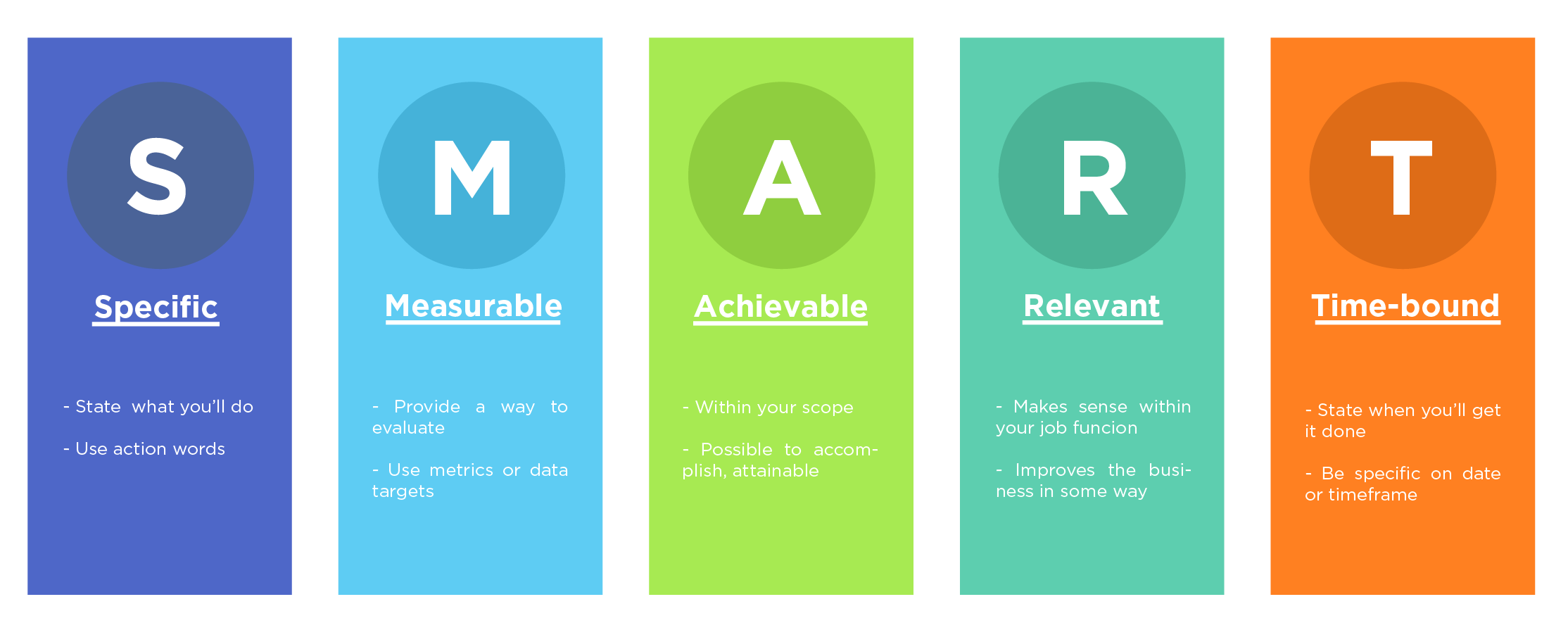
SMART goal setting is a goal-setting method that considers certain factors about a goal relative to the person setting it. These factors are simply the five different letters in the SMART acronym for goal setting. It is relative to the person setting the goal because what is true for A may not be true for B; or what is possible for A or within A’s ability to achieve may not be possible for B or within B’s ability to achieve. What does the goal setting acronym SMART stand for?
  • S—Specific
  • M—Measurable
  • A—Achievable
  • R—Realistic/Relevant
  • T—Time-bound
Is it possible that this acronym can make a long lasting impact in your life? Is it possible that a mere goal setting metric like SMART can help you achieve so many of your unfulfilled goals? Is it possible that if you practice SMART goal setting, you will be able to have faster results, understand your goals better, overcome the habit of procrastination, and achieve a lot? The power to achieve your goals is in your hands. It is important to extend the inquiry by asking: How many times have you said you’ll do "X," but failed to do so? We all have goals, and we all have 24 hours each day at our disposal. While some people find it easy to achieve their goals without procrastinating, some find it difficult to do so. For some people who have succeeded again and again in achieving their goals, they have simply found an easy way of doing this. Is there something they know that you don’t?

How Smart Goal Setting Makes a Lasting Impact

Smart goal setting examples can be found all around you. Through SMART goal setting, Stephen Cooley was able to grow his real estate business to the point of closing at $110 million in sales when the average price point of homes was between $100,000 – $200,000 in South Carolina((BoomTown: Don’t Believe in Goal Setting? Then Listen to Stephen Cooley’s Team)). Through SMART goal setting, Steve Jobs was able to improve the fortunes of Apple and prevent the company from going bankrupt, even when it had barely 90 days left before being declared so. SMART goal setting can make a lasting impact in your life in several ways.

Make Your Goal Clearer

When you use the SMART criteria to set goals, it is easier for you to understand the various phases of your goal. By using SMART goal setting, you’re able to ask yourself relevant questions pertaining to your goal.

Motivate You Into Acting on Your Goals

When you use SMART goal setting and break down the goal into smaller goals or milestones, the bigger goal no longer looks intimidating or impossible. Jack Canfield, co-author of Chicken Soup for the Soul, wrote in his book How to Get from Where You Are to Where You Want to Be about how they applied the rule of five in marketing their book, Chicken Soup, and were able to make the book a best seller after some months((Jack Canfield: Creating “Miracles” with the Rule of Five)). The rule of five simply means doing five specific things every day that will move you closer to achieving your goal. In order not to be overwhelmed, you would have to measure your performance using the right metrics. Here we are considering the Measurable and Achievable aspects of the SMART acronym. It is critical that you measure yourself in terms of lead measures. What are lead measures? They are the things you do that leads you closer to your goals. On the other hand, you would have to avoid “lag measures.” While lag measures mean a successful outcome that you wished for and got, they can be emotionally draining and deceitful because, whenever they don’t happen, you can become discouraged. Therefore, it is better to stick to lead measures.

Help You Save Time

You can achieve more when you use SMART model goal setting. To be strategic, your goal would have to be specific, measurable, achievable, realistic, and time-bound. If you can’t identify any of these points in your goal, you probably will be wasting your time on a wild goose chase. When your goals are written down, it’s easier for you to go into action mode.

Improve Your Self-Discipline

Self-improvement is an important thing for everyone to do periodically. When you set SMART goals, it makes you realize that you have to sit up and work on achieving them.

How to Set SMART Goals

See the source image To make your SMART goals work, use the following tips:

Specific

Every goal ought to be specific. It is important to guard against making vague goals because even when they have been achieved, you may not know. This is because you weren’t specific enough. For example, “I will start planning toward retirement” is vague. Rather than write that, you could say, “I will start planning toward retirement by starting an annuity plan.” This is more specific. When you are specific on your goal, it’s easier for you to identify all its components and work accordingly toward achieving it.

Measurable

Your goals must be measurable. When they are measurable, it’s easier for you to follow through. A goal like this is not measurable: “I want to make millions of dollars.” You can make it more measurable by saying, “I want to make one million dollars selling one hundred thousand copies of my book at ten dollars each.” Also, using our SMART goal setting examples while explaining the Specific acronym, you can make the goal more measurable by saying, “I will start planning toward retirement by starting an annuity plan and saving $500 every month.”

Achievable

How realistic or actionable is your goal? Is it practical enough to fit into a given time frame? Is it something you are able to achieve in your capacity? You would only be setting yourself up for failure if you sets goals that are not reasonable. A goal like this is highly unrealistic and, therefore, not achievable: “I want to be the Governor of Texas in six months,” especially since the elections will be coming up in three years. Goals must be written down relative to the experiences of the one setting them. They must resonate with you. It is important that you have at least some of the resources needed to actualize this goal. It is also important that you consider your time frame. When the time frame to achieve a complex goal is too short, it is rare that such goal will be completed. Thus, using our previous example, if you write “I want to make one million dollars in ten days selling one hundred thousand copies of my book at ten dollars each,” you would only be setting up yourself for failure. This is especially true if you’re not a popular author or if you’ve never sold even up to one thousand copies of any of your previous books, whether e-copy or in print.

Realistic/Relevant

Before you proceed to making the commitment toward that goal, you need think about how realistic and relevant it is. Being realistic means you should be willing to make all the commitments required for that goal to be achieved. If your goal is relevant, it fits into the life you've imagined for yourself.

Time-Bound

Every goal must have a commencement date and an end date written down. It is also important that you break down your goals into phases, chunks, bits, or milestones. The act of having deadlines set to your goals is ample motivation that drives you into action. Without a deadline, it is not possible for you to know if you’re making headway with your goals. “I will start planning toward retirement by starting an annuity plan and saving $500 every month for the next twenty five years” is a time-bound goal. Remember that some goals are short-term while some are long-term. It is important to always bear this in mind, because this will help you in making a clear and realistic strategy when SMART goal planning. Without SMART goal setting in view, much of our goals may likely end in our minds, on paper, or just midway into implementation. SMART goal setting reveals to us all the action points of our goals and helps us to have an awareness of every aspect of our goals.

The Bottom Line

What matters at the end of the day is what you do with the contents of this article because the power to achieve your goals is in your hands. It is not enough to have a goal. It is not enough to put it down in writing. It is important to have a strategy in mind while putting it down. This strategy is a guideline or set of rules that point you in the right direction. It is SMART goal setting in the given circumstance. After writing down your goals, you will have to be ready to take action. There should be a clear action point. Write down what you need to do on daily, weekly, or monthly basis. When your goals are realistic, they make them worth the chase. One of the things to bear in mind is that, in order not to be overwhelmed by the daunting nature of your goals, remember to always break them into milestones, chunks, or bits. In fact, take one day at a time. Do not bother yourself with the one-year, three-year, five-year or ten-year plan as this may likely overwhelm you with fear and doubt. Let your focus be on each day. What will I be doing today? Consider this and go for it.

More on the SMART Model for Setting Goals


How to Focus on Yourself and Accomplish Your Goals in Life

How often do you focus on yourself? During your morning meditation? Before bed, when you’re winding down? If you want to accomplish your goals, it has to be constant. You have to put yourself first, even when it involves saying no to others. At a high level, focusing on yourself is about paying attention: What do you truly want? What’s standing between you and your best, happiest, goal-conquering self?

Focusing on Yourself Isn’t Selfish

Just like everyone else on this planet, you deserve to get what you want out of life. That doesn’t mean you’re a selfish person; it simply means you’re the one who has to work for it. Say your goal in life is to be an amazing parent. To do that, you can’t take care of your kids 24/7. Although you’re going to have to clean up after them sometimes, you can’t support them without a stable career. You can’t teach them to manage their mental health if you don’t take care of your own. Before you can give others your best, you have to sort out your own priorities. And again, it has to be constant: Your goals might change, and that’s OK. What isn’t OK is focusing on others at the expense of yourself.

How to Focus on Yourself And Get What You Want in Life

Achieving your goals has to be a lifelong endeavor. That’s why it’s so important to start today. Use these strategies to go after your goals and get your life moving in the best direction possible.

1. Spell out Your Dreams

Get a college education. Land a job that makes a lot of money. Reach that next rung of your career. The traditional vision of success appeals to a lot of people, but it may not be right for you. Ask yourself: What does the life I actually want look like? It’s up to you to create a vision for your life. You don’t need to know all the details, but you should be able to paint the broad strokes. Say you know that you enjoy history and writing. The key stages of your life vision might include:
  • Work for a state historical society.
  • Become a freelance writer.
  • Write a historical fiction novel.
  • Win the Booker Prize for Fiction.
  • Become the modern Leo Tolstoy.
Or, let's say you are working in healthcare, and while you don't want a complete career change, you do want to pivot the direction you are headed. You can start looking into online programs that would allow you to earn certifications without having to go back to school to earn another degree. There’s no “right” or “wrong” dream. All that matters is one thing: that you’re willing to work for it.

2. Practice Constantly

Ralph Waldo Emerson said, “Do the thing, and you will have the power.” That “thing” is whatever your goals require of you. One way or another, you have to put in the work. Writing skills don’t build themselves. Strong families aren’t forged by an absent parent. The good news is, you don’t have to do it all today. Break your goals into small, manageable pieces. If reading a craft book is what’s stopping you from taking the leap to be a freelance writer, start by reading just 10 pages per day. Over a month, that’s 300 pages—a full-size book. How does learning the business of freelance writing in just a month sound? Small steps add up. Take one or two each day, and you’ll make more progress toward your goals than you thought possible.

3. Face Your Triggers

You’ve been told to avoid your triggers, but when it comes to focusing on yourself, that isn’t the best advice. How can you grow as a person if you run away from every trial? If you truly want to focus on yourself, you have to face your triggers. Say your heart is set on holding public office. If you want to accomplish your goal, you’re going to do things that might scare you, including:
  • Speaking in public
  • Saying no to people
  • Taking personal attacks in stride
  • Working with people who you disagree with
Remember, you grow most when you’re challenged. Focusing on yourself means putting yourself in tough situations.

4. Tap Into Your Sixth Sense

Focusing on yourself isn’t a science. Finding your path requires you to get in touch with your intuition. When you’re intuitive, you can sniff out a bad relationship before getting too close. According to best-selling author Malcom Gladwell, you can evaluate people with about 70% accuracy((Barking Up the Wrong Tree: Was Malcolm Gladwell right? Can you trust your intuition?)) in a mere five minutes. How is that possible? Because past experience is powerful. Intuition is another word for using your experience to see beneath the surface of a situation. To focus on yourself, you have to trust yourself. With that said, intuition isn’t infallible. Don’t let it stop you from seeing what’s right in front of you. For example:
  • Your intuition is heavily influenced by your biases. If you find someone attractive, you may be more likely to glass over their bad characteristics.
  • If you’re in a bad mood, you may be overly pessimistic. Take another look at the situation once you’re feeling better.
  • Hearsay isn’t a good base for intuition. Don’t read too much into what others tell you.
The bottom line? Be aware of your gut feelings, but don’t let them drive the car.

5. Switch It up

Focusing on yourself isn’t the same as being single-minded. If you want to achieve your goals, you need new experiences to help you climb higher. Every so often, try something new. It doesn’t matter if you don’t want to do it again; what’s important is that you learned something about yourself. Not sure where to start? Try one of the following:
  • Go ziplining
  • Learn a foreign language
  • Dye your hair
  • Travel to another country
  • Fix an unfamiliar car or home problem yourself
  • Invert your schedule
Experimentation helps you build skills and deepen your sense of self. Both of those things are critical if you want to reach your goals.

6. Put Your Health First

What better way to focus on yourself than to prioritize your health? When you feel better, you’ll get more done than you would working yourself into the ground. You can get a long way by taking a “mother’s advice” approach to your health. That means:
  • Get at least 7-8 hours of sleep a night.
  • Exercise for 30 minutes at least three times per week.
  • Eat lots of fresh fruits and vegetables.
  • Spend less time on social media.
  • Meditate for 10 minutes per day.
  • Avoid drugs and alcohol.
  • Take breaks often.
  • Ask for help when you need it.
If you struggle with maintaining healthy habits like consistent exercise, then try to make it more fun. For example, I’ve started taking electric bikes that have pedal assist and an accelerator out with friends.

7. Start a Side Project

Side gigs allow you to call the shots. It’s a lot easier to focus on yourself and achieve your goals when you’re in it for yourself. Side projects teach you to love work again. The key is to choose projects that are aligned with your life goals. For instance:
  • If you want to become an acclaimed artist: Moonlight as a graphic designer.
  • If you want to become a professional driver: Be an Uber driver in a big city.
  • If you want to become a veterinarian: Volunteer for the Humane Society.
  • If you want to become a famous musician: Join a local band.
Although it’s nice to earn some extra income via a side gig, that shouldn’t be your goal. If it is, look for a different job. The point of side projects is self-exploration. With that said, side gigs can help you further your main gig. Engaging in one shows potential employers that you’re willing to go the extra mile. Unlike many nine-to-fives, they let you build a portfolio of work that reflects your true interests.

8. Work Backward

When you’re old and gray, what kind of life will you wish you’d lived? Taking an end-of-the-road perspective can help you see blind spots in your plans. For example, it may be a dream of yours to live in a dozen different countries. If you achieve that, however, will it bother you to feel like you never really put down roots anywhere? If you also want to be a parent, will you be able to do both while giving your kids a stable upbringing? Working backward is how you play devil’s advocate with yourself. Make sure your life goals don’t require you to make an unacceptable trade-off along the way.

The Bottom Line

What legacy would you like to leave? Are you willing to put in the work and accept the consequences? Make a change today, and you’ll have taken the first and most important step to achieving your life goals.

More on How to Focus on Yourself


36 Important Resume Skills (For All Types of Jobs)

Most jobs require specialized skills. At the same time, there are a lot of resume skills that apply across the board. If you’re on the hunt for a new job, give your resume a refresh. Employers want to know: Can you communicate effectively? Are you easy to get along with? Can you manage your time effectively? Remember, you may not get a second look. Use your resume to make a great first impression. Holistic ability is what employers want to see when hiring. These resume skills can make you a top pick regardless of what role you’re applying for.

Communication

Being properly understood is critical. On any team, you must be able to relay and interpret messages with speed and precision. How you describe yourself, the concision of your phrasings, and the layout of your resume are great ways to showcase these skills.

1. Writing

Whether it’s emails or official documents, writing skills are essential for candidates in any industry. Clear, concise phrasings minimize misunderstandings and save the recipient time. This is probably one of the most important resume skills.

2. Verbal Communication

Speaking clearly and eloquently is one of the first things a hiring manager will note in an interview. Communicating over the phone is commonplace in business. Outline this skill on your resume, and they’ll invite you in to listen for themselves. This is easily one of the most important resume skills in most industries.

3. Presentation

Sales pitches and company meetings may include presentations, which require special communication skills. Being able to spearhead and properly carry out a presentation shows organization and resolve.

4. Multilingualism

Knowing more than one language can open doors for you and the business you represent.((BBC: The huge benefits of working in your second language)) Being able to speak another language allows your company to serve a whole new demographic.

5. Reading Comprehension

At any job, employee handbooks, company newsletters, and emails will come your way. Being able to decipher them quickly and effectively is an important resume skill. This goes hand in hand with having excellent writing skills.

Tech Savvy

Technology is evolving rapidly, especially in the business world. Be sure to mention the technologies you’re familiar with on your resume, even if you don’t expect to use them daily.

6. Social Media

Almost everyone has some form of social media these days. Companies use platforms like LinkedIn and Facebook to reach new audiences, provide customer service, and build brand loyalty.

7. Operating Systems

Can you use a Mac? What about a PC? Most jobs today require the use of a computer. Prior experience navigating common operating systems will help you acclimate much more quickly. This has become an important resume skill ever since the start of the information age.

8. Microsoft Office

Of all the software in the world, Microsoft’s Office suite might be the most popular. Word, Excel, Powerpoint, and Outlook are widely used in the business world. Having this as part of your resume skills is very helpful especially in certain industries. 9. Job-Specific Programs Did you get the hang of HubSpot in your last role? Is Slack something you’ve mastered? Be sure to mention them on your list of resume skills. These demonstrate that you can pick up new tools quickly.

Interpersonal Skills

Despite the rise in technology, businesses are run by people. Working with and for people means you need to be able to handle yourself with poise in different social settings. Highlight roles and situations on your resume that involved tricky conversations.

10. Customer Service

No company can succeed without its customers. Being able to treat customers with respect and attention is an absolute must for any applicant. Specific industries regard this as the most important resume skill their prospective employees should have.

11. Active Listening

Listening is an underrated skill, especially for leaders.((Inc: 6 Reasons Improving This Leadership Skill Should Be Your Top Priority)) If you can’t listen to other people, you’ll struggle to work as part of a team.

12. Sense of Humor

You might wonder why having a sense of humor is a part of your resume skills. Humor is important for building rapport, but getting it right in the workplace can be tough. Everyone loves someone who is entertaining and can lighten the mood. On the other hand, people are turned off by immaturity and inappropriate jokes.

13. Conflict Resolution

A customer stomps up to your desk and starts yelling about a problem he or she is having - how do you handle this situation? The right approach is to work to resolve the situation, not to escalate or avoid it.

Teamwork

One of the best parts of any job is the bonds you build with your co-workers. Fostering healthy relationships can make the workspace more enjoyable for everyone.

14. Collaboration

Whatever your line of work, chances are good that you’ll be working with others. Being able to collaborate effectively with them is critical if the whole team is to hit its goals. You can use various apps and tools available to help you collaborate with your team.

15. Leadership

Even if the title of the job you’re applying to isn’t “manager” or “executive,” there will still be moments when it’s your turn to lead. Prove that you’re up to the challenge, and you’ll be looked at as a long-term asset. Listing this as one of your resume skills is certainly an eye-catcher for most.

16. Reliability

Work isn’t always easy or fun. You have to be willing to pull your weight, even when times are hard. Otherwise, your co-workers won’t feel as if they can count on you. Reliability is important in maintaining the cohesion of a team. You should let people know that they can rely on you.

17. Transparency

To work as a team, members must be willing to share information with each other. Are you willing to own up to your mistakes, share your challenges, and accept consequences like an adult? Let them know that you're transparent and reliable.

Personal Traits

Your resume is about selling yourself, not just your education and work history. The good news is, your “soft” skills are a great opportunity to differentiate yourself. Use bullets beneath your past experiences to prove you have them.

18. Adaptability

In any role, you’ll need to adjust to new procedures, rules, and work environments. Remember, these are always subject to change. Being able to adapt ensures every transition goes smoothly.

19. Proactivity

An autonomous employee can get work done without being instructed every step of the way. Orientation is one thing; taking on challenges of your own accord is another. Being proactive is an essential resume skill, especially if you're eyeing for managerial roles in the future.

20. Problem-Solving

When problems arise, can you come up with appropriate solutions? Being able to address your own problems makes your manager’s life easier and minimizes micro-management. Problem-solving is an important yet often overlooked resume skill.

21. Creativity

Can you think outside of the box? Even roles that aren’t “creative,” strictly speaking, require creative thinking. Creativity also helps in your ability to solve problems.

22. Organization

Staying organized makes you more efficient and reduces the risk of mistakes. Organization skills make life easier not just for you, but also for other members of your team. This makes it an important skill to put in your list of resume skills.

23. Work Ethic

Every company wants hard workers on its team. You’re applying for employment after all, not a place to lounge around. Putting this on your list of resume skills is just as important as actually exhibiting it in the workplace once you're hired.

24. Stress Management

How well do you work under stress? If you’ll be required to meet tight deadlines, you’ll have to prove you can handle the heat.

25. Attention Management

Whether you’re developing a partnership or writing a blog post, attention to detail makes all the difference. People who sweat the details do better work and tend to spot problems before they arise. Use Maura Thomas's 4 Quadrants of Attention Management as a guide to managing attention.((Maura Thomas: Four Quadrants of Attention Management: A Model to Maximize Productivity))

26. Time Management

Time is money. The better you are at using company time, the more valuable you’ll be. Show that you can make every second count. Managing your time also means being punctual. No employer wants to deal with a team member who’s constantly tardy. This is commonly included in most people's resume skills, but not everyone lives up to it.

27. Patience

Things won’t always go your way. Can you calmly work through tough situations? If not, you’ll struggle with everything from sales to customer service to engineering.

28. Gratitude

When things do go your way, are you gracious? Simply being grateful can help you build real relationships.((Forbes: Gratitude And Pasta: A Recipe For Real Relationships)) This also helps foster a better team atmosphere.

29. Learning

Employers want to invest in people who are looking to grow. Whether you love to take online courses, read, or experiment with hobbies, make sure you show you’re willing to try new things.

30. Physical Capability

Many job postings have the classic line, “must be able to lift X amount of pounds” or “must be able to stand for X hours per day.” Play up past positions that required you to do physical labor.

31. Research

How easily can you dig up new details about a concept? Research skills are critical for marketing, business analysis, writing, account management, and more.

32. Money Handling

Being able to count bills quickly and accurately is important at any company with a brick-and-mortar storefront. Integrity and honesty are key when you’re running the cash register or reconciling bank statements.

Commitment

To employers, every new hire represents an investment. Are you worth investing in? Prove it. Employers need to see signs of commitment before they bring you on board.

33. Longevity

Hiring managers love to see long tenures on your resume. This suggests that you’re in it for the long haul, not just passing through for a quick buck.

34. Fidelity

For an employer-employee relationship to work, there has to be trust. Employers tend to find out when someone is hiding side gig or sharing information they shouldn’t be. References from past employers can prove that you’re loyal to companies that hire you.

35. Obedience

You won’t agree with every choice your employer makes. With that said, you have to respect your role as an employee. Obedience is about doing what your leader decides is best, even if you have a different perspective.

36. Flexibility

Life is full of surprises. A month into your new job, your role could change entirely. Flexible people can roll with the punches.

Final Words

Perform a self-audit: Which of these skills will your potential employer want to see? Add them to your resume strategically, and you’ll be that much closer to your dream job.

Tips on How to Create a Great Resume


15 Ways to Live a Fuller and Happier Life

You want to learn how to live a fuller happier life, and that is amazing! Happiness is entirely within your control; you just have to release the idea that you can find happiness from external sources. You create happiness for yourself by changing your attitude towards your life and improving your mindset. I have split this list into three sections: Let Go, Discover, and Take Action. We cover all the things you need to let go of to life a fuller life, the parts of you that you need to discover, and the actions that you need to take in order to live your best life.

Let Go

Learning to let go of things that no longer serve you is imperative on your path to a happier life.

1. Let Go of Perfection

Nothing slows down happiness and growth faster than the relentless pursuit of perfection. It stops you in your tracks, frozen with the endless edits, tinkers, and changes to create your idea of perfection. You will never be happy if you are constantly in the pursuit of perfection, because perfection is unattainable. You can perceive something as perfect, but if you constantly search for perfection, you will only ever find more flaws. You are coming from a headspace that leads you to believe it isn't good enough, and that negative headspace can't be filled with more tinkering and changing; it can only be filled with love and acceptance. Let go of trying to do everything perfectly. Do everything imperfectly, and breathe through that nagging thought that it isn't perfect. You'll be surprised by how much stress is left behind.

2. Let Go of the Idea That You Know Everything

As we become teenagers and adults, we develop this mindset that we know everything and to not know something is to be weak and vulnerable. Let go of this idea and start questioning everything you think you know. The concept that you know everything and that you are always right is a closed mindset. You can't learn, grow, and change if you aren't open to new ideas and ways of thinking. Practice saying things like: "I did not know that," "What do you think about this?" and "Is this true, or is this something I have just known my whole life?" Question your reality because it might be just repeated, old, and outdated ideals.

3. Let Go of Your Ego

Your ego is a wonderful tool at times, but when your ego gets too bossy, it becomes a problem. What is the ego? The ego is your idea of self((Psychology Today: What Is the Ego, and Why Is It So Involved in My Life?)). The ego makes you act for appearances instead of principles. When you’re performing for imaginary people’s imaginary expectations for you, you can only lose because you are creating the expectations and making them unrealistic. It is a constant practice to let go of the ego. Practice gratitude and letting go of those all-consuming thoughts.

4. Let Go of Constant Comparison

If you really want to learn how to live a fuller happier life, you have to stop comparing yourself to other people. Comparing yourself to others is futile because you aren't the same. You haven't walked in their shoes, and you don't have their resources or skill set. You are different, and focusing on comparing yourself to them will only bring negative results. Comparison ultimately results in resentment and deprives you of the joy in your life because, instead of focusing on all that you have, you focus on how you aren't enough. Be inspired by other people and use it to propel your goals forward, but keep your eyes on your own unique life.

5. Let Go of Focusing on Negative Situations

I hate the phrase "think positive," but it is misunderstood. It doesn't mean ignore your problems and feelings; it means get creative. Find another solution. Think outside of the box! It is so easy to focus on the bad that is happening to you, but try not to focus on all the lack; practice gratitude and focus on all that you have. Redirect your attention to potential solutions to your problems. Reach out for help if you need it. You can control how you perceive and handle situations. For example: Life is hard, and you are down, and you can't stop feeling sad even though you are doing your best to avoid it and change your mindset. Try a new approach. Sit with your feelings, feel them fully, and face them so they can pass. Don't focus on the negatives out of your control. Focus on the positive, the things to be grateful for, and all that you have.

Discover

Life is full of lessons and surprises that are constantly waiting to be discovered. However, the most important discoveries are found inside of you.

6. Discover Your Values

Who are you? What do you believe in? If you want to learn how to live a fuller happier life, start with working out who you really are, what you truly believe in, and what your values are. Once you know who you are, what you value, and who you want to be, live your life in this way, despite what others may think of your choices.

7. Discover Self-Compassion

Life is hard, confusing, and messy. You aren't a God. You are just a person trying to figure it out like the rest of us. Give yourself a break; you don't have to have it all figured out. Always speak to yourself with kindness, even after you have done something wrong. Learn from your mistakes and be kind to yourself, and you will be so much happier. After all, it's hard to be happy when there is someone living in your head constantly being mean to you.

8. Discover How to Live With No Regrets

When I was 14, I saw this motivational quote printed on wallpaper: "When you want to do something, do it right away. Do it when you can. It's the only way to live a life without regrets." I still remember it because it is so true. Do you want to wake up at 70 or 80 or 100 and realize that you have regrets? Money comes around, time does not. If you want to do something, go do it. Now. Live your life right now, because you never know when you will wake up regretting all the things you never did.

9. Discover Balance

If you want to learn how to live a fuller happier life, you need to find balance. Do more things you love! Have more fun! Spend some time finding balance in areas that you are lacking. For example, a workaholic will most likely need to have adventure. Someone who is constantly stressed may need to incorporate yoga or meditation into their routine. Find a way to stabilize your actions and emotions to live happier.

10. Discover Your Self-Expression

If you learn how to express yourself emotionally and creatively, you will find a new world of happiness and fulfillment. Embrace your inner artist. Speak your truth, and say how you truly feel, fearlessly. Part of living authentically is expressing who you are, even if people don't like it. Live your truth, and find your tribe. You are wonderful and important, and you will find happiness in expressing who you really are.

Take Action

Taking action in life is only helpful if your actions help you stay true to your authentic self. Practice the actions below to learn how to live a fuller happier life.

11. Leave Your Comfort Zone

To live your fullest life, it means you have to leave your comfort zone and achieve your goals. Everything you want is on the other side of your comfort zone. Fear and happiness may seem like opposites, but they aren't. Fear is just the step to help you up to the cookie jar that is happiness. To get there, you must be brave enough to get on the step and risk falling off.

12. Take One Day at a Time

Focus on living your best day each day. Don't focus on how bad the past has been or what the future could be. Every day is a new day, and your past mistakes were lessons for you to apply today so you don't repeat your mistakes. Focus on how you can improve today to be happy, fulfilled, and hit your goals in the future.

13. Surround Yourself With People Who Lift You up

You are only as happy as your environment. If you are surrounded by negative people who don't believe in you and try and keep you down, your ability to be happy and fulfilled will be capped. If there are people in your life trying to sabotage your happiness, you'll have a difficult time overcoming those negative emotions. You are a combination of the five people you hang out with most, so make sure they are on your team and will to spread positivity wherever they go. Don't be afraid to change up your people; you are doing them a favor, as well.

14. Do What Makes You Happy

Not everyone is going to understand what you are doing, and people will try and tell you that you are crazy and hold you back. However, if it makes you happy and fulfilled, do it anyway. Prove them wrong. Innovators have to push the boundaries of what is possible, and this applies to your life. You are an innovator, too. Your project is your life, and you have to be willing to continue down your path despite the negative voices that may come your way.

15. Take Personal Responsibility

It's time to take action and take personal responsibility for your life. Bad things happen to people every day, and you have to stop blaming other people and situations for your bad experiences. This is a simple but vital mindset shift because it takes control back. If you are responsible for everything that happens to you and you do, then you can change it. Take responsibility for each thing that happens to you, and use the knowledge you gain to prevent the same mistakes in the future. However (and this is key), don't use it to blame and torture yourself about how bad a person you are. Use it to learn and apply to the future, without self-shaming. None!

Final Thoughts

Learning how to live a fuller happier life is completely in your control. It is all about attitude, mindset, and actions taken to create the life you want. It can be scary and overwhelming, but if you take small steps and practice gratitude, you can find your happiness. You deserve to be happy, so choose it.

More Tips on How to Live a Fuller Life