
Wednesday, 2 December 2020
7 Ways to Build Good Habits and Live Your Best Life
https://youtu.be/UccIM_lLUl8 Every habit starts with a psychological pattern called a "habit loop," which is a three-part process. As soon as a behavior becomes automatic, the decision-making part of your brain goes into a sleep mode of sorts. Habits can be extremely powerful in defining who you are and what future you have because you are doing things that you don’t even think about that are either helping or hindering you. If you have a habit that holds you back, you are never going to reach your full potential. So, make sure you have the right habits! In this episode of the Lifehack Show, I'm diving in to the 7 ways to build good habits that will help you live your best life!

5 Ways to Maximize Productivity While Working From Home
For most of the United States and the rest of the working world, working from home has become the new norm, with no foreseeable end in sight. As days fill up with instant messaging, endless emails, and constant distractions, many find it challenging to stay productive and get work done, leading to burnout, fatigue, and loss of motivation over time. Working from home productivity just isn't easy. Companies are starting to recognize the toll that working from home is having on their leadership teams and employees. Yet, very few corporations possess the proper resources to educate and update their workforce on ways to work from home, which is why so many continue to struggle with the delicate balancing act of having their work-life not interfere with their personal life. Even before COVID-19 hit the world, working from home was destined to become a reality, with up to 80% of workers polled by Owl Labs stating that they wanted to work from home, at least part of the time((OWL Labs: State of Remote Work 2019)). These statistics are great news for all parties involved. Companies capable of allowing their employees to work remotely are estimated to see an annual savings of $11,000 per halftime telecommuting employee, with an additional $2,500 to $4,000 in yearly savings for the employees who choose to work remotely((Global Workplace Analytics: Latest Work-At-Home/Telecommuting/Mobile Work/Remote Work Statistics)). So how do we set our people up for success while working from home? More specifically, what drivers and factors determine the productivity of company leaders and employees while working remotely? These answers lie with the brain by creating daily habits of success focused on maximizing leadership communication, employee productivity, engagement, and sustained cognitive processing.
 This distinction may not seem earth-shattering based on the initial impression. Still, it's a significant factor for working from home productivity when you consider the evidence that the average working person is interrupted every 3 minutes and 5 seconds, decreasing to interruption intervals every 2 minutes and 11 seconds when using an electronic device such as a computer or phone((Gallup: Too Many Interruptions at Work?)). By merely using the Pomodoro technique, a remote worker can vastly improve their productivity by eliminating any outside factors that can take them away from their work. It should be noted that these distractions aren't merely just wasting time. They're also wasting precious brainpower((Vanderbilt University: Task Switching)) and energy resources. The brain uses up nearly 20% of the body's energy reserves to produce electrical messages between neurons and maintain the integrity of various neural structures((Scientific American: Why Does the Brain Need So Much Power?)). Excessive switching between tasks((Science Direct: Task-Switching)) depletes the brain's coveted resources, causing faster rates of burnout, fatigue, decreased self-control, and altered cognitive processing. Your time is valuable, so don't waste it on things that won't matter in the long run. Your company and employees depend on your leadership skills to be sharp at all times.

1. Sleep Your Way to Success
There's a reason we spend (or should spend) a third of our lives sleeping. Sleep is a superpower we all inherently possess, yet up to a third of the population in today's current workforce reports consistently having issues with getting the recommended minimum of 7 hours of sleep each night((CDC: Short Sleep Duration by Occupation Group — 29 States, 2013–2014)). Yes, sleep is essential for allowing the brain and body to recover, but it's also vitally important for the consolidation of memories and higher-level cognitive processing((Physiological Reviews: About Sleep's Role in Memory)). If you genuinely want to get more done while working from home, prioritize your sleep by going to bed and waking up at the same time each night. This template will help you dial in your circadian rhythm and improve your ability to feel refreshed consistently((Sleep Foundation: Circadian Rhythm)). Mid-afternoon naps can also be a great way to give the brain and body a short period of rest, as long as the naps are less than 20 minutes, which is the threshold where the brain can fall into a deeper sleep((Sleep: How Long Is an Ideal Nap?)). Resting longer than this can cause you to wake up feeling groggy, tired, and fatigued because you will be waking up in the middle of a sleep cycle. Still convinced that sleep doesn't matter? Keep reading. Researchers at the University of Michigan performed a study in 2014 that uncovered an astonishing 24% increase in hospital admissions for heart attacks on the Monday following daylight savings time in the spring, when we lose an hour((Interventional Cardiology: Daylight savings time and myocardial infarction)). These findings were also followed by a 21% decrease in the frequency of heart attack admissions during the "fall back" daylight saving time, when gain an hour. If the simple fluctuation of an hour can yield these dire consequences, what do you think consistently losing 2-3 hours of sleep each night is doing to your brain and body? Sleep like your life work from home productivity depends on it, because it does.2. Exercise to Build Physical and Mental Endurance
Physical exercise is one of the most powerful drivers of our brain and nervous system. There is a reason babies move around inside a mother's womb: Movement is well-known to be a significant driving force behind our nervous system's development and maturation. Although a baby may not be intentionally performing the movements themselves, we know that physical activity is a foundational basis for the proper development of the brain and higher-level cognitive processing systems((Psychology and Aging: Exercise holds immediate benefits for affect and cognition in younger and older adults)). You can learn more about the brain's role in movement in this TED Talk with Daniel Wolpert: https://ift.tt/1MGUa03 Most attribute physical exercise to losing weight, building muscle, and maintaining a healthy BMI, but it also carries significant benefits for our mental and emotional health((The Primary Care Companion to the Journal of Clinical Psychiatry: Exercise for Mental Health)). Aerobic exercises such as jogging, swimming, biking, and walking can reduce anxiety and depression((Psychiatria Polska: Effects of exercise on anxiety, depression and mood)) by enhancing activity in the frontal lobe((Medical News Today: What does the frontal lobe do?)), a brain region associated with positive self-esteem, personality, and cognitive processing. Movement is also an essential factor for increasing our ability to learn new tasks and focus because it influences the production of a specific protein, Brain-Derived Neurotrophic Factor (BDNF), which is responsible for optimizing neuroplasticity, learning, and memory((European Journal of Neuroscience: Hippocampal BDNF mediates the efficacy of exercise on synaptic plasticity and cognition)). Studies have even confirmed improved workplace productivity and decreased absenteeism via workplace-related health initiatives and educational programs focused on physical exercise, which can positively influence nearly all the spheres of an individual's personal and professional life((BMC Public Health: The effectiveness of workplace nutrition and physical activity interventions in improving productivity, work performance and workability: a systematic review.)). If you genuinely want to be a high-achieving leader and move your career forward with working from home productivity, make the conscious choice to move your body.3. Use Food to Fuel Your Body and Brain
Thomas Edison was ahead of his time back in 1903 when he stated, "The doctor of the future will give no medicine, but will interest his patients in the care of the human frame, in diet and in the cause and prevention of disease." Nutrition is the keystone of health. It provides the raw materials to help us maintain our brains and bodies, which are always under constant remodeling and repair from the stress we place on ourselves throughout life((Organogenesis: Tissue repair)). Food choices can significantly alter how we feel and are used as the primary fuel source for our body's gas tank. Food doesn't just feed our body; it also feeds the bacteria that live inside our bodies. These beneficial bacteria form a symbiotic relationship with our bodies, meaning that both parties benefit from each other's existence. They play a large role in regulating underlying inflammatory processes and have recently been involved in mediating the onset of neurodegenerative conditions like Alzheimer's((JNM: Brain-Gut-Microbiota Axis in Alzheimer’s Disease)), Parkinson's((The Cure Parkinson's Trust: New Evidence Suggests Parkinson's Might Not Start in The Brain)), and Multiple Sclerosis((Medical Sciences: The Gut Microbiome in Multiple Sclerosis: A Potential Therapeutic Avenue)). Gut bacteria also play a big part in regulating our immune system, as nearly 70% of our immune system is located in our gut((Clinical and Experimental Immunology: Allergy and the gastrointestinal system)). Our gut bacterial profile also plays a vital role in the production of neurotransmitters. The latest estimates state that our gut produces nearly 90% of our body's serotonin((Caltech: Microbes Help Produce Serotonin in Gut)), which is the feel-good neurotransmitter that becomes out of balance in conditions like depression, anxiety, and PTSD. Food is no longer viewed just for its taste and texture. It can play a pivotal role in your overall health and well-being, possessing the ability to increase your energy levels and working from home productivity throughout the day. True leaders understand these principles and will do what is necessary to take their game to the next level.4. Utilize Time Management Techniques
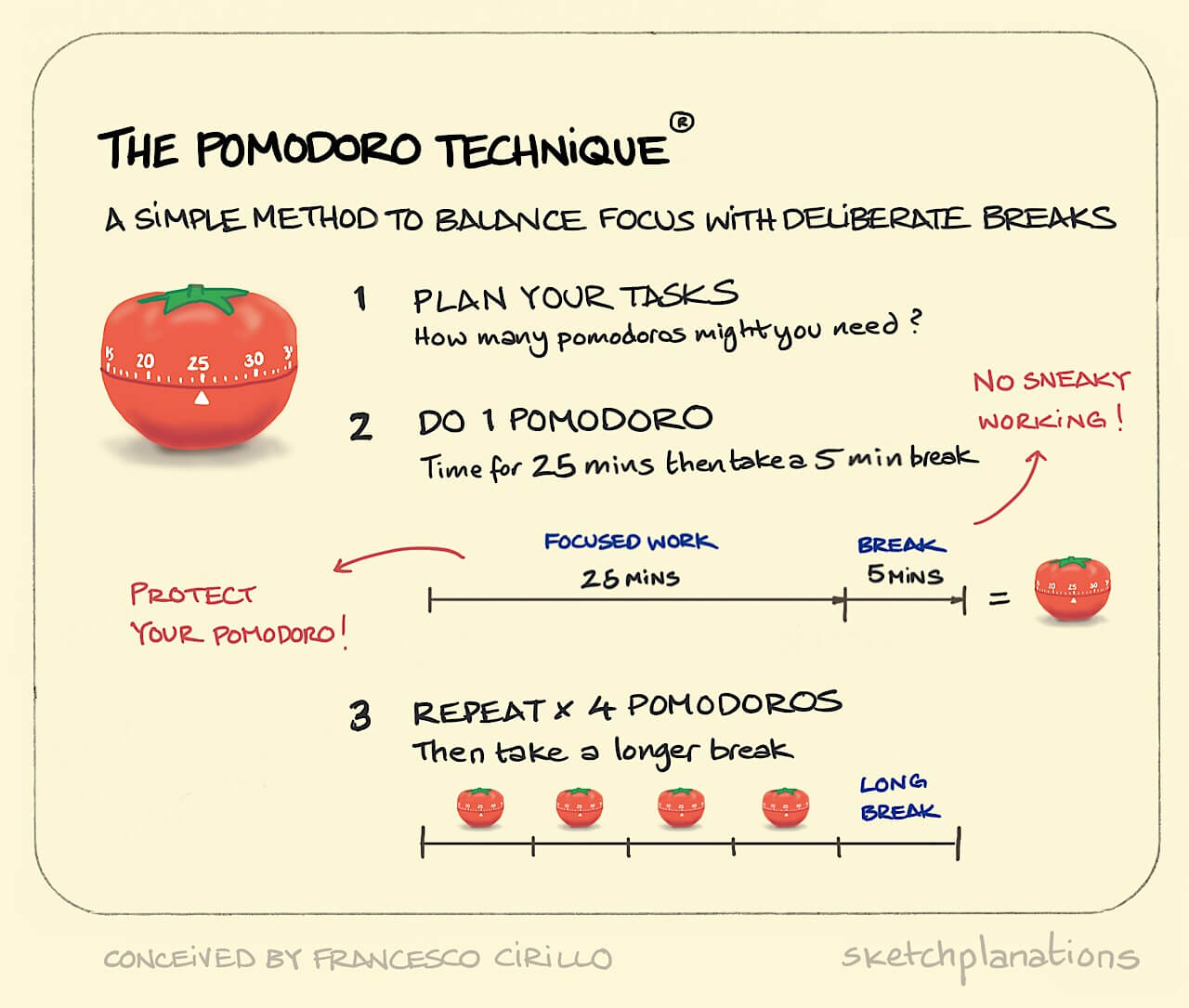
We set timers and alarms for cooking, waking up, and exercise, yet we rarely choose to set a timer for work. Why is that? For most of you reading this, it may have never crossed your mind, but using a timer to prioritize work has been around the working world for many years. The Pomodoro technique, named after the developer, entrepreneur, and author James Cirillo, was invented in the 1990s to maximize productivity by utilizing time-sequenced periods of focused work. Cirillo created the technique to cut large projects and time-consuming tasks into smaller 25-minute periods of tolerable work, with a tiny caveat: The shorter periods of time are designated to be used strictly for the task at hand and nothing else((Sketchplanations: The Pomodoro Technique)). This distinction may not seem earth-shattering based on the initial impression. Still, it's a significant factor for working from home productivity when you consider the evidence that the average working person is interrupted every 3 minutes and 5 seconds, decreasing to interruption intervals every 2 minutes and 11 seconds when using an electronic device such as a computer or phone((Gallup: Too Many Interruptions at Work?)). By merely using the Pomodoro technique, a remote worker can vastly improve their productivity by eliminating any outside factors that can take them away from their work. It should be noted that these distractions aren't merely just wasting time. They're also wasting precious brainpower((Vanderbilt University: Task Switching)) and energy resources. The brain uses up nearly 20% of the body's energy reserves to produce electrical messages between neurons and maintain the integrity of various neural structures((Scientific American: Why Does the Brain Need So Much Power?)). Excessive switching between tasks((Science Direct: Task-Switching)) depletes the brain's coveted resources, causing faster rates of burnout, fatigue, decreased self-control, and altered cognitive processing. Your time is valuable, so don't waste it on things that won't matter in the long run. Your company and employees depend on your leadership skills to be sharp at all times.
5. Set Your Schedule for Success
How often do you schedule your haircut? What about your oil changes? These questions may seem trivial, but they bring up a relevant point: Scheduling is a consistent way to make sure things get done. Working from home provides many luxuries that can't be found in the office, but it's easy to fall into the mindset that this added flexibility means less structure to your day. The opposite is true. If you're working remotely, setting a schedule for when and how you want to work could be one of the most important factors for facilitating your productivity throughout the day. Why? Because it's easy to fall into the trap of working for the entire day, checking your e-mail into the evening hours, and never genuinely checking out of your workday. Setting a schedule is an essential component for maximum productivity because it facilitates a set structure for remote workers to follow, which can be difficult now that they're working from home and taking a break whenever they feel like it. Setting a schedule for starting and stopping work is crucial to not only avoid burnout; it's also essential to allow time away from work to spend time with loved ones and enjoy your personal time. Creating a structure will also provide an example for your employees and team members to follow, which will inherently facilitate greater outcomes and working from home productivity. As Benjamin Franklin says, "Those who fail to plan, plan to fail."The Bottom Line
To truly make remote work a success, it will require strong individual and team leadership to make it happen. Everyone needs to be on the same page to facilitate systems and proper channels of communication. The moment leaders and individuals start to veer off track is when the spokes begin to fall off the wheel of work from home productivity and team success. Individuality is essential to turning this remote-working dream into a reality, so leaders must find ways to fail early, fail fast, and fail often to find the success that works for their team members and organization. Implementing these simple steps should be effortless and sustainable for the long term, but it won't just happen overnight. The adage of "it takes 21 days to form a new habit" is outdated, with new research pointing that it actually takes an average of 66 days to form a new habit((European Journal of Social Psychology: How are habits formed: Modelling habit formation in the real world)). The more consistently leaders work on creating these habits, the easier they will become.More Tips on Working From Home
- How to Work From Home: 10 Tips to Stay Productive
- 10 Work from Home Desks to Boost Your Productivity
- 7 Ways To Supercharge Your Productivity When You Work From Home
How to Work Hard the Smart Way: 4 Daily Rituals to Follow
Habits are what sets an average leader apart from a great leader. We can argue that talent is the biggest factor; we may debate how the amount of charisma sets the two apart. Yet, if you were to show me what you believed to be a great leader, I can show you the habits that made her/him great. Great leaders have great habits and know how to work hard the smart way.
 But how often have you heard people talk about an evening routine? Tomorrow is won the day before it happens. When you fail to plan your day, you may put your effort toward in the wrong things. Route replaces routine. Indecision replaces decisiveness. Losses replace wins. The discouragement will deflate your momentum and increases the chances of procrastination. That is why we set our schedule the night before.

Developing Great Habits Is Hard Work
In my early college days, I had spent a lot of time learning how to play the trumpet. Playing the trumpet took time and discipline. I had some natural talent, but not enough to hide my lack of ability. My trumpet teacher was a man of discipline, and there was no doubt he had talent. What stood to me was his work ethic. He had to be one of the hardest working mentors that I had the privilege of working with. One afternoon, I was in his office getting ready for my weekly trumpet lesson. As I was preparing, my eyes scanned the room and saw that there were quotes all over his office. My eyes rested on one quote that forever changed my thinking about my playing. It was a quote from my high school basketball coach Tim Notke that would become popular through professional athletes Kevin Durant and Tim Tebow:"Hard work beats talent when talent fails to work hard."Hard work trumps talent. The key to success is not found in your talent or ability. Talent and ability are necessary, but they are not the primary factors. They are supporting roles in the story you are writing. Ultimately, hard work is the key to your success. A good work ethic creates the momentum that propels you forward towards your goals.
Motivation Is Not the Answer
How many times have you seen someone go to a conference, get inspired, and then come home and do nothing? If motivation were the answer, the world would have transformed hundreds of times over. Yet, when we look out our doors or turn on the news, we do not see a utopian society. We have thousands of people who become inspired but lack the work ethic to apply anything they have learned. Time and time again frustration creeps in. We are so motivated and inspired by what we see but fail to put in place the things that would change our lives. Frustration happens when the gap between what you expect to be true and what is true gets bigger. Motivation tends to create an expectation that is not rooted in reality. We want to take on the world but cannot get off Netflix long enough to do so. Motivation is not the answer, but working hard is. Good habits and routines that produce success are the byproducts of a strong work ethic. The habits and routines we create and follow are the foundation on which we build a winning life.How to Work Hard by Working Smarter
Here are 4 routines that will help you learn how to work hard and achieve your short term and long term goals.1. Define What a Win Looks Like
In football, a player that crosses into the end zone gain points. In soccer, a player kicks the ball into the net to score. Hockey, lacrosse, and basketball are all the same. The player takes the object and moves it into the designated area to gain points. The team with the most points wins the game. Why is it that we can define what a win looks like in sports, but we fail to do so in our leadership, our businesses, or our homes? Learning how to work hard without setting a target is futile. It is insanity to work hard without having a clear direction to place your energy. I would argue that defining a win is one of the most important routines that a leader can have. Defining a win separates superficial activity from meaningful activity. When I define a win, I know the goal line I have to cross((The Balance Careers: Interview Question: "How Do You Define Success?")). Knowing where the goal line is informs me of the activity I have to engage in to cross it. Without a clear direction, I am spinning my wheels hoping that I will get to a destination I haven't defined. It is like asking a GPS for directions but failing to input the destination.4 Steps to Define a Win
- Know the outcome you desire.
- Declare the outcome in specific, meaningful terms.
- Write the outcome down.
- Set your activity list to only do that which will complete your goals.
2. Evaluate Your Activity
Not all activity is equal. There are things you must do, things you need to do, and things we can either give away or delete. The greatest challenge of a leader is understanding the difference. Understanding what activity is busywork and what activity is mission work is pivotal. Not only do we need to learn how to evaluate our activity, but we must make this a core routine in our arsenal of success. Stop working so hard on everything and start learning how to work hard on the right things. Not every activity will move the needle forward for you. In fact, you were never meant to do everything yourself! Once we stop trying to be a martyr in our leadership, we can start looking at how to take things off our plates through delegation. Based on the Eisenhower box, there are 4 things that we look at when deciding on which activities are important:- Do now
- Plan to do it later
- Delegate to someone else
- Delete it
- Does this activity move me towards or away from my goals?
- Do I have to do this activity or can I give this activity away to someone else?
- Does this activity have to be now right now or can it be scheduled for later dates?
- Does this activity have to be done at all?
3. Prioritize Your Calendar
If you were to show me your calendar, I could show you why you are not further along. When you lack the routine of placing things on your calendar, two things happen. First, what does not make it on your calendar does not get done. It is a simple truth that is often overlooked. Your calendar contains the power to change your life. Yet, we don't use our calendars to their fullest potential.“You will never change your life until you change something you do daily. The secret of your success is found in your daily routine.” -John C. MaxwellAlso, if you don't mark you activities on your calendar, you are leaving it open to other's priorities.
“The key is not to prioritize what's on your schedule, but to schedule your priorities.” -Stephen CoveyHaving a routine in your life where you place things on your calendar is pivotal to your success. This is not a routine one should overlook. It's time to take your leadership and business to the next level. It's time to start putting your daily routines on your calendar, along with your priorities.
4. Reflect on Your Day and Plan the Next
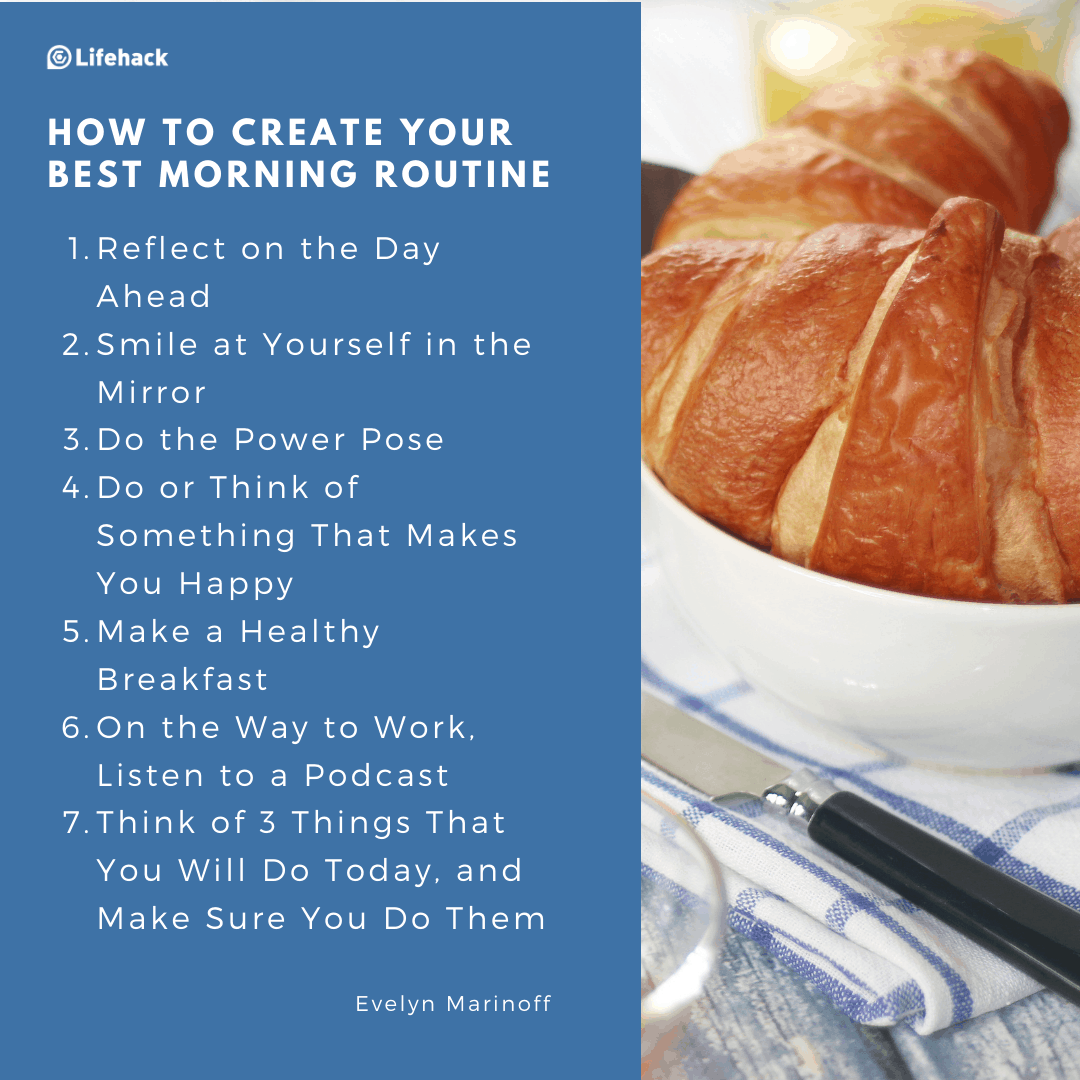
We are all about the morning routine. Whatever that looks like for you, there should be a routine in the morning that sets you up for success. Hard work starts when your feet hit the ground in the morning. Creating the habit of winning starts with the first thing you accomplish that morning. If you win your morning, you will win your day. But how often have you heard people talk about an evening routine? Tomorrow is won the day before it happens. When you fail to plan your day, you may put your effort toward in the wrong things. Route replaces routine. Indecision replaces decisiveness. Losses replace wins. The discouragement will deflate your momentum and increases the chances of procrastination. That is why we set our schedule the night before.
“Every battle is won or lost before it is ever fought.” -Sun TzuWorking hard doesn't have to be hard work. It shouldn't take much out of you learn how to work hard as long as you work smart. Having a time where you reflect on the day and set your priorities is the difference-maker. Use these questions to reflect on your day:
- What went well?
- What didn't go well?
- What can I change?
- What do I need to start doing?
- What do I need to stop doing?
The Bottom Line
Navigating through life is hard work. Yet, the work doesn't have to be hard when you work smarter. When you create routines that support your mission, you create wins. Working hard, the smart way will tip the balance in our favor. Boxing legend Joe Frazier said:"Champions aren't made in the ring; they are merely recognized there."Champions put in the hard work behind the scenes. The world recognized them as a champion when they saw the results of the hard work. Right now, you are doing the work of creating a champion in yourself. That work is setting your routines in order because you now know that success flows from your daily routines. If you are not experiencing the success you desire, then it is time to change things up.
More on Creating Healthy Routines
- Powerful Daily Routine Examples for a Healthy and High-Achieving You
- Your Routine is the Key to Achieving Your Goals
- Work Smarter, Not Harder: 12 Ways to Work Smart
6 Surefire Tips to Build Self-Confidence That Is Unstoppable
Aren't we all just supposed to "fake it till we make it"? Isn't that the key to success, how we should build self-confidence? Millions of books proclaim this diatribe each year. We're told to plaster on a smile, don the latest fashion, and give ourselves positive pep talks in the mirror each morning. If you're anything like me, you have read hundreds of self-help books and tried to catch the confidence bug. You might have even tried to tap into your inner Tony Robbins and cover your apartment with thousands of positive post-it notes. But, after about a week of positivity, you don't feel more confident. In many ways, you feel more confused. Building self-confidence isn't a formulaic process––it's an individual process. It has to feel right and comfortable. It should fit like sweatpants, not skinny jeans. This means that, if we want to improve ourselves, we have to know and accept ourselves. If you're tired of decorating your home with inspirational quotes or adding one more self-help book to your collection, this article is for you. I'll give you the six practical tips that you need to build self-confidence and self-acceptance. Let's get you started on this journey.

1. Accept Who You Are
You will never receive enough applause or accolades that will make up for your insecurity. If you want to build self-confidence, then you need to own who you are and learn to stand up tall in your shoes before adding more accessories to your personality. After all, confidence is not about being the most decorated; it's about being comfortable in your skin. If you want to build self-confidence, then you need to take the time to celebrate your distinct personality. Take a moment to learn about your strengths and your weaknesses, and be at peace with where you are––even if it's not where you want to be. Self-confidence starts with accepting yourself––your strengths, weaknesses, and even your quirks. In many ways, it requires you to embrace your entire being. In essence, it's giving the world your whole self and asking for nothing in return.2. Accept That You Will Be Terrified (and That's OK)
We all remember spelling bees when we were kids. We would listen intently and pray that we wouldn't forget all the letters. As we uttered our guesses, our knees knocked, our peers stared, and sweat beat down upon our brow. This moment was torture––for everyone. It was terrifying having to stand in front of our entire classroom and scramble letters in rows. Self-confidence isn't a cure to fear. It's not a unique combination of pixie dust that makes us invisible to conflict or struggle. In many ways, fear is the only way to experience self-confidence. Isn't that great news? Okay, it's not the most fantastic news, but it is comforting. Think about it. If you want to get that promotion, you have to face your fear. If you audition for the lead on Broadway, you have to belt out Aida, even if you voice cracks. All of these moments are glorious because of fear. If there was nothing to face––no barrier to climb––then you would never experience the joy of success. Self-confidence occurs when we embrace the fear and allow it to compel us forward.3. Make Peace With Your Past
Take a moment to stand still and look back. Where you are now is not where you were––and that is a powerful thing. There's something powerful about perusing through old photographs. We might cringe over our fashion choices and laugh at our crazy hairdos. However, we also experience the nostalgia of going back in time. For better or for worse, we can't escape our journey when trying to reach our goal. If you want to build self-confidence, you need to be willing to accept your past, even the parts that you want to forget. You might want to burn the negatives and forge ahead, but to move forward, you have to find peace with your past and your present. Self-confidence is not pretending or performing––it's making peace with who you were, who you are, and who you will become. In many ways, it's accepting your experiences, taking responsibility for your mistakes, and figuring out how to move forward with healthy habits.4. Be Happy for Others
One of the most significant ways to build your self-confidence is to celebrate someone else and take the pressure off yourself. Bask in the excitement of a friend or a colleague. We all want to be happy for those around us, but it's easy to be jealous. Sometimes popping another bottle of champagne for a friend seems like a monotonous chore. If you struggle to celebrate others, you're not alone. You're not selfish; you're self-conscious, and there's a big difference. It's impossible to applaud your friends or your colleagues when you can't even accept the person staring back at you each morning. Many of us were raised in households to believe that accepting our strengths means being prideful. We learned to shy away from the spotlight and refuse credit for a job well done. There's nothing wrong with being reserved, but if your preference for privacy projects upon those around you. You're not humble; you're raining on someone else's parade. Allow people around you to shine, and be their biggest fan. When you lift others, you celebrate their strengths without judging their weaknesses. When we take the time to be happy for those around us, it helps us celebrate our own victories build self-confidence.5. Be Willing to Put in the Work
If you're hoping to absorb and build self-confidence through the pages of another bestseller, I have one word of advice for you: put the book down and grab those weights, run on the treadmill, or lean into that stretch. Here's the deal: Self-confidence isn't easy; it takes work. It doesn't come in a Flintstone vitamin; it comes through sweat. Building self-confidence requires everyone to workout, but not everyone will be working out the same way or at the same pace. Remember, building self-confidence is not about beating the competition. It's about accepting who you are, improving yourself, and learning to trust in your knowledge and capabilities.6. Don't Let Your Childhood Scars Write Your Story
All of us have childhood scars, but we don't have to carry them with us as adults. Even if you had a perfect childhood, your self-confidence was influenced by your personal experience. No one can claim your story, but all of us can empathize with some form of childhood struggle. Our childhood experiences have influenced our psyche, our self-perception, and our ability to build self-confidence((Psychology Today: 8 Reasons It's So Hard to Overcome a Tough Childhood)). However, if we're willing to see ourselves holistically, we'll be able to live our lives authentically. It's important to understand your journey as much as your goal. Take a moment and write down everything that comes to mind when you receive compliments. Do you dismiss them? Do you base your entire self-worth on them? Write down your reactions and then process the reasoning behind your response. You can do this exercise with a therapist, a trusted friend, or even on your own. If you're willing to go back in your past and address your scars, you'll be able to have a greater understanding of yourself and not be rocked by compliments or criticisms. When you're grounded in who you are, you'll be able to experience life without fear and, ultimately, write your own story with self-confidence.Final Thoughts
If you want to build self-confidence, remember that it's a process. Don't hurry to the finish line to get to the end of the race. If you take the time to accept yourself, fail forward, embrace the journey, and give yourself grace along the way, you'll have everything you need to be more self-confident. Take today and figure out who you are and who you want to be, and don't lose your identity in the process. If you utilize these tools, you won't have to fake it till you make it––you can make it without losing yourself along the way.More Tips on Being Self-Confident
- How to Be Confident: 51 Proven Ways to Build Self-Confidence
- How to Build Self Esteem (A Guide to Realize Your Hidden Power)
- 11 Easy Ways To Boost Your Confidence
Tuesday, 1 December 2020
How to Be Determined and Achieve Your Goals
You have set yourself a new goal. You’re excited, inspired, and motivated to achieve your next level of success. Things are going great, and you’re making progress. Then, it happens—out of nowhere, you find yourself stuck, stalled, or stopped. You can’t believe that just a short time ago you were on fire and crushing it, and now you’re not getting any closer to achieving what you want. You’ve hit “the wall.” How can you stay determined when you hit the motivation wall? It’s common to feel great about starting a new project or goal. In the beginning, we feel like we have the energy and passion to get something or accomplish something that we want. Willpower is what most people rely on to get started. However, willpower is not enough. It has a short life, and it alone cannot sustain the effort needed to reach the finish line when obstacles get in the way. You need a better strategy. Here are 3 keys to staying motivated and determined no matter what, so you can use your time right: set S.M.A.R.T. goals, set tour “Why”, and set your schedule.

Key #1: Setting S.M.A.R.T. Goals
Your “GPS S.M.A.R.T. Goals” are specific goals meant to move you in the direction of your overall success. To be successful, you have to first make sure your goal is set up correctly. Take the time to craft written goals and put them down on paper. This is the first step to make sure you have the highest chance of success. It’s like setting the right address into your GPS. S.M.A.R.T. goals must be Specific, Measurable, Attainable, Relevant, and Time-centered.Specific
Create your goal with as much detail as possible. It should be written with precision, clarity, and specifics by focusing on the five W’s:- Who?
- What?
- Where?
- When?
- Why?
Measurable
Establish specific criteria for measuring your goal so you can track your progress and stay motivated.- How will I measure progress?
- How will I know when my goal is achieved?
- How much?
- How many?
Attainable
Make sure that your goal is achievable and realistic. It should stretch you and push you to your limits but still be obtainable.- What appropriate and inspired actions do I need to take to meet my goal?
- How can I achieve this goal?
Relevant
Choose a goal that you are willing and can put the appropriate time and effort into. Also, that goal should be something that actually matters to you and/or the collective.- Does it connect to my overall short-term and long-term plans?
- Is this goal going to make a positive difference for me and/or others?
- Is this aligned with my "why" or purpose and my values?
Time-Centered
Have scheduled and trackable tasks and timelines. This inspires action and holds you accountable while also helping you stay determined. Also, you should set a specific time frame for accomplishing your goal.- When will this goal be completed?
- Am I committed to investing the time needed?
Key # 2: Your "Why"
The bigger the “why” the easier the “how.” —Jim RohnClients come to me when they're stuck, stopped, or struggling to have the life they want and when they want to accelerate their progress or have more consistent results than they’re getting, whether it’s in their business or their personal lives. One of the very first things I ask any and every client is this: “What are you committed to having?” That can be anything from their life purpose, a specific business goal, or a life goal. Most people have a clear understanding of the goal, such as “building my business,” “having a better relationship with my spouse,” or “being healthy and fit.” The big question comes next. I ask them the simple question, “Why do you want that?” The typical response is a generalized surface answer with no deep emotional connection to their core motivation and purpose. It has been pre-programmed for so long that it doesn’t have a current and relevant emotional connection. This gap between their obvious answer and their core motivation is the primary reason why so many people get stuck, stopped, struggle, or lack consistency and motivation. Simon Sinek, one of the leading thinkers on this topic, tells us in his book, Start with Why: How Great Leaders Inspire Everyone to Take Action, that “everyone knows what they do 100 percent of the time. Some know how they do it. Very few people in organizations, in the world, and their own personal life know why they do what they do.” His definition of “why” is “the purpose or cause—the single driving motivation for action.” Knowing your own "why" is the key to connecting with the deep motivational centers of your brain that inspire action. Your “why” gets you to connect with your purpose. Your “why” then becomes your purpose identified, and this helps you stay determined.
Why Is Your “Why” So Important?
Your "why" gives meaning to everything you do. You can appear to be successful on the outside, but if you are not internally aligned with your why, you will never truly feel satisfied in life. Your "why" directs and guides you. Not only can your "why" give you meaning, but it can also give you a clear direction about where to go in life. It can help you make both big and small decisions and take the next step. Your "why"motivates you. In life, there will be difficult times to go through. You may experience setbacks, rejection, and failure. In such situations, your "why" can give you the motivation you need to keep going. It also becomes your GPS guide in everything you do with your time and schedule.Identify Your Why
I have a specific process you can use to uncover your purpose. It involves answering the questions below. You must ask yourself the key question 4 to 5 times. As an example, I’ve provided my own answers as a way for you to understand what the process is like. “What am I committed to having?” My answer: “To be the best researcher, speaker, and coach.”- Why is this important to me? My answer: “So I can feel good about helping people improve their lives.”
- Why is that important? My answer: “So they feel someone is in their corner supporting them.”
- Why is that important? My answer: “So they believe that they can have the life they want.”
- Why is that important? My answer: “To help people discover and live their true purpose.”
Your "Why" Makes Your Time Relevant
Connecting with your why ensures that you are using your gifts and talents in a way that connects you with your true purpose, making a positive difference for you and your community. This is key to learning how to be determined because it directs and maximizes your time in a purposeful and meaningful way that gives relevance to everything you do.Key #3: Schedule Everything
Now that you have established your SMART goals and determined your "why," it’s time to schedule what you need to do to accomplish them. You can do this successfully by making sure you put your tasks on your calendar. Your calendar is where you are committing your most valuable asset—time—to your most important priorities. If your tasks are not on your calendar with the appropriate time scheduled for them, there is a good chance in our 24/7 hyper distracted world they won’t happen. Your daily schedule should be written as a visual reminder of what you have chosen to do on any given day, which guides the intentions you set for each day. It represents what’s important in your life and business. There is an old productivity saying that I live by: “If it’s not on the calendar, it didn’t happen.” Live with this mindset and calendar everything important, and scheduling will be the key to unlocking your motivation and potential and staying determined.Final Thoughts
Knowing how to stay determined despite the hardships you'll face is not an easy task. So, the next time you’re lacking motivation, set yourself up for success by using these 3 steps: set S.M.A.R.T. goals, connect to your “why”, and schedule everything. Doing this will ensure that you start strong, build momentum, and stay determined in reaching your most important goals.More Tips on How to Be Determined
- If You Want A Successful Life, Be Determined About What You Want First
- How to Persevere (And Get Ahead!) When the Going Gets Tough
- 6 Effective Ways to Become Persistent
Top 10 Motivation Tips Learned From Highly Successful People
To achieve your dreams, you need discipline, tenacity, courage, and a strong vision. You have to put in years of hard work. But aside from these, you also have to be highly motivated. Without motivation, you’ll suffer from procrastination or burnout. You’ll lose interest in that dream that you swore you’d turn into a reality. All of us need that strong motivation that continues to drive us forward—even when we feel like giving up. These 10 motivation tips from highly successful people will help keep you moving forward so you can achieve your dreams.

1. Dream Big
"If your dreams don’t scare you, they’re not big enough." —Ellen Johnson SirleafMy very first motivation tip for everyone is to dream big. To really stay motivated, you have to set your sights high. Some of the most successful people in the world did things that many people thought were impossible. Most people thought the Wright brothers were crazy when they said they were going to figure out a way for people to fly. Many people believed that automobiles would never become a good form of transportation. Dream big. If you play small, you’ll get small returns. Motivational speaker Les Brown said,
“It’s better to aim high and miss than aim low and hit.”Creating small dreams and goals will stop you from doing great things. It will make you think you’re actually doing something significant when you’re not. So, always aim high.
2. Stay Curious
"Look up at the stars and not down at your feet. Try to make sense of what you see, and wonder about what makes the universe exist. Be curious." —Stephen HawkingStephen Hawking, one of the most brilliant cosmologists of our time, was able to unravel the mysteries of the universe because he was curious. His deep curiosity of theoretical physics, black holes, and singularities led to many theories and broadened our understanding of space, time, and the universe. Always be curious when you’re working toward your goals. Do your research. Be curious about new apps and technologies that will make your job easier. And be curious about your own beliefs, assumptions, and ideas. Always question the way you’re doing things. Is there a better way? Are you doing things for the right reasons? Even when you think you’re on the right track, ask other people to play devil’s advocate with you so they can use their curiosity to make sure you’re headed in the right direction.
3. Surround Yourself With Great People
"You are the average of the five people you spend the most time with." —Jim RohnThe people we surround ourselves with have a big impact on our lives and our personal development. This might be one of the most overlooked motivation tips because people often only look at themselves but not their environment. Have you ever been around a negative person and walked away feeling negative and cynical? Have you been around someone positive and felt happier the rest of the day? Avoid negative people. Surround yourself with like-minded, positive people who will inspire you to reach higher and become a better version of yourself. Find people who take action instead of constantly making excuses. Build a tribe of people who are focused on success.
4. Use Failure to Motivate You to Succeed
"Failure is another steppingstone to greatness." —Oprah WinfreyFailure can hold you back or help you succeed. I used to avoid taking action because I was afraid of failure. I wouldn’t talk to that woman because I was afraid of rejection. I wouldn’t apply for that high-paying job because I was afraid of not getting hired. I finally realized that failure was the motivation I needed to achieve my biggest goals and dreams. After talking to a lot of women and not getting the first date, I finally learned from my mistakes and became better at getting a phone number. After making a lot of interview mistakes, I began rehearsing my answers to common questions, going through mock interviews with a friend, and correcting my mistakes. I later began landing those high-paying jobs. Take your ego out of the equation. Don’t look at failure as evidence that you’re not good enough. Instead, look at each failure as an opportunity to chisel your rough edges and get you a little closer to your goal.
5. Be Different
"Two roads diverged in a wood, and I—I took the one less traveled by. And that has made all the difference.” —Robert FrostFrom 1997 to 2002, Apple used the slogan “Think different.” This not only helped their branding but also set them apart from their competitors. While other companies were focusing on making money, reducing costs, and copying their competitors’ designs, Apple focused on doing things differently. They achieved this by creating great products that provided an outstanding user experience. Products that were innovative, simple in design, and very easy to use. This need to do things differently led to their meteoric success in the technology market and stock market. This might not be a motivation tip you've heard of before, but don’t be afraid to be different. All of us are unique. We were born with different strengths, weaknesses, gifts, and talents. It’s the things that make you different that make you unique. Use those unique gifts and strengths to motivate you to achieve your dreams.
6. Read About Super-Successful People
A great way to learn how to get motivated is to read books either by or about super-successful people. You can read their biographies, autobiographies, or other books they’ve written that outline the steps they took to stay motivated, even when things got tough. I really love autobiographies and biographies because they drill down into the minds and lives of high performers. They show the power of human determination when people are faced with terrible adversities. They teach us how to beat incredible odds to become successful. There are many autobiographies available out there that will inspire you.7. Take Action Now
Have you ever wanted to do something but analyzed it so much that you never did it? You probably suffered from analysis paralysis, which is thinking that you need more information than what’s required to start something. The most successful people are motivated by taking immediate action. Jeff Bezos didn’t wait to get tens of millions of dollars in venture capital funding before starting Amazon. Bill Gates didn’t hire 80 people and develop the first iteration of the Microsoft Office suite before launching Microsoft. Media mogul Gary Vaynerchuck said,“Some of the greatest entrepreneurs in the world didn’t necessarily start out with a grand vision. They started with an idea and an action.”If you have an idea, start taking action to make it a reality. You’ll never have all the solutions to all the problems you’re going to face. Start implementing the idea and learn as you go. Don’t ever try to get all or even most of the answers upfront. Start executing. The more action you take, the more problems you’ll face. The more problems you face, the more solutions you’ll find. As you tackle obstacle after obstacle, you’ll soon realize you’re well on your way to success.
8. Take Responsibility for Your Life
"You must take personal responsibility. You cannot change the circumstance, the seasons, or the wind, but you can change yourself. That is something you have charge of." —Jim RohnIt’s difficult to stay motivated if you believe that you have no control over what happens in your life. There are a lot of things we can’t control, but there are also many things we can control, such as our thoughts, beliefs, behaviors, and to a large extent, our destiny. People who believe they generally have control of their lives have an internal locus of control. On the other hand, People who believe that outside forces have control of their lives have an external locus of control. These are people who believe that the government, a system, politicians, bad luck, and other things have control of their lives. The problem with believing that external forces control your life is that you don’t think you can take charge of your life. You don’t believe you can make the changes necessary to live a great life. This is a huge mistake. Focus on the biggest thing you can control and change: yourself. Once you believe you have control of your life, you can make the positive changes that will pull you closer to your biggest dreams.
9. Help Other People
"Success isn't about how much money you make; it's about the difference you make in people's lives." —Michelle ObamaThere’s a reason that Bill Gates, Mark Zuckerberg, Matt Damon, George Clooney, Oprah Winfrey, and many other extremely successful people love helping their fellow human beings. It feels great, and it makes the world a better place. One of the best motivation tips of all is to help other people. When I got out of prison after serving a 2-year sentence for a felony drug crime, my only goal was to get a good job, make money, and stay out of trouble. I got a very good education and have had a great career in technology for almost two decades. I made a lot of money but noticed that it didn’t make me a lot happier. Have you ever bought something new and were happy for a short amount of time and then the happiness quickly faded away? That’s how I felt when I bought cars, clothes, electronic devices, and even my first house. Then one day, everything changed. I started going back into prisons to teach incarcerated men the business, personal development, and job readiness skills they needed to start their own businesses or get good jobs when they were released. Helping these guys gave me an extremely high level of happiness that I never experienced before. It motivated me to keep helping people and live a more purposeful life. I wasn’t the only one who felt this way. At these prison volunteer events, I met executives from the world’s biggest tech companies. After talking to many of these super-successful tech volunteers, I learned that one of the things that motivated them the most was helping other people. Many of them had more money than they could spend in 30 lifetimes, but that’s not what gave them the most happiness and purpose. It was helping other people.
10. Do What You Love
“Your work is going to fill a large part of your life, and the only way to be truly satisfied is to do what you believe is great work. And the only way to do great work is to love what you do.” —Steve JobsThis is probably the most important motivation tip that will help you become successful. There will be times when you’ll be working long hours, working with people you don’t like, or doing things you don’t like. If you don’t love what you do, you’ll have a very hard time dealing with the negative, tedious aspects of the job. Most of us spend the majority of our waking hours working. It makes sense to do something you’re passionate about. When you do something you love, you’ll be more creative and bring your best work to the world.
Final Thoughts
All of us have dreams, but not everyone achieves them. As you work toward your dreams, you’ll inevitably run into obstacles. The bigger your dreams, the bigger the challenges you’ll face. There will be times when you’ll be tired, but you will have to keep going. There will be months when tons of things will go wrong. You’ll encounter stress, self-doubt, negativity, and opposition from other people. No matter how hard things get, you have to keep going. Using these motivation tips will inspire you to keep moving forward so you can achieve those big dreams.More Motivation Tips
- 8 Tips to Create a Day to Recharge Your Motivation
- How to Motivate Yourself: 13 Simple Ways to Try Now
- Tips for Increasing Employee Motivation
How Not To Lose Focus While Working (Backed By Science)
Do you sometimes start working on something important but can't seem to stay concentrated? Whether it is a test that you’re studying for, a big important assignment at work, trying to code your app, or doing research that is important for you—you easily lose focus. You’re always eager to enter Instagram or Facebook, go to the refrigerator, or wander thinking about almost every other thing that you shouldn’t be thinking about. The good news is that you’re not alone. Lack of focus is a common issue among a lot of people, which can affect their capability to get the important stuff done. It can also make people stressed and lose motivation. There are many types of research on that topic. Perhaps one of the most influential writers about deep work is Cal Newport, the author of Deep Work, which explains the importance of profoundly concentrating and how to do so. I'm going to cover his methods and also others written by experts in the field. One of them is the author of Indistractable: How to Control Your Attention and Choose Your Life, Nir Eyal, and also, the author of Can I Have Your Attention?: Inspiring Better Work Habits, Focusing Your Team, and Getting Stuff Done in the Constantly Connected Workplace, Curt Steinhorst. I'm going to cover other researches and researchers and—most importantly—provide you with hands-on tips on how to regain concentration when you always lose focus.

The Main Theories
According to Newport, deep work is “deep efforts that create new value, improve your skill, and are hard to replicate.” In other words, this is the thing that is going to differentiate you from others that do not have the capabilities to create an unreplicable work—what he describes as “the superpower of the 21st century.” Nir Eyal’s superb book summarizes the leading theories and most updated research on the things that keep us distracted. He created an equation that compares time management to pain management. He claims that every time that our thoughts wander, it is because there is something we’re running away from. It can be fear of failure—we don’t want to start doing something we’re unsure we can achieve, and that makes us watch yet another episode of Friends on Netflix. Watching Friends is more comfortable and in some cases, more fun. It can also be boredom that we’re running away from. Many other reasons can make us want to escape the pain of distractions. In his theory of Flow, the Hungarian-American psychologist Mihály Csíkszentmihályi defined it as being “fully immersed in a feeling of energized focus, full involvement, and enjoyment in the process of the activity.”((Digital Chalk: The Flow Model in Learning)) Sometimes when our capabilities don’t match what we’re trying to achieve, it stresses us out and makes us less focused. There are many theories, and the gist analyzes both internal and external reasons for being unfocused. That means blocking external distractions—such as social media sites and notifications—side by side by dealing with internal distractions. These things make us unfocused even when there are no outside distractions that keep us from doing what we want. There are many frameworks to solve that. One relevant framework was suggested by Curt Steinhorst. Steinhorst offers four vital elements for focused teams: Clarity, Capacity, Want, and Community. First, you need to understand what you need to do, know that you can do so, make sure that it is aligned with your needs and wants, and have a supportive community. For example, if your boss expects you to answer emails every two minutes, there’s no way you would be able to get deep work done. You’re expected to answer emails every two minutes.6 Tips for Focus Improvement
The good news is that there are so many things that you can do if you always lose focus. You don’t have to do all of them, as that would be overwhelming. Even choosing the ones you like the most can significantly impact your habits and focus level.1. Physical Activities
These types of activities have been scientifically proven to help people become more focused. According to an article published in Harvard's Health Blog,((Harvard Health Publishing: Regular exercise changes the brain to improve memory, thinking skills))"Exercise helps memory and thinking through both direct and indirect means. The benefits of exercise come directly from its ability to reduce insulin resistance, reduce inflammation, and stimulate the release of growth factors—chemicals in the brain that affect the health of brain cells, the growth of new blood vessels in the brain, and even the abundance and survival of new brain cells."You don’t have to become a marathon runner. Personally speaking—and this is common among other peers—I go for a run whenever I’m tired and not concentrated enough. It helps give a boost to my concentration level. Other proven methods for focus enhancement include meditation, drinking small doses of coffee, eating healthy, keeping yourself hydrated, and sleeping over 7 hours a night.
2. Digital Distractions
Although distractions have been here for thousands of years, digital distractions are a relatively new way that impacts our brains and thoughts and makes us lose focus. In their paper, Effects of Individual Differences in Blocking Workplace Distractions, Microsoft’s researchers concluded that “for most, cutting off workplace distractions increases focus and productivity.”((Microsoft: Effects of Individual Differences in Blocking Workplace Distractions)) There are tons of apps that help you deal with external distractions. Some of the leading ones are Stay Focused, Rescue Time, Cold Turkey, and many others. Notification blockers can also help you stay undistracted. Emails are also a big distraction for most of us, but we’ll address that in the section that addresses work habits.3. Internal Distractions
Even blocking any possible external distractions won’t make you invincible to distractions. Distracting thoughts have been here from the times of ancient Greece. Mindfulness is a top way to stay focused and on top of your thoughts. According to an article in Harvard Business Review,((Harvard Business Review: How to Practice Mindfulness Throughout Your Work Day))“Mindfulness is not about living life in slow motion. It’s about enhancing focus and awareness both in work and in life. It’s about stripping away distractions and staying on track with individual as well as organizational goals.”Other proven methods to tackle internal distractions are music and being in the wilds. In fact, according to a Stanford study, music can help your brain absorb new information more easily.((Science Direct: Neural Dynamics of Event Segmentation in Music: Converging Evidence for Dissociable Ventral and Dorsal Networks)) You can use sites such as Brain.fm and Noisly to do that.
4. Work Habits
There are some misconceptions about work habits that also harm someone’s ability to focus. One of them is believing that multitasking is feasible. Although some researchers claim that some kinds of multitasking are possible, most believe that it is inefficient and will make you lose focus instead. According to the American Psychology Association,((American Psychological Association: Multitasking: Switching costs))“Doing more than one task at a time, especially more than one complex task, takes a toll on productivity.”Possible solutions to tackle lousy work habits can help. Some of the methods are:
- Time Blocking - Block a time in your calendar to work on a specific task.
- The two-minute rule - If you can answer an email within two minutes, do it, and don’t leave it for later.
- Pomodoro techniques - Work for 25 minutes, then rest for 5. This way, you can know that you’re focused for a certain amount of time.
5. Physical Workspace
You should know yourself, but for most, a clean workstation can help you stay focused. Princeton scientists determined that our brains like order, and when our brain gets visual reminders of disorganization, it drains our cognitive resources. So, clean your desk! Temperature is also a factor when it comes to being focused. According to a Cornell University study,((Cornell Chronicle: Study links warm offices to fewer typing errors and higher productivity))“Chilly workers not only make more errors but cooler temperatures could increase a worker's hourly labor cost by 10 percent. When the office temperature in a month-long study increased from 68 to 77 degrees Fahrenheit, typing errors fell by 44 percent, and typing output jumped 150 percent.”
6. Behavioral Analytic Tools
You can trick yourself into doing what you don’t like using behavioral economic tools that influence your behavior. One example might be an online tool such as Focusmate, which uses social pressure and accountability to stick with your tasks. You can schedule a time to work on a specific task with someone you don’t know, and both of you keep an eye on each other that you are indeed working. Another interesting tool is Stickk. They’re using what’s called loss aversion—the tendency to prefer avoiding losses, to help you maintain your important goals in mind. “By asking our users to sign Commitment Contracts, stickK helps users define their goal (whatever it may be), acknowledge what it’ll take to accomplish it, and leverage the power of putting money on the line to turn that goal into a reality,” they mention in their site. They literally make you pay if you don’t meet your goals. This discourages from losing focus.Summary
There are many ways to improve your focus. All of them are helpful, but it is hard to start with everything all at once. One way to start improving your focus is by choosing your favorite tips that are easier for you and start implementing them. Be compassionate to yourself even if you fail in doing everything and start to lose focus. Self-compassion is a way to stay resilient, and that is also helpful.More Tips on How Not to Lose Focus
- 7 Tips To Improve Your Attention Span And Focus Instantly
- Easily Distracted? Here’s How to Regain Your Focus
- How to Not Get Distracted: 10 Practical Tips to Sharpen Your Focus
Subscribe to:
Posts (Atom)