Friday, 16 June 2023

How to Prioritize Goals When You Have a Lot to Achieve

Do you ever feel like you’re juggling too many goals, with the ambition to catch them all but end up dropping them instead? Many of us, whether we’re managers, employees, or entrepreneurs, face this mountain of aspirations that we wish to conquer. But it’s time we accept a hard truth: our time and energy, they’re not infinite. We can’t catch all those juggling goals at once.

Picture this: A diligent manager has a plan. She wants to increase sales, improve customer service, roll out a new product, and upgrade the company’s software—all in the same quarter. On paper, it seems doable. But without prioritizing these goals, she finds herself spread too thin, stuck in a whirlwind of tasks that lead to little or no progress on any of these fronts.

Now, let’s consider an eager employee. He’s decided to impress his boss, finish a challenging project, improve his technical skills, and spearhead a new initiative—all while maintaining his excellent performance at his day-to-day tasks. His fervor is commendable. Yet, without clear prioritization, his long days turn into a muddle of uncompleted tasks, missed deadlines, and burnout.

We can all relate to the manager and the employee. There’s always a galaxy of things we want to achieve, but our rocket has only so much fuel. The reality is, without setting priorities, our many ambitions might remain just that—ambitions.

So, what’s the way out of this labyrinth of unrealized goals? It’s the art of prioritizing. Prioritizing our goals doesn’t mean giving up on some of them. Instead, it’s about giving each goal its own time in the spotlight.

In this article, I’m going to share with you a well-crafted strategy to help you prioritize your goals effectively.

No more juggling, no more scattered efforts. It’s time to turn the chaos of ambition into a reality, one prioritized goal at a time.

How to Prioritize Goals (Step-by-Step Guide)

There’s a simple yet effective way to clear the clutter off the table of your aspirations – the 5/25 Method.

With this method, you can simplify and streamline your path to success. No, you won’t be deserting any of your dreams. Instead, you’ll be focusing on them, one at a time, like a sharpshooter zooming in on a target.

The name Warren Buffett may resonate with this method, but the business tycoon himself didn’t claim to have invented it.[1] Regardless of its origin, this method offers an accessible tool to help you in sifting through your goals. Here’s the lowdown:

1. List Down Your Top 25 Goals

Start by casting a wide net. Consider all aspects of your life, including personal, professional, and financial spheres. It could be anything from “Get into the habit of exercising” to “Improve productivity at work”.

The key here is not to limit or judge yourself. You’re simply brainstorming, so allow all the ambitions to flow onto paper.

If you’re struggling, refer to the helpful resources for some inspiration:

2. Select Your Top 5

Once you’ve got your list, your next task is to identify the 5 goals that resonate most with you. These are the goals that make you feel excited and passionate, the ones that, if achieved, could significantly transform your life for the better.

This might be challenging, as you might feel attached to more than 5 goals. However, remember that choosing five doesn’t mean discarding the others, but rather deferring them.

3. Prioritize Your Top 5

Now, with your top 5 goals in hand, arrange them in order of importance. This doesn’t mean the rest are not important; rather, it’s about understanding where you want to channel your energy first.

What’s the one goal that, if you could achieve it tomorrow, would make the most significant positive impact? That’s your number one.

Then, identify the second most impactful, and so on.

4. Avoid the Other 20

This step may sound counterintuitive. After all, these are goals that you’ve listed as important to you. But this is about focus.

With your top five goals identified, the remaining 20 should be placed on the back burner. These are not discarded or forgotten, just not your current focus.

Doing this allows you to commit your time and resources to the most meaningful goals without diluting your efforts.

5. Regularly Review and Revise

Life is not static. Your circumstances, values, and interests may change. Therefore, revisiting your goals periodically (say, once a month) is crucial to ensuring they still align with your personal or professional growth.

If a goal no longer serves you or a more pressing one emerges, adjust your top 5 accordingly. This is not about being inconsistent; it’s about being responsive to your evolving life.

The 5/25 Method, when executed properly, can be a powerful tool for taming your aspirations and directing your energy effectively.

It’s not about achieving everything all at once, but about making consistent progress toward what matters most to you.

Bonus Tips

In addition, I have a few tips for you on how to best apply the 5/25 Method:

  • Assign a fixed time for finalizing and ranking your priorities. We often delay important tasks under the guise of needing more time to think. Don’t fall into this trap. Simply schedule an hour to think about your goals and priorities.
  • Stick to your priorities. Once you’ve identified your top 5 goals, commit to them. Doubts might creep in, but resist the urge to constantly reevaluate. That’s where your periodic reviews come into play. During these reviews, you can adjust your goals as needed.

For more tips on achieving your goals, don’t miss out on this comprehensive guide: The Ultimate Guide to Goal Achieving

Final Thoughts

Amidst the towering mountains of ambitions, lies the path that will lead you to your desired destination. The 5/25 Method is your compass—it helps you discern the path that’s right for you.

Embracing this approach doesn’t mean surrendering your many dreams. Instead, it’s about focusing on the dreams that matter the most, right now.

And when these dreams are realized, they’ll create a domino effect that sets the stage for the next ones to come to life.

Let’s put the overwhelm and chaos of multiple goals behind us, and welcome the clarity and calm of prioritized goals, making our ambitions achievable, not just wishful thinking.

TL;DR

Don't have time for the full article? Read this.

❯

Having multiple goals can often lead to scattered efforts and minimal progress due to limited time and energy.

❯

To manage multiple goals effectively, they must be prioritized. This allows us to channel our efforts into the most impactful objectives first.

❯

The 5/25 Method is a powerful tool for prioritizing goals. It involves listing 25 goals, selecting the top 5, focusing solely on them, avoiding the other 20, and regularly reviewing and revising.

❯

Listing 25 goals encourages comprehensive brainstorming across all aspects of life.

❯

Selecting the top 5 goals helps to concentrate efforts and resources, ensuring these vital goals are not lost amid less impactful ones.

❯

Avoiding the other 20 goals helps in eliminating distractions and maintaining focus on the top 5.

❯

Regular reviews and revisions ensure that the prioritized goals remain aligned with current circumstances and values.

❯

Prioritizing goals is not about achieving everything at once, but about making consistent progress towards the most significant goals.

❯

Achieving prioritized goals can have a domino effect, paving the way for the achievement of subsequent goals.

Featured photo credit: Jess Bailey via unsplash.com

Reference

The post How to Prioritize Goals When You Have a Lot to Achieve appeared first on Lifehack.


Thursday, 15 June 2023

Productive Procrastination: Is It Good or Bad?

Ever heard of the phrase “productive procrastination?” At first glance, it seems like a sweet deal, right?

Doing something productive while also putting off what you’re supposed to be doing? Is it even possible?

Let’s dive into this curious phenomenon and see if it’s as golden as it sounds.

What Is Productive Procrastination?

Productive procrastination is an intriguing paradox, a curious blend of action and avoidance. You’re ticking off tasks, your mind is engaged, your hands are busy, but something’s amiss. You’re humming with activity, yet the most crucial task, the one that could really shift the dial, remains untouched. You’re running in place, not moving forward.

Take a remote worker for example. There’s a critical project looming ahead, something that requires deep thought, a dash of creativity, and a lot of focus. The deadline is approaching, but instead of making a start, the worker decides to declutter the email inbox. Thousands of old emails are sorted, labeled, and deleted.

There’s a certain satisfaction in this, a sense of orderliness. Hours roll by, the inbox is clean and tidy, but the important project? Still untouched.

Now, let’s peek into a more domestic setting. It’s a weekend, and there are a series of chores to tackle: bills to pay, a broken faucet that needs fixing, and groceries to restock. Among these tasks, fixing the faucet is most pressing, as it’s causing a water leakage. But instead of addressing this problem first, the homeowner decides to embark on an impromptu task: reorganizing the kitchen pantry. Jars are labeled, shelves are rearranged, and spices are alphabetically ordered.

The homeowner feels a sense of achievement, the pantry looks splendid, but the faucet? It’s still leaking.

In both instances, time and effort were spent on tasks that felt productive but were not the most important or urgent tasks at hand.[1] While it might feel like progress is being made, in truth, the key tasks — the ones that can really make a difference — are being procrastinated on. The needle doesn’t move, and that’s the core issue with productive procrastination.

Is Productive Procrastination Good?

There is a certain allure to being busy. In a society that often equates busyness with importance and achievement, it’s easy to be seduced by the constant hum of activity, even if it’s misplaced.

However, this is where the danger lies. When we employ busyness as a protective shield, masking our avoidance of truly important tasks, we are drifting away from the path that leads us to our goals.

Imagine your dreams and aspirations as a mountain peak. Each task that takes you closer to the summit is a step forward. However, productive procrastination is akin to walking around the base of the mountain, admiring the scenery, picking flowers, or clearing pebbles.

While these activities may give you a sense of accomplishment, they don’t get you any closer to the peak. The hard climb, the real journey that takes you to your dream, remains unstarted.

In this context, it becomes clear that productive procrastination is not our friend, but a stealthy adversary. All the effort and hard work you’re putting in don’t contribute to your true objectives if they’re expended on the wrong tasks.

You could be the most industrious person, but if your industry is not directed towards your goals, it’s akin to running on a treadmill – lots of sweat, but no real forward motion.

This leads us to a crucial point: busy does not equal productive. They’re two distinct entities. Busyness pertains to the quantity of tasks performed, often regardless of their value or relevance.

On the other hand, productivity pertains to the quality and impact of the work done. A productive individual doesn’t just do more; they do what matters most. They prioritize tasks that bring them closer to their goals and make the most meaningful impact.

So, while productive procrastination might seem appealing on the surface, it’s a mirage that distracts us from the genuine progress and prevents us from realizing our dreams. Understanding this distinction is the first step towards breaking free from this deceptive trap.

The Illusion of Productivity

What’s particularly insidious about productive procrastination is how seamlessly it masquerades as genuine productivity. It’s a trap so cleverly disguised that we often fall for it without even realizing it. And why wouldn’t we? After all, it feeds into our desire to feel accomplished, competent, and in control.

Conventional procrastination is easy to spot – it’s avoiding work and doing nothing. The report you’re supposed to be writing remains untouched, the laundry piles up, and the nagging voice in your head keeps reminding you about your inaction. There’s a clear consciousness of avoidance, a tangible sense of guilt or discomfort.

In contrast, productive procrastination sneaks up on you. It’s the silent saboteur, quietly undermining your efforts while making you believe you’re doing well.

How? By getting you busy, so busy, in fact, that you hardly have a moment to pause and consider the true value of what you’re doing. You’re replying to non-urgent emails, organizing your workspace, cleaning the house – all tasks that give an illusion of progress, yet often do little to move you closer to your goals.

And here lies the pitfall:

While you’re immersed in these tasks, you feel productive. After all, you’re crossing items off your to-do list, your hands are full, and you’re on the move. It feels good, it feels right. You bask in this feeling of busyness, this sense of motion, mistaking it for productivity.

But in reality, you’re stalling. By focusing on low-value tasks, you’re inadvertently diluting your potential to accomplish tasks that really matter.

It’s this blissful ignorance, this false sense of accomplishment, that lures us into the trap of productive procrastination.

How to Avoid Productive Procrastination

Recognizing this deceptive pattern is the first step towards overcoming it, and reorienting ourselves towards truly productive actions.

The key to avoiding productive procrastination is self-awareness and a solid system to organize your day. Here are some strategies to help you break free:

1. Identify Your Most Important Tasks or Activities

This is your starting point. It all begins by clearly knowing what tasks hold the most value and impact in your work or personal life.

What are the tasks that move the needle, that bring you closer to your goals? Prioritize these tasks above others.

Make a list, keep it visible, and remind yourself why these tasks are so crucial.

2. Harness Your Power Hour

For most people, mornings offer a fresh reservoir of energy and focus. This is your power hour — the golden time when you’re at your productive peak. Dive into your most important tasks during this period. Don’t let trivial tasks steal this precious time.

By dedicating your best energy to your high-priority tasks, you not only ensure they get done, but also that they get done well.

3. Block Your Schedule

If you’re not a morning person or if your circumstances don’t allow for a morning power hour, that’s fine. The principle remains the same: dedicate your best time to your high-priority tasks.

Block out specific periods in your schedule solely for these tasks. Treat these time blocks as appointments with yourself that you can’t afford to miss. It’s all about making a commitment and sticking to it.

For a more comprehensive understanding of procrastination and how to overcome it, check out: What Is Procrastination and How to Stop It

Final Thoughts

The allure of productive procrastination lies in its ability to make us feel good about being busy, without moving us closer to our true objectives. But with a clear understanding of what matters most, and a strategy to tackle these tasks head-on, we can avoid falling for this trap.

In the end, it’s all about ensuring that your efforts align with your goals, and that your actions lead you in the right direction. Productive procrastination might feel comforting, but true progress lies in breaking free from it, and channeling your energy towards what truly matters.

As the saying goes, work smarter, not harder. After all, life is too short to spend it spinning in circles.

TL;DR

Don't have time for the full article? Read this.

❯

Productive procrastination is a paradox where you seem busy but are actually avoiding your most important tasks.

❯

This phenomenon is common in both work and everyday life scenarios, where less important tasks take precedence over urgent or crucial ones.

❯

Productive procrastination is detrimental as it distracts from tasks that contribute to our true objectives. Despite the feeling of being busy, we’re not necessarily being productive.

❯

People fall into the trap of productive procrastination because it provides a false sense of accomplishment, making them feel good about themselves, while they ignore their highest priority tasks.

❯

To avoid productive procrastination: 1. Identify and prioritize your most important tasks. 2. Use your highest energy periods (usually mornings for most people) to tackle these important tasks. 3. If that’s not possible, block specific time slots in your schedule to complete these tasks.

❯

Overcoming productive procrastination involves aligning our efforts with our ambitions, ensuring that our actions truly lead us closer to our goals.

Reference

The post Productive Procrastination: Is It Good or Bad? appeared first on Lifehack.


Friday, 2 June 2023

What Is a Hybrid Work Schedule And How To Make It Work

As many as nine in ten remote employees[1] would prefer to continue with a “hybrid work schedule,” allowing them to work away from the office for at least some of the time.

Working remotely from the office used to be a rare occurrence for the privileged professional. But the practice became commonplace when businesses had to make operational adjustments during the pandemic. Suddenly, numerous employees were actually required to work from home. Research[2] shows that some 5 percent of workers engaged in remote work prior to the pandemic, which quickly rose to over 50 percent in the months following the COVID outbreak in 2020.

In what proved to be a game changer in the world of work, employees working remotely demonstrated to their employers that they could be trusted and productive while working away from the office. In fact, productivity actually increased during this time according to numerous surveys.

During this experiment, most employees found they did not miss the commute. The extra time saved going back and forth to the office (for which they were not being compensated) was spent more productively attending to the tasks at hand. This now makes a full time, five-day-a-week return to the office a “hard sell” for employers.

Hybrid work schedule may not be the preference of all bosses. But in order to keep talented employees happy, many employers now offer hybrid schedules.

What Is a Hybrid Work Schedule?

A hybrid work schedule allows employees to work some of the time in the physical office and some of the time away from it.

The ways in which employers allow workers to divide their time varies from company to company. Some employees come to the office one day a week. Others may come two or three days a week.

Sometimes, the days at the office are coordinated — so that staffers show up for Monday morning quarterback meetings, brainstorming sessions, and planning meetings. Other times, the employees can more or less “choose” which days to show up at the office.

The hybrid schedule used most often provides only one off-site day each week (35%). Findings show,[3] however, that companies haven’t settled on a common hybrid schedule. The number of days that hybrid workers spend at the office is nearly equally divided between one day per week, two or three days per week, and four days per week (approximately one-third each).

Not surprisingly, Mondays and Fridays are the least preferred days to work in the office. As a result, hybrid work has the effect of blurring the beginning and the end of the work week.

The Pros and Cons of a Hybrid Work Schedule

Keeping workers happy is the central motivation for offering a hybrid work schedule. At the same time, employers must grapple with the altered dynamics that having part present/part absent workers creates.

Benefits of Hybrid Work

Among the many benefits that companies and their workers find from a hybrid schedule include:

1. Better Work-Life Balance

Remote workers have the flexibility to address other life responsibilities, such as running errands, taking elderly parents to appointments, or attending children’s school events.

The freedom to work around pressing family obligations enables workers to feel more effective in handling the separate aspects of their lives.

2. More Trust

Giving employees more control over their own schedules sends a message that managers trust their employees to give their best regardless of where they carry out their work.

Employers feel no need to look over their workers’ shoulders to keep them on task.

3. A Break from the Commuting Grind

Removing the daily commute saves employees substantial time that they can devote to work output instead. They gain more personal time at both the beginning and the end of the workday.

4. Fewer Distractions

Remote workers are better able to put their heads down and stay focused for long blocks of uninterrupted time when they’re free from the distractions of office chatter and intrusions.

Their ability to create their own workspace at home where they aren’t repeatedly interrupted helps them put in extended, concentrated efforts.

5. A Motivator

After a day or two of working independently, many employees will show up at the office more motivated to engage with and troubleshoot with their team.

Similarly, once they’ve reconnected with colleagues at the office, they’re more psyched to strike out on their own to tackle their assigned tasks. Such flexibility staves off burnout and invigorates enthusiasm for the company and its mission.

Challenges of Hybrid Work

Conversely, many companies have discovered the potential downsides to offering a hybrid work schedule. These are among the challenges:

1. Trouble with Trouble-Shooting

As many found when remote working mandates were in place, it’s difficult to troubleshoot technology glitches or find quick answers to pressing work questions without having immediate access to office staff.

Off-site workers and IT staff need a better system for solving problems remotely.

2. Maintaining Focus

While dealing with quirky co-workers at the office can disrupt focus, for some, keeping themselves engaged may be challenging.

Some employees need the gentle reminders the old system provided. Deadlines may not feel as real when there’s no boss around to enforce them.

3. No Community

Working from home can feel like working in a bubble. The isolation does not necessarily lead to better work output either.

Bouncing ideas off others in-person opens us up to new kinds of interactions that help us broaden our world, hone our people skills, and make smarter, more informed decisions.

Bonds develop from spending significant portions of our days solving problems together. These connections keep us stimulated and engaged.

4. Difficulties Onboarding

Hybrid work schedules make onboarding new employees much more challenging. Without sufficient instruction or the ability to get questions answered quickly, new hires can be left to flounder.

What’s more, when they miss out on building tangible working relationships with managers, team members, or potential mentors, many workers will feel ignored.

5. Less Recognition

Let’s face it, everyone wants to feel that their efforts are valued and appreciated. Simply receiving an expression of thanks, whether formally or informally, results in a deeper connection to the company as a whole.

But in a hybrid work environment, it may be harder for bosses to keep track of who’s doing the work and who’s coasting. The doers are harder to recognize and therefore receive less recognition than they should.

How to Transition to a Hybrid Work Schedule

What Managers Can Do

1. Be More Efficient

Company managers will want to take stock of what work can best be performed independently, and which tasks require face-to-face interaction.

Communication with team members about how to make efficient use of remote time and in-person time will clarify expectations.

2. Increase IT Support

The change from requiring full time in-house hours to a hybrid work schedule will mean more reliance on technology to effectively track work and communicate efficiently.

Making sure everyone has the technical capacity to perform their work and stay connected to their team is key and may mean increasing IT support services. Ensure that off-site workers and IT staff have a system for solving problems remotely.

3. Focus on Staff Cohesion

Companies with hybrid work schedules will want to intentionally provide opportunities to foster employee relationship building so that employees feel a sense of community in the company.

Especially with new hires, companies must be cognizant of the particular needs of their new employees and allow opportunities for them to share in the social glue that binds employees together.

4. Give Accolades Liberally

It’s important to let employees know how much their efforts contribute to both the success of the company and the fulfillment of its mission. When employees feel recognized, they stick around.

Company leaders need to commit to frequent celebrations of impactful employee contributions — preferably when employees are gathered in-house.

What Workers Can Do

1. Carve Out a Suitable Workspace

If you share living space with family members or roommates, find a place where you can close a door and block out the hubbub.

2. Stick to Your Workday Routine

When working remotely, try to maintain a normal work schedule. True, no one is likely monitoring your work hours (though some employers do!).

Instead of turning off your alarm clock and pulling the covers over your head, make an attempt to stick to your regular workday start and end times.

3. Curb Distractions

Limit your social media intake to once or twice a day. Finish a project or assignment — or come to a natural stopping place — before making that personal call or logging into that news feed.

If you want to learn more strategies on how to stay productive while working remotely, don’t miss: How to Work Remotely (Your Complete Guide)

Final Thoughts

As companies continue to experiment with the hybrid work schedule, they will give their employees the flexibility they’ve come to expect while ramping up their productivity in return. lIt’s a working model that’s likely to remain for the long term.

TL;DR

Don't have time for the full article? Read this.

❯

A hybrid work schedule allows employees to work some of the time in the physical office and some of the time away from it.

❯

Benefits of a hybrid work schedule: includes improved work-life balance, increased trust between managers and employees, time saved from commuting, reduced distractions, and enhanced motivation and enthusiasm.

❯

Challenges of a hybrid work schedule include troubleshooting difficulties without immediate access to office staff, maintaining focus and productivity without traditional office structure, lack of community and limited social interaction, onboarding challenges for new employees, and reduced recognition due to limited visibility for managers.

❯

Managers transitioning to a hybrid work schedule can streamline work tasks for remote and in-person work, increase IT support for seamless communication, foster staff cohesion through relationship-building opportunities, and give frequent recognition and celebrate employee contributions.

❯

Workers transitioning to a hybrid work schedule can establish a dedicated workspace that provides privacy and minimizes distractions, maintain a consistent workday routine, starting and ending work at regular times, minimize distractions by setting boundaries with social media and personal activities, focusing on work tasks before engaging in non-work-related activities.

Featured photo credit: Sweet Life via unsplash.com

Reference

The post What Is a Hybrid Work Schedule And How To Make It Work appeared first on Lifehack.


Tuesday, 16 May 2023

3 Fundamentals of Staying Focused and Improving Concentration

Staying focused and retaining concentration has become increasingly challenging in today’s fast-paced world full with continual distractions. Our capacity to concentrate on our goals and tasks is constantly being tested, whether it’s the constant barrage of notifications on our smartphones or the never-ending stream of information vying for our attention.

However, there are 3 key elements that serve as the foundations of a strong focus, allowing us to overcome these obstacles and strengthen our attention:

  • Mental Strength: Your mental strength is determined by how firmly you can direct your attention, maintain concentration and uphold your mental energy. When you direct all your energies toward your goals, your mental strength is utilized properly.
  • Clear Thinking Patterns: These reflect how sharply and efficiently your mind can process information. You cannot focus on any objective or goals if your thinking pattern is disoriented. It is imperative that you keep a clear head when focusing your attention on goals.
  • Mindfulness & Awareness: Everyone gets distracted, but your skill to control and manage your mental state to overcome these distractions demonstrates your mindfulness and awareness. Mindfulness also extends to mindful meditation, where one is aware of the present and chooses to live in the present. You can expect better focus when you are completely aware of your present situation.

In this article, I will go over these 3 fundamentals in depth and introduce to you practical ideas and tactics to stay focused and improve your concentration.

Fundamental #1 – Mental Strength

How firmly do you direct your attention, concentrate and maintain your mental energy? Here are the key factors that influence your capacity for Mental Strength:

Your Focus Muscle

Your mental power determines how well you can focus your attention, retain your concentration, and sustain your mental energy. It signifies that your mental strength is adequately utilized when you put all your energies toward your goals.

Staying focused is an ongoing process, and it will get easier as you practice. Strengthening your concentration muscle will help you focus better. For success in education, work, and life, the ability to focus is essential.

Eastern religious meditation practices have influenced a lot of Western ideas about mindfulness.

The supreme emptiness that permeates everything else, for example, is the focus of some Buddhist meditations, while in Zen meditation, the emphasis is on not thinking about anything in particular but rather on being aware of everything that is happening around you. Even while meditating, some Zen masters will keep their eyes open.[1]

The mind-muscle connection can be summarized as a deliberate and conscious muscle contraction. Passively moving weight versus actively moving weight is determined by your ability to direct the tension you create during exercise toward a specific muscle or group of muscles.

Is Relying On Willpower A Good Idea?

But don’t we also have the willpower for that?

Yes, we do! But we cannot rely solely on willpower. The willpower of a person is never stable. Effective willpower takes time to develop. It’s preferable to think of willpower as an added advantage to the underlying processes that enable you to succeed even when your willpower fails.

Why?

Because, in a sense, willpower is limited. Numerous factors lead to fluctuation in your willpower. Your age, life circumstances, support system, etc., directly impact how strong you can be based on willpower. If you think about it, how can you depend on your willpower when you are unsure if your willpower can sustain itself independently?

To put it another way, no one can maintain superhuman discipline and control every single minute of the day. And, let’s face it, willpower is no match for crying kids when you’re trying to meditate, freezing temperatures when you’re out for a walk, or a box of donuts at work when you forgot to have breakfast.

All of this indicates that relying solely on willpower will not help you reach your objectives in the long run.

Raw Force Of Concentration And Willpower Is What You Need

To improve your focus, you need the raw force of concentration and willpower. It refers to how strongly you can consciously direct your attention towards something and how long you can hold that level of attention.

Microsoft conducted a study in 2015 that found that the average human attention span is 8 seconds – less than that of a goldfish.[2] However, due to the above distractions and notifications, this number has decreased. Rather than focusing on a single task, the human brain is better equipped to seek new experiences.

You won’t be able to learn in class, study at home, listen in on conversations, fulfill your work duties, or safely do chores like slicing vegetables and driving a car if you can’t pay attention when you need to. Executive function is also heavily dependent on the ability to focus.

You need to pay attention to the force of concentration clubbed with willpower. It will help you sharpen your focus and increase your attention span.

How To Develop Focus Muscle?

The brain is a muscle, and it can be trained like any other physical body muscle. Your brain is in charge of maintaining focus. When you work a muscle and then rest it, it will grow stronger. Developing focus muscle is an ongoing process, and it will get easier as you practice.

You need to practice resistance training and do activities that push your mental strength beyond your comfort zone. Simple techniques like focus push, moving the needle, and discipline to go the extra step are some of the ways to develop focus muscle.

For example, even when tired, gather the energy to make your bed or finish washing those dishes kept in the sink. The more your push your focus, the more it develops your focus muscles.

When your mind wanders, the attention muscle brings it back to your task. That is pretty much how artists and sportspersons maintain their focus. It shows that nobody’s focus starts with superhuman strength. One needs to make that happen, and the top performers train their focus muscles just like a daily workout to keep them sharp.

Pick one to train your focus muscle

7 Actions
Try and go to sleep before 11 pm every night. Lack of shut-eye will ruin your concentration. Getting more sleep will help you concentrate better.
Exercise for 30 minutes every day starting from today.
Read for 20 minutes every day starting from today.
Before beginning any task, make a list of the most important things that require extra concentration and the estimated time it will take to complete them. For this reason, the brain must be alert and ready to focus on the task at hand.
While you’re working, take breaks to get up and do something completely unrelated to what you’re working on. This will aid in the recharge of the brain.
Disable all notifications on your computer and phone while working to keep them out of the way. Also, avoid being interrupted by outside noise, friends, or co-workers while you are working.
Name the things surround you that is affecting your productivity. Be mindful of how your surroundings affect your mood and productivity. If your workplace isn’t welcoming, you’ll struggle to concentrate.

Your Mental Energy

The ability or willingness to carry out cognitive tasks such as problem-solving, maintaining attention, dictating emotions, focusing, and making decisions is called mental energy. We need mental energy just as much as we need physical energy to climb a set of stairs or lift a heavy object. It is the fuel reserve that you need to apply your Focus Muscle.

How well you manage your mental energy determines how effectively your Focus Muscle works. Therefore, it is essential to learn to manage your mental energy.

Brain fog and the inability to focus are common symptoms of low mental energy. A lack of mental energy can be caused by various factors, such as being pulled in many directions at once, having to juggle personal, family, and work obligations, or simply being overstimulated by your surroundings.

Do you know how your muscles get tired and need a break when you work out? Or are you attempting to persuade yourself not to complete the final rep?

The same principles apply to the workings of the brain.

To improve your ability to focus, you must first train your brain.

Focused, uninterrupted time spent on one task is what training is all about. This is the number of repetitions in a set you perform when working out.

To train means to practice the skill repeatedly. You want to be able to enter a state of flow at least a few times a day. This is how many sets you do at the gym.

Each muscle has a finite amount of strength, either diminishing from inactivity or growing stronger from purposeful exercise. Both require rest after intense exertion to restore their strength and stamina.

You get the same feeling of internal dread/doubt right before starting an intense workout – the one that says, “I’m not sure I want to do this” – as you do right before deciding whether or not to read a long article, and in both cases, you have to make up your mind, bite down, and get started.

Boost Mental Energy

1 Action
For a deeper dive, check out this Energy Boosting Guide

Fundamental #2 – Clear Thinking Patterns

How sharply and efficiently your mind processes information? We can help improve this through:

Efficient Mental Models

Thinking requires mental energy. We waste a lot of energy over-thinking things or thinking about things that don’t matter. Mental Models make your thinking more effective by simplifying complicated concepts and making decision making faster and easier.

Here’re some examples:

Smart Information Management

We are bombarded with a tremendous amount of information every day and this sometimes tends to blur our thinking. The key to clear thinking is managing all the information adroitly. You need to adopt a smart information management system so that you can use every piece of information to your advantage.

Here’re some problems our brain is facing today:

Information Overload

The information we have access to has grown exponentially. We have greater access to information than we have ever had in all of the histories of humanity.

With the advent of the internet, almost every comprehensible information is available at your fingertips. If you want to find out a particular recipe, just Google it! Looking for information on Mars? Just visit the NASA website or a similar erudite online resource.

You can literally find extensive material on any subject and feed the information to your brain till you get tired.

But what happens when you demand more from your brain than its capacity?

When the brain is repeatedly asked to do more than it can, the result is always mental exhaustion. As a result, this is the major effect of information overload, in which the mind cannot keep up with the massive amount of data it must process.

Mental fatigue causes decreased productivity, increased dissatisfaction due to failure, and stress from hard labor or comparison to peers [3]. Think about it – when you are extremely tired, you will not be able to work with your usual gusto or passion. A stressful state of mind will not only delay the decision making process, but also you from taking action.

Weakened Focus

Our mind can only process a particular amount of information at a given point in time. When we try to feed irrelevant or unrequired information to it at the time of making important decisions, it would lead to unnecessary stress.

For example, when you see an unread email while doing a task, your effective IQ drops to 10 points [4]. Even young individuals, who have grown up in a world awash with online distractions, appear to require unbroken periods to execute difficult activities effectively. As a clear sign, this weakens your focus when your mind cannot process the right information at the right time.

Therefore, when you need to process more information for a decision, you need to divert your focus to the quality of information rather than the quantity. When you do not practice information-quality control, the additional information will mess up the thinking process.

Chaotic Information

Our mind is filled with chaotic amounts of information. Some ideas are relevant and beneficial, while others are irrelevant and counterproductive. These include random facts, commercials, and everyday news. Every minute, numerous thoughts are churned out of the human mind, which works like a vast factory of welcome and unwelcome thoughts.

However, waves of activity sweep your cortex at night, eliminating anything that hasn’t been labeled to be stored [5]. Since there is too much information, our brain often gets confused with processing the necessary information.

Our task is to carefully separate the thoughts and only focus on the useful ones while ignoring the others.

A Simple System To Manage Information Proactively

The human brain has a clever mechanism for identifying crucial events: it picks out a few items we see or hear and holds on to them, examining them more thoroughly to make sense of them. This is called Selective Attention — meaning paying close attention to only a few of the items our senses detect. This keeps us from becoming overwhelmed by the many things we see, hear, and feel.

Paying attention, according to neuroscientists, consists of two parts:[6]

  1. Picking important things out of the continual flow of information that reaches our senses (for example, sight, hearing, and touch)
  2. Safeguarding these important things from being overridden by less important pieces of information.

Selective Attention is the best way to filter unnecessary information and process the important information. To understand what information your mind needs to retain and what doesn’t, here’s what you can do:

1. When Seeking Information On The Internet, Keep A Clear Goal

Decide beforehand, what specific information you will seek on the internet. Do not let distractions divert your attention. You don’t have to pay attention to everything that you read or see. Learn to keep integrating the data to help you avoid knowledge gaps.

One of the best ways to keep focus while searching the internet is to maintain an external digital file to collect the relevant information. Alternatively, you can also use a writing pad to keep notes of only the required information. This would allow us to stay focused on the goals and only peruse the relevant information.

2. Do Not Give Attention To All The Information You Review

Not every piece of information you gather will be relevant. Your prime focus should be only on details or information that is related to the task at hand. Avoid giving attention to everything line-by-line.

You can skip through the sections or segments that are irrelevant. It would help you save time and more importantly you can stay focused on finding the required information.

3. Process Information With An Open And Objective Mind

One of the prime purposes of information gathering is to gather knowledge. Had you already been aware of the subject, you wouldn’t have scouted elsewhere. Therefore, while processing the information, you must avoid making assumptions and look at the information with an open and objective mind. It would help you make a judicious and informed decision.

4. Organize The Information You Receive So That You May Read Less And Think More Deeply

“Bottom line is, if you do not use it or need it, it’s clutter, and it needs to go.”– Charisse Ward

Organizing the information will help study the details properly. You can start by eliminating all the non-essential emails from your inbox. If needed, you can also use technology like Google Docs or Word documents to remember information that you don’t need for an immediate task.

5. Take Regular Breaks For Your Brain To Avoid Information Overload

Breaks can help to decrease or prevent stress, help to sustain performance throughout the day, and lessen the need for a long recuperation at the end of the day, according to studies.[7]

If you want to improve your focus then try disconnecting from the internet and going entirely offline. Also, try to meditate once a day, right before going to bed. According to some studies, meditation and mindfulness techniques may have an impact on the brain’s structure and function.[8]

Try This Today

1 Action
Take your phone and go to your Facebook or YouTube. What do you follow that are providing you with information that is necessary and useful for your growth and improvement, and what are not? Unfollow those that aren’t helping you to be a better person or live a better life.

Develop a Digital Brain

Another method for dealing with information overload is to create a second brain. The advantages of having a Digital Brain include increased productivity and better decision-making.

You’ll learn how to develop your own Digital Brain, including strategies for determining what information truly matters to you, choosing the right tools for recording and organizing data, and optimizing retrieval for quick and efficient access in How to Build a Digital Brain (Your Second Brain).

Fundamental #3 – Mindfulness & Awareness

Mindfulness is the practice of paying attention on purpose, moment by minute, to one’s internal and external experiences, including thoughts, feelings, and bodily sensations, as well as the external world.

An active inquiry into the nature and functioning of the mind, awareness meditation draws on the qualities of presence cultivated through mindfulness practice.[9]

Mindfulness and awareness depend on how skillfully you control and manage your mental state and overcome distractions. You can use these key elements to improve awareness and mindfulness:

Clear Intention

Having clear intentions resonates with being aware and in control of what you’re doing and why you’re doing it.

Most people are led by their thoughts instead of leading their thoughts. It means they passively follow every thread of thought without really being aware of it.

It’s amazing and baffling how our minds work. It aids in the development of creative approaches to challenging issues. When we think back on a past experience, we can relive it in vivid detail, even if we weren’t physically present at the time.

However, one’s own ideas have the potential to confine one with worry, stress, and terror.[10] The mind may be a dangerous place if not kept in check. You’re stuck in a never-ending loop of self-doubt that keeps you from trying anything new. That way of thinking prevents you from seeing the world and taking the necessary steps toward success.

1. Be Aware Of What You’re Doing And Why You’re Doing It

A growing body of evidence suggests that focusing on the here-and-now, both in terms of one’s internal experiences and those of the external world, can have positive effects on mental health.[11] That’s why it’s crucial to master the art of mental self-discipline.

For instance, you suddenly feel hungry and start thinking about what to eat for dinner, leading you to think of what you ate last night, etc. All this can be termed as an internal distraction. Some thoughts that occur to you that fall under the category of stuff you could be doing right now.

The mind is a fickle thing, it wanders, but thankfully, we have the power to identify such internal distractions and work towards eliminating them as far as possible.

When the mind is not at peace, it welcomes all kinds of alternative thoughts. This is the main cause of internal distraction because you are expending huge amounts of mental energy thinking about things other than what you’re supposed to be focusing on.

When your mind is in the midst of making a mental shift from one task to the next is when you are most vulnerable to distraction. When switching gears, you could decide to do something “only for a moment,” but your brain quickly becomes engrossed in the new task.

So, how to do it?

To begin, understand that you can only choose your response to adversity. Focus on what you can do right now to achieve the outcomes you desire. Stop dwelling on things you don’t have control of at the moment. Simply prepare for the best.

Be Aware of Your Thoughts

1 Action
Jot down what you’re thinking. Now dump all your thoughts in a place and look at each of your thoughts. Which ones should you keep and which ones should you ditch?

2. Setting Priority

You can only set priorities if you have a clear intention. Otherwise, all priorities seem important simultaneously. While we like prioritizing our tasks, we frequently overlook what is truly important. Rather than focusing on urgent but ineffective tasks, consider which activities yield the best results.

Prioritizing entails cohesively organizing all of your activities. You prioritize them based on their importance and utility. This enables you to make the most efficient use of your resources and energy.

You begin by focusing on the most significant aspects of the situation. Then you work your way forward until all of your day’s resources have been depleted. The most important task receives the most attention this way.

To prioritize effectively, try the Superstructure Method.

Before commencing on any project at Lifehack, we always follow a simple foundation. We might start by simplifying things by doing it as a fast exercise.

It’s known as the “MoSCoW Analysis” in corporate language. The Superstructure Method is what we call it at Lifehack (because it sounds cooler to us!)

Here’s how it works:

We begin by setting a clear goal for ourselves. What is your goal? What are we attempting to accomplish?

Then we make a list of all the activities or actions that must be completed in order to attain the goal.

From this list, we categorize them into one of three things:

  • Must-haves – Absolutely critical to achieving the objective. Without it, the result we want is meaningless.
  • Should-haves – Important but not critical. However, leaving it out may lessen the quality of the final result.
  • Good to haves – Having it is nice, but not including it won’t have any negative impact on our objective.
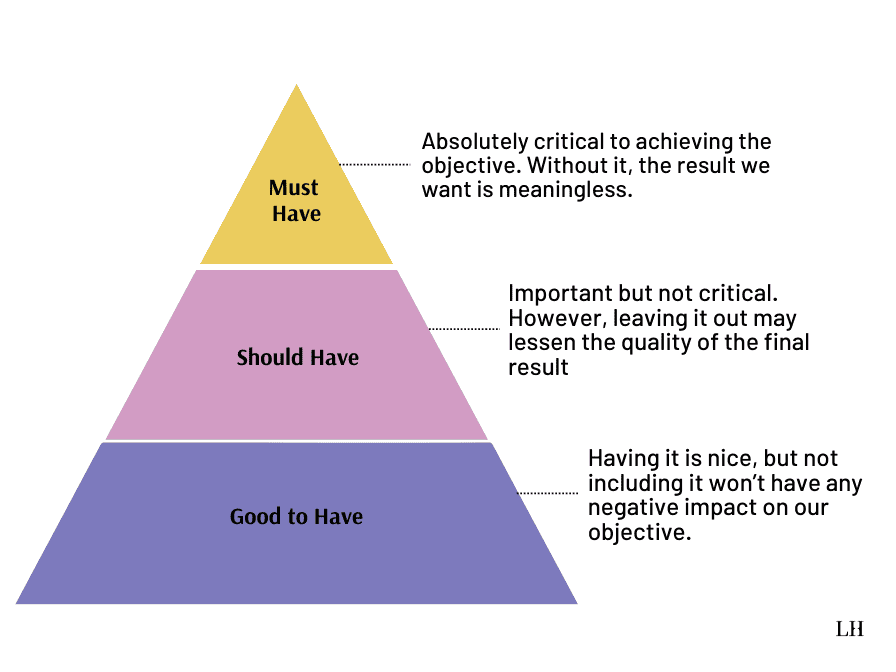
superstructure method

The Superstructure Method provides us with incredible clarity and focus, ensuring that the resources we invest are always put to the best possible use. We use it for things like research, learning new skills, and even meetings because it’s so handy.

One of the best things about using the Superstructure method is that you can apply it to every aspect of life. Even though the idea of Superstructure started from the work at Lifehack, now it is used everywhere. For example, you can apply the simple steps while moving houses, planning a holiday, creating a diet plan, or chalking out your exercise schedule.

Here’s an example on how to make use of the Superstructure Method:

  • Let’s say you want to lose weight. So set out by laying a clear goal that you wish you lose weight by ____ kgs/lbs.
  • Now determine what must be done to achieve your goal. You can jot down all the options such as dieting, hitting the gym, quitting junk food, jogging, etc.
  • The next step is to bifurcate your options into “must haves” (which can be quitting junk food), “should haves” (like exercising, jogging, etc.), and “good to haves” (dieting)

There’s only so much you can accomplish in a day, no matter how well you prioritize, and some distractions are unavoidable. When it comes to creating objectives and prioritizing activities, it’s critical to be realistic. You’ll build unrealistic expectations of others around you if you don’t, and you’ll always feel like you’re slipping behind.

Remember that the goal of prioritization is to devote time to the most important tasks, those that will make a difference in the long term and propel you forward.

You’ll feel less reactive and more focused and intentional if you handle prioritization correctly. The goal is to finish work that represents genuine progress while letting the rest—all the “busyness”—fall by the wayside.

Adapt the Superstructure Method

1 Action

Mindful Habits

There are many times in our daily lives when we feel fully overwhelmed by personal and professional duties. We strive for work-life balance on a daily basis, yet we are just human. We go about our daily lives without pausing to consider what we’re doing and why we’re doing it.

To be fully aware of your emotions, you must first comprehend your mental process. If you’re experiencing a strong feeling, such as anger or sadness, and you know what idea or action prompted the emotion, you’ll be able to cope with it more effectively and avoid acting rashly. Practicing such mindful habits can help you deal with a challenging situation in a new way and can significantly improve your attitude.

Our consciousness is always focused outward. It constantly reacts to our environment. And this sometimes leads to a build-up of stress, the strain on mental energy, and weakened focus. To ensure that you stay away from the negative impacts, it is important to practice mindful habits.

The practice of mindfulness aids the development of new neural networks in the brain. You’re essentially retraining your brain to find better and new methods to handle activities and cope with stress and emotions through creating neural networks. You’re also assisting yourself in improving your focus.

When you are mindful, you are fully aware of every thought, emotion, and action that occurs in your life. You concentrate on the present time before reacting rashly. Mindfulness is essential for ensuring that we have clarity on the many things for which we are responsible in our life.

Researchers reviewed more than 200 studies of mindfulness among healthy people and found mindfulness-based therapy was especially effective for reducing stress, anxiety, and depression. Mindfulness can also help treat people with specific problems, including depression, pain, smoking, and addiction.[12] Researchers believe the benefits of mindfulness are related to its ability to dial down the body’s response to stress.[13]

Here’s how to make mindfulness part of your regular routine:

1. Focus On Your Breathing When You Feel Distracted

As per research, slow, regulated breathing was found to be associated with improved feelings of wellbeing, relaxation, and mental clarity. Adult volunteers trained in diaphragmatic or “belly” breath exercises for eight weeks had a significant decrease in the stress hormone cortisol, as well as an improvement in their ability to pay attention for long periods of time.[14]

Use the 4-7-8 breath when you feel distracted. Inhale deeply while counting to four, then hold your breath while counting to seven, and then exhale slowly while counting to eight. There will be a total of four times this pattern is repeated. Simply return to the breath and the counting whenever you find yourself distracted during the mindful meditation.

Practice Breathing

1 Action
Find a peaceful spot to sit for a few minutes. Try closing your eyes and keeping your back straight. Read How to Increase Concentration with Meditation

2. Try The Reel It In Method

Reel It In Method is a practical strategy that you can apply to overcome your distractions.

Besides helping you to immediately transform a distraction into something useful, practicing this method as a mental exercise helps you to strengthen your focus muscle.

This method is for the 90% of distractions where you have a choice — whether to click on that Facebook notification, reply to the WhatsApp message right away, or worry about that thing you have to do next week right now.

With the “Reel It In” Method, you’ll be able to make the right choice to take every time. In fact, with each new distraction, you’ll make a choice even more concrete.

Step 1: Clear Your Mind

Let’s begin with a little mental exercise and go through a typical distraction scenario:

Say a distraction comes from an external source like an email notification, a Facebook post on your feed, or a message from a friend; or from an internal source like a stray thought, a lingering worry at the back of your mind, or something you suddenly remembered.

Your snap/default reflex is to quickly jump to the distraction. To read that email, scroll through Facebook, etc.

Now imagine this time you STOP and practice a little bit of mindfulness.

Before you act, do a quick and simple breathing exercise that only takes a few seconds instead:

  • Close your eyes.
  • Take a deep breath and hold it in for a count of 5.
  • Then exhale. And as you exhale, imagine your mind releasing all the things it’s holding on to.
  • If it takes more than one breath, then take a few more. Each time you exhale, feel your mind releasing.
Step 2: Gain Instant Presence

Bring yourself back to NOW — this moment.

Imagine that your mind has lines connecting to different things that are drawing your attention. They could be things you’re worried about, things you have to think about, or things you have to remember.

Now imagine reeling these lines back in… like a fishing rod.

You are returning your attention back to yourself. Recentre your focus.

Tell yourself:

“Nothing matters except this moment.”

Instant presence is important because you are literally living in this moment. The past is the past. The future hasn’t happened yet.

Too often, we act based on the past, which we can’t change; or future fears/worries which we are not set in stone.

What you do now is what really matters. This moment is your reality.

Now, to refocus, ask yourself these questions:

  • What are you doing now? Why are you doing it?
  • What do you need to achieve so that your time isn’t wasted?
  • What’s the most important thing I could be doing right now?
  • Is this distraction urgent? Do I need to divert attention right now?
  • Do I need to care about it? Why?
  • Will I regret spending time on this later?
Step 3: Make a Decision

To put away a distraction for good, you have to process it. That means you have to make a decision about it so that your mind can be at peace about it.

If you don’t and just ignore it, it will just resurface and bother you again until you do.

Kickstart Mindfulness

3 Actions
Make a “Distraction Follow Up” to-do/task list – It’s dedicated to processing the random distractions that come up during the day. Use it to write down whatever needs to be done. The idea is that once you write it down into a task. You tell your mind to forget about it.
Set yourself some time each day – To process your accumulated random to-dos, like 30 minutes after lunch and 1 hour before getting ready for bed. The idea is to clear your list as you go through the day so that you don’t feel overwhelmed.
Schedule a time to focus on it – You don’t ignore it. Instead, you commit to it but just not right now.

Bottom Line

Staying focused and developing concentration has become a critical ability for success in a world plagued with numerous distractions and competing demands for our attention. Understanding and implementing the three fundamentals of remaining focused will transform your capacity to concentrate and boost your overall productivity.

Featured photo credit: Eden Constantino via unsplash.com

Reference

The post 3 Fundamentals of Staying Focused and Improving Concentration appeared first on Lifehack.