Monday, 21 November 2022

Time Poverty: What To Do If You Feel Time Poor

Time is money. Yet, why is it that so many people focus on how they spend their money, but not how they spend their time?

In today’s fast-paced world, research shows more and more people are persistently feeling “time poor.”[1] While time poverty to some people may not seem as important as material poverty, time poverty causes several negative implications from lower well-being, physical health, and productivity that cannot be ignored.

Nearly 50% of Americans report feeling they “don’t have enough time these days”, according to a 2015 Gallup poll.[2]

And yet, despite constantly feeling like there’s not enough time in the day, many continue to work long hours, sacrificing valuable time with friends and family in the hopes of finally catching up on their busy schedules.

What Is Time Poverty

Time poverty is not having enough discretionary time.[3] Discretionary time is the amount of time available to do activities to build your social and human capital, such as spending quality time with loved ones.

Discretionary time is impacted by the need for people to devote significant portions of their life to necessities like sleeping or work responsibilities (both paid and unpaid).

Time poverty ultimately can make you feel overwhelmed, with seemingly too many things to do in too little time. Juggling both time necessities vs discretionary time can make many feel constantly under pressure, forcing individuals to have to make decisions and prioritize certain aspects of their life over others.

Cause of Time Poverty

Time poverty can look different depending on the unique individual and their particular life circumstances.

For instance, research found that parents tend to have less leisure time (up to 14 hours less time per week) than individuals without children.[4] Moreover, single-parent households have even less leisure time than two-parent households or childless households.

In general, women also tend to have less leisure time than men because of various unpaid work responsibilities (i.e. chores and childcare). Therefore, not only does being a parent minimize your amount of leisure time but being a woman can also decrease your leisure time.

This explains why working moms are so time poor as they must find the time to balance both making a living via their careers and spending time caring for their children.

A manager can also experience significant time poverty. This is because, not only does a manager hold the responsibility to effectively manage their team to ensure they are productively completing their work tasks, but the manager also has their own responsibilities they must complete outside their leadership role.

Failure to effectively dedicate time to their team can cause many problems such as employee dissatisfaction, confusion, and lack of productivity teamwide. Yet, too much time spent on leadership and not on the manager’s work responsibilities can make it appear that the manager doesn’t get any work done at all.

A third example of poverty of time is individuals working multiple jobs to support themselves financially; therefore, not having adequate leisure time outside of all their working hours.

While each of these three examples shows varying examples of time poverty causes, common themes like an undervalue of time vs money and a lack of sensitivity to small losses of time over money are common themes in cases of time poverty.

In other words, people tend to value material resources or money over time-related resources. This is due to time resources being invisible and intangible compared to material resources, making it more difficult for humans to quantify how valuable time is in their lives.

The beauty of time is that we are all given 24 hours a day of it. Therefore, by effectively being able to learn how to gain more time like the way you make money, individuals can gain back more quality time to improve their overall quality of life.

The Impact of Time Poverty

Time poverty can negatively affect many facets of our lives. Four main consequences of time poverty in our life include impacting our physical health, mental health, relationships, and work performance.

Physical Health

The poverty of time makes for less time available to devote to our physical health and well-being. Research found that time-poor individuals had different eating and physical activity habits than non-time-poor individuals.[5]

While time-poor individuals are less likely to purchase fast food, time-poor individuals are less likely to engage in active travel (i.e. walking or biking to work, if possible). As a result, less active travel and ultimately less time spent exercising and improving physical fitness can negatively impact one’s physical health.

Mental Health

Time poverty inevitably can put mental strain, stress, and pressure on individuals. A Harvard Business School study evaluating why time poverty matters found that poverty of time can greatly reduce one’s psychological well-being.[6] This can play a role in reducing one’s subjective level of life satisfaction and mental health as more and more time is spent on working longer and harder at the expense of one’s mental health.

Relationships

Further research links poverty of time to negatively influencing the quality of an individual’s relationships.[7] Less quality time with friends, family, and even time to form new relationships can make an individual feel more isolated and lonely. And yet, with more time spent on work-related tasks, this results in sacrificing your time maintaining and forming new relationships to keep up with life’s necessities like work demands.

For example, this can mean less time spent with your own children, thus needing to rely on childcare services to properly watch and care for your children while you are busy with work. The poverty of time thus not only affects the individual but can negatively impact the current and future relationships of the individual.

Work Performance

An individual’s work performance can also suffer at the hands of time poverty. Research supports that time-poor individuals suffer from reduced productivity at work.[8] Therefore, a lack of adequate focus and time to effectively complete work responsibilities can negatively impact both employee and employer.

Not only is the employee not working to their greatest potential, but the employer is reaping the repercussions of time poverty as the employee (and potentially many other employees within the company) does not work effectively as they could to benefit the employer.

How to Stop Being Time Poor

While being more efficient with your time is easier said than done, you may be surprised to learn all the little moments of time you waste throughout any given day that can easily add up and contribute to being time-poor.

Two ways to stop being time poor are by focusing on being more intentional with your time and making quality time a priority in your life.

1. Be intentional with Your Time

Life consists of a million and one different responsibilities and distractions. By not being aware of where your time is going, you can fall victim to constantly feeling time poor.

Your decisions in what you choose to do (or not do) will impact the amount of time you have in a day. While some things like sleep and time dedicated to working are necessities, you’d be surprised by how much time is wasted in a day.

For example, all those times you scroll on your phone throughout a given day add up. While it may seem harmless to check your phone for 5-10 minutes every hour, this can add up to 90-plus minutes wasted every day just checking your phone. Therefore, every minute counts and the time wasted every day can add up quickly if you aren’t aware of it.

In order to be more intentional with your time, and to reduce the amount of time you waste, it’s critical you take charge of your time. How you take charge of your time is entirely up to you depending on your individual needs.

That being said, various methods can help you be more intentional with your time, such as:

  • Planning and Scheduling Your Time: Consider planning out your day’s priorities the night before or the morning of.
  • Time Blocking: Try using a digital or physical calendar broken down by the hour to block off windows of time throughout the day you’d like to complete certain tasks.
  • Getting Rid of Distractions: Distractions are a huge time-sucker. Try to evaluate what distractions are in your life (for many it may be your phone) and try to distance yourself from those distractions to stop wasting valuable time.

Want to learn more about how to stay focused? Check out our article on “How to Focus and Stay Sharp (A Comprehensive Guide)” to gain back valuable time in your life.

2. Make Quality Time a True Value in Your Life

Everyone has a finite amount of time on Earth. While this may seem morbid, the reality is we all have the same limited time constraints of 24 hours a day, 365 days a year, with an average life expectancy between 70 to 80 years of age.

To make the most of your time, you must value quality time. How you spend your time with someone or doing something is more important than the quantity of time you spend on something. For example, what’s the point of spending hours with your family if all you’re going to do during that time is worry and think about work?

Some ways you can strive to value quality time in your life are:

  • Being Mindful of the Present: Train yourself to be more present in your life, rather than allowing one area of your life to influence another. For example, when you are spending time with your family, be present and in the moment rather than focusing your thoughts and attention elsewhere.
  • Meditating: Meditation can be a great way to train your brain to be in the present moment.
  • Reflecting: Reflection is another way to help value the quality of time in your life. Reflection allows you the ability to learn more about yourself, consider where your life is going, and question if you like the path your life is taking. Journaling is a great way to practice reflection.

Final Thoughts

We all are given the same 24 hours each day. What you do with your time is completely up to you. This sense of accountability and responsibility that your time is entirely yours can be both overwhelming and freeing.

Those who constantly waste time or don’t value their time can easily make excuses like “I don’t have enough time” as a way to justify or excuse why they don’t spend more time on valuable areas of their life like their health and relationships.

However, if you are feeling time poor, that doesn’t mean you have to live your life constantly feeling one step behind. By being more intentional with your time and valuing quality time, you’ll begin to learn ways to make better use of your time so you improve your overall well-being and dedicate more time to what matters most in your life.

Featured photo credit: Wilhelm Gunkel via unsplash.com

Reference

The post Time Poverty: What To Do If You Feel Time Poor appeared first on Lifehack.


Tuesday, 18 October 2022

How To Manage A Multigenerational Workforce (11 Tips)

It’s no secret that the workforce is changing. And with that change comes new challenges and frustrations. However, with change, also comes new opportunities to learn, grow and innovate.

But, in many cases, it’s easier said than done especially when managing a multigenerational workforce.

After all, it’s not simply about adopting new forms of modern technology; it’s about understanding and accommodating your team’s different motivations, expectations, and working styles.

This article aims to give you the confidence you need to lead all ages on your team. Here are 11 tips to help you manage your multigenerational workforce

11 Tips for Managing a Multigenerational Workforce

Like any other management, you have to start with the basics. Often, these are things that are within your control and things that you can change within yourself.

1. Encourage an Open-Minded Attitude

One of the most important things you can do as a manager is to encourage an open-minded attitude in your team.

With so many different generations in the workplace, it’s vital that everyone feels they have a voice. Create an environment where everyone feels comfortable sharing their thoughts and ideas.

Here are three ideas to get you started:

  • Make it a point to solicit feedback from all team members, regardless of age
  • Have open hours where team members can drop by your office to chat and share ideas
  • Encourage an environment of healthy debate and respectful disagreement

Open-mindedness is key to managing a multigenerational workforce because it gives all of your employees the chance to fail forward. Someone will inevitably make a mistake, cause an offense, or speak from their implicit bias at some point.

It’s imperative to foster a culture of accountability so that everyone knows that these things are not tolerated. But, it’s just as important to encourage an environment where people feel comfortable making mistakes without fear of judgment or retribution.

2. Promote a Culture of Learning

Right now, there are four generations in the workforce and all of these generations have different expectations, working styles, and motivations.

  1. Baby Boomers (born between 1946 and 1964)
  2. Generation Xers (born between 1965 and 1980)
  3. Millennials (born between 1981 and 1996)
  4. Generation Zers (born after 1997)

For example, Generation X prefers to work in isolation, whereas millennials are more likely to seek collaboration.

When you place these two generations side-by-side, it’s easy to see how conflict can arise. However, if they both feel comfortable discussing their expectations and needs openly and honestly, they can find a middle ground that works for everyone.

Creating a Culture of Learning in Your Workplace

Think about it this way; if you can create an environment where everyone feels comfortable learning from each other, then conflict becomes an opportunity for growth and innovation, not a source of frustration.

Here are three ideas:

  • Hire a multigenerational team of experts to lead company-wide training sessions on emotional intelligence, unconscious bias, and cross-generational communication
  • Encourage mentorship by pairing up employees of different ages to learn from each other
  • Designate a specific day each week or month as a “learning day” where everyone is encouraged to read an article, listen to a podcast, or watch a TED talk that exposes them to new ideas and generational perspectives

3. Encourage Cross-Generational Collaboration

One of the best ways to foster a culture of learning is to encourage cross-generational collaboration.

In fact, studies have shown that multigenerational teams are more innovative because they’re able to draw on a broader range of experiences and perspectives. In short, they’re able to think outside the box. [1]

When you place people of different ages and stages in life side-by-side, they can share their unique perspectives and ideas and ultimately give your business a competitive edge. And isn’t that the main goal?

Diversity is key to innovation, so if you want your business to stay ahead of the curve, it’s imperative to provide your team with opportunities to collaborate across generations.

Here are a few ideas to get you started:

  • Have various ages provide feedback on upcoming projects and give them the freedom to add their mark
  • Encourage employees of different ages to share their favorite tools and apps with the team
  • Appoint co-leaders of different ages to oversee company-wide initiatives

Cross-generational collaboration can be complex, but it’s worth the effort. By encouraging your team to share their unique perspectives, you’re opening the door to a world of possibilities and setting your business up for success.

4. Don’t Forget to Have Fun

There will always be differences between the generations, but that doesn’t mean you can’t find common ground and enjoy working together.

Being in a room where people of different ages are all working together can be a lot of fun. And, as studies suggest, an enjoyable work environment is more productive.

So, how can you make sure your workplace is fun for everyone? Here are three ideas:

  • Plan company-wide social events that cater to different interests like having a board game night, a karaoke night, or a movie night
  • Organize intergenerational sports teams and have them compete against other businesses in your industry
  • Encourage employees to decorate their workspaces in a way that reflects their personality

Fun should be a top priority in any workplace. And it should be especially high on the list if you want to manage a multigenerational workforce.

Not only does it foster a positive and productive work environment, but it also helps everyone feel valued and appreciated. That’s something all ages can get behind.

5. Manage Expectations

When managing an intergenerational workplace, it’s essential to manage expectations. You won’t always see eye-to-eye with every employee, and that’s okay. In fact, it’s to be expected.

There will be generational clashes. The most important thing is to manage them in a way that doesn’t result in conflict. After all, the last thing you want is for your team to be divided or feel disrespected.

Here are a few tips to help you manage expectations:

  • Be flexible when it comes to accommodating different generational needs like allowing a millennial to work remotely for two days and letting a baby boomer work daily
  • When hiring, be clear about your expectations when it comes to multigenerational work environments
  • Touch back with your team regularly to ensure everyone is on the same page by having clear and easy-to-implement expectations

If you can manage expectations, you’ll be well on your way to managing a multigenerational workplace successfully. Just remember to keep the lines of communication open and be willing to accommodate different needs.

6. Evaluate Your Own Biases

When it comes to managing a multigenerational workplace, it’s important to evaluate your own biases. We all have them, and they can often cloud our judgment.

For example, you might be biased against millennials because you think they’re entitled or are always on their phones. But chances are, you know at least one millennial who doesn’t fit that stereotype.

And, even if they do, does that mean they’re not a good employee? Of course not. In many ways, they might be precisely what your business needs.

On the other hand, if you’re a millennial, you might have preconceptions about baby boomers or Gen Xers. Maybe you think they’re out of touch or don’t value inclusion and diversity as much as you do. But that’s not always the case.

In fact, many Fortune 500 companies are led by these two generations, and they’re some of the world’s most inclusive and diverse workplaces. Just look at Google, Cisco, and IBM.

Often, as leaders, we become the multigenerational workforce challenges we want to avoid. If you want to lead a multi-generational workplace effectively, you need to understand your own biases and how they can become a barrier to success.

7. Encourage Mentorship

Mentorship is a great way to manage a multigenerational workplace. It creates a sense of community among your team and allows different generations to learn from one another.

For example, an employee with the company for 20 years can mentor a newer employee on the company’s history, culture, and values. [2]

And in the same way, a Generation Z employee can teach older employees about the latest technology, social media trends, and how to stay relevant in today’s ever-changing world.

Many companies mistake mentoring for mimicking, but it’s much more than passing down information. It creates relationships built on trust, respect, and shared goals. When your team has that, they can achieve anything. And that’s what you want in a multigenerational workplace.

8. Budget for Leadership Training

A healthy workplace takes time, effort, and resources to maintain. That’s why creating a budget for executive coaching, retreats, and conferences should be a top priority for multigenerational workplace managers. After all, leadership starts at the top.

When you invest in your development, you set the tone for your team. You’re saying you’re committed to growth, learning, and change. And that sends a powerful message to your team.

So, what are some things you should include in your training budget?

  • Leadership development workshops
  • Inclusion and diversity training
  • Conflict resolution courses
  • Communication seminars
  • One-on-one coaching

The sky’s the limit when it comes to what you can include. Just make sure you take the time to invest in yourself as a leader. It’ll pay off tenfold in the long run.

9. Promote a Work-Life Balance

Every generation values work-life balance differently.

For baby boomers and Generation X, it might mean having the time to pursue their hobbies and interests outside work. For millennials, it might mean more flexible hours to spend time with family or friends. And for Generation Z, it might mean taking time out for mental health days or extended vacations. They all differ, and that’s okay.

The important thing is that you, as a manager, make an effort to understand what work-life balance means for each of your employees. Then, do your best to offer options that work for everyone. And one of the best ways to do this is by providing flexible work hours.

When you give your team the freedom to create their schedules, you show them that you trust them and give them the power to take control of their time. [3]

That’s something everyone can appreciate regardless of their generation.

10. Partner With Human Resources

This one might seem like a no-brainer, but it’s worth mentioning. Having an engaged HR team could help you enjoy the benefits of a multigenerational workforce.

Human Resources is there for a reason. They can help you navigate the complexities of managing a multigenerational workplace and provide valuable insights into company policies, procedures, and benefits.

They’re also a great resource regarding compliance issues, training opportunities, and resolving conflicts. So, if you feel overwhelmed, reach out to your HR team. They’ll be more than happy to help you and give you the support you need to succeed.

11. Be Patient

Lastly, being patient is one of the essential tips for managing a multigenerational workplace.

Give yourself and your team time to adjust to each other’s communication styles, work habits, and ways of thinking. It won’t happen overnight, but eventually, you’ll find a rhythm that works for everyone.

How To Manage A Multigenerational Workforce

6 Actions
Encourage an Open-Minded Attitude: Start by listening to your employees and letting them share their opinions. Regardless of age, everyone has to be heard or feel heard especially by their leader.
Promote a Culture of Learning: Different generations have different expectations, working styles, and motivations. When a culture of learning is encouraged, your employees can have an environment that inspires them to learn from one another instead of focusing on their differences.
Encourage Cross-Generational Collaboration. Let your people work with one another despite their age. This encourages them to share their ideas which creates a more innovative approach to things.
Evaluate Your Own Biases. As a leader, you may have your own biases against other generations. Learn to set this aside and avoid the barriers that can hinder success and encourage mentorship.
Budget for Leadership Training. If you have the budget, investing in leadership training can help your people act accordingly and implement the values you want to instill.
Promote a Work-Life Balance. Every generation has its own description of how to have a balanced life. Try to find common ground and provide the best solution that caters to all generations. Also, don’t forget to incorporate fun!

Conclusion

Remember, managing a multigenerational workplace is a marathon, not a sprint. So, take your time, learn from your mistakes, and give your team the grace they need to do the same.

By following these tips, you’ll be on your way to creating a multigenerational workplace that’s productive, cohesive, and inclusive for everyone. And that’s a goal worth working towards.

Featured photo credit: Shridhar Gupta via unsplash.com

Reference

The post How To Manage A Multigenerational Workforce (11 Tips) appeared first on Lifehack.


Thursday, 8 September 2022

15 Ways To Stop Overcommiting Your Time And Energy

In a world that celebrates the hustle and grind, it’s easy to find yourself constantly overcommitting your time and energy or on menial tasks that never move us toward the life we want to live. It’s no wonder then that people live in a state of perpetual overwhelm, burnout, stress, or anxiety.

The good news is that you can break the pattern of overcommitting yourself and take control of your life. Committing to yourself first and implementing the tips below will help you break out of this old pattern and stop the anxiety, burnout, fatigue, and overwhelm you have been experiencing so you can start living life on your terms.

Like any pattern we consistently repeat, there will be learning stages involved in breaking it. At first, you may find that you don’t even realize you have overcommitted yourself until you’re already in a state of overwhelm and frustration.

When this happens, take time to figure out where things went wrong that led to the overcommitment. From there, you can apply these tips to break the cycle.

How To Stop Over Committing

1. Do a Time Audit

To get your time, energy, and commitments under control, you need to figure out where they are leaking.

To do this, grab a notebook and set an alarm every 15 minutes on your phone. Use these check-ins to write down what you did in the fifteen-minute timeframe. Do this exercise for a minimum of three to seven days.

At the end of each day, or week, take time to reflect on how you spend your time. Try considering that each minute is $1 and whether that time or “money” was well spent. From there you can use this exercise to decide if a task is something you should continue, stop or delegate.

If you’ve ever heard the story of the philosophy teacher filling the jar with rocks you can take this exercise one step further and decide if each task is a rock, a pebble, or sand.[1]

2. Know Your Limits

We have a finite amount of mental energy each day. Because of this, we are limited in the number of tasks we can complete. Brian Tracy, one of the world’s experts in productivity and time management, suggests that we are capable of completing three to six tasks each day. [2]

You may find that there are days when you have less energy and can only complete three tasks. While other days you can do more. Is there a pattern to this energy flow?

Women, typically have less energy during their menstrual cycle and may complete fewer tasks. You may find that you have more energy on Mondays than you do on Fridays or during the first week of the month than the last.[3]

When we start to pay attention to our patterns and how our energy flows, we can be better prepared to know when to draw the line on what we are capable of achieving.

3. Never Commit Right Away

Give yourself a buffer to consider all factors before committing to anything. Politely let the person know that you will get back to him within a day so that you can assess yourself if you can commit. This gives you:

  • Time to consider your other obligations
  • See the importance of this commitment
  • Prepare how you will respond

It’s important to give yourself this buffer if you made lots of decisions that day. Studies on decision fatigue show that the more decisions someone has to make during the day, the poorer quality their decisions become. As our mental energy for the day decreases, so do our willpower and ability to make decisions that are aligned with our goals and needs.[4]

4. Overestimate the Amount of Time Required

One of the reasons people end up overcommitting is that they don’t consider the amount of time it will take to complete a task. People may consider that an appointment will last for an hour but fail to consider the time it takes to travel to and from the appointment, sitting in traffic, or if someone is running late.

If we overestimate the time required, we build a natural buffer to allow ourselves to deal with any challenges that may arise. If a task takes less time than we’ve allotted, you end up with extra time to commit to yourself and practice more self-care.

5. Check in With Your Gut

Be honest, how many times have you committed to something you really didn’t want to do? Then you end up not only overwhelmed because of overcommitting, but also resentful towards yourself.

When you give yourself the buffer before making a decision, you also give yourself time to check in with yourself and ask:

  • Is this something I want to do?
  • Is this something I feel obligated to do?
  • Do I have the energy to follow through and feel good about it?
  • Will this commitment drain my energy and lead to negative emotions?

If you feel this commitment is more out of obligation or if it’s something you really don’t want to do, say no. It’s okay to say no to a commitment even if it will let someone else down.

There is no point in sacrificing your mental health to make someone else happy.

6. Check in With Your Goals & Values

  • Is committing to this move you towards your goals or further away?
  • Will it take time and energy that could be used towards your goal?
  • Is this commitment aligned with your values and beliefs?

If a commitment is far from your goals, or out of alignment with your values and beliefs, the cost is much more than just time. The energetic toll on you will keep you stuck in overcommitment and overwhelmed for a lot longer.

It can also lead to more frustration and resentment in the long run if your goals are delayed.

7. Know Where You’re Going

To make intentional decisions, you need to know where you are going. Whether this is a short-term goal or the legacy you want to leave behind in your life, you can’t make intentional decisions without this information.

Without knowing the end destination you’re shooting for, every opportunity becomes just another shiny object that could distract you.

8. Set Boundaries

Once you’ve determined whether you want to commit or not, set the boundaries for your time and energy.

If you’ve decided not to commit, use the following language patterns to set a firm, yet respectful boundary:

  • I appreciate this opportunity but now is not the right time for me to take on an additional workload.
  • I respect your courage to ask for help on this project, but my plate is full and this may affect the quality of my work
  • I agree it’s important to ask for help but agreeing to help you would overwhelm me.

If you are agreeing to the commitment, it’s still important to set boundaries on your time, energy, and expectations.

9. Stick to Your Decision

Once you’ve made your decision, move on from it. Contemplating whether you made the right decision or not only keeps you stuck expending additional energy on the commitment that you already decided to take or wasn’t a priority for you.

Make your decision and move on from it quickly.

10. Stop Keeping Score

In his book Influence, Robert Cialdini talks about the law of reciprocity. This is when someone does something for us or gives us something, and we feel obligated to do or give something in return. Often people end up overcommitting to something out of obligation.[5]

However, this obligation becomes an even bigger energy drain when we begin to experience resentment or other negative emotions when overcommitting.

Instead of keeping score over who you owe what, remember that returning a favor is best done from a place of having a genuine desire to help someone or give them your time and energy.

11. Know Your Priorities

The Pareto Principle tells us that 80% of the output of a given situation is determined by 20% of the input. We can use this principle to our advantage when determining which tasks to commit to and which to delegate or just let pass.[6]

To use this principle, ask yourself which tasks will require 20% of your time, energy, or effort, but will yield an 80% result. Prioritize those tasks and delegate the rest to avoid overwhelm and overcommitment.

12. Reprogram Limiting Beliefs

Overcommitting is common in people who have taken on traits of people pleasing or perfectionism. However, oftentimes these identities or beliefs become a self-fulfilling prophecy.

For example, if you believe that saying no would hurt someone’s feelings, being unable to provide the full effort due to exhaustion from overcommitting would likely hurt him anyway. Take some time to reflect if there is a limiting belief or emotional wound that is causing you to overcommit to things.

Once you identify the limiting belief, write down all the evidence you have to prove the limiting belief and the evidence that disproves it.

13. Recognize Self Sabotage

Continuously overcommitting to things may be a form of self-sabotage that keeps you stuck in a stress addiction loop. The pattern of overcommitting stops you from moving toward your goals and dreams.

If you believe that you unconsciously sabotage yourself, meditate on the following questions:

  • What would happen if I stopped overcommitting myself?
  • What am I afraid will happen if I have the time and energy to achieve my goals?
  • How can I better manage my time and energy?

14. Reduce Your Exposure to Ambivalent Friends

An ambivalent friend is someone commonly referred to as a “frenemy.” A person who is supportive and loving one day and highly critical and mean the next. You always feel the need to walk on eggshells with these people, and they leave you feeling downright exhausted.

Studies on ambivalent friends have been shown to harm our health, including feeling more stressed, needing more sick days, and a bigger drain on our emotional energy.[7]

15. Prioritize Time for Rest

In today’s world, rest is the first thing we let go of to fit more tasks into our day. But we aren’t machines. Rest is a necessary component for better health and decision-making. Block out the time you need for regular rest before taking on additional commitments. This ensures that you can fully show up for the tasks you’ve determined are important to your goals, values, and ultimate success.

How To Stop Overcommitting Your Time And Energy

5 Key Takeaways
5 Actions
Do a time audit: Set an alarm every 15 minutes. After the alarm goes off, write down what you were doing in those 15 minutes, and by the end of the week, reflect on where your time was spent.
Never commit right away: Give yourself a buffer of a day or two to consider your other obligations before you agree to commit to something.
Don’t overestimate the amount of time required: Consider how much time a task will really take including preparation, travel, and traffic if driving is involved.
Stop keeping score: Often people end up overcommitting to something out of obligation. Instead of keeping score over who you owe what, remember that returning a favor is best done from a place of having a genuine desire to help someone or give them your time and energy.
Prioritize time for rest: Rest is a necessary component for better health and decision-making. Block out the time you need for regular rest before taking on additional commitments.

Conclusion

Overcommitting yourself is one of the fastest ways you can destroy your health, your success, and even your relationships and reputation. Implementing these tips into your life will help you refocus your commitments on the most important aspect of your life – YOU!

Featured photo credit: Nubelson Fernandes via unsplash.com

Reference

[1] Odessa: A Story of Priorities and a Jar
[2] Brian Tracy: Eat That Frog!
[3] Hologic: Why Am I So Tired During My Period?
[4] Medical News Today: What is decision fatigue?
[5] Influence At Work: Increase Your Influence
[6] Asana: Understanding the Pareto principle (The 80/20 rule)
[7] Facebook: Fake Friends

The post 15 Ways To Stop Overcommiting Your Time And Energy appeared first on Lifehack.


Wednesday, 7 September 2022

How to Simplify Decision Making With the Superstructure Method

Decisions. We make them several times a day every day, most of the time without even realizing. But often, you have to make life-altering decisions. Is there a system in place that can help you make smarter, better decisions every single time?

Yes! And here at Lifehack we call it the Superstructure Method that you can use to simplify decision making.

The Superstructure Method will help you make better decisions by:

  • Realigning your focus to what’s truly important a.k.a. prioritization
  • Saving you time
  • Creating and enhancing clarity
  • Improving your life overall by giving you a structured approach to decision making that you can rely on

Let’s dive in.

Simplify Decision Making with the Superstructure Method

First off, what is the Superstructure Method?

In the business landscape, you might have heard of MoSCoW Analysis.[1] The Superstructure Method is similar but an even better version.

The Superstructure Method is a tool for prioritization. Think of it as a tabular (or colorful, if you want to add colors for the categories!) way of representing the prioritization process.

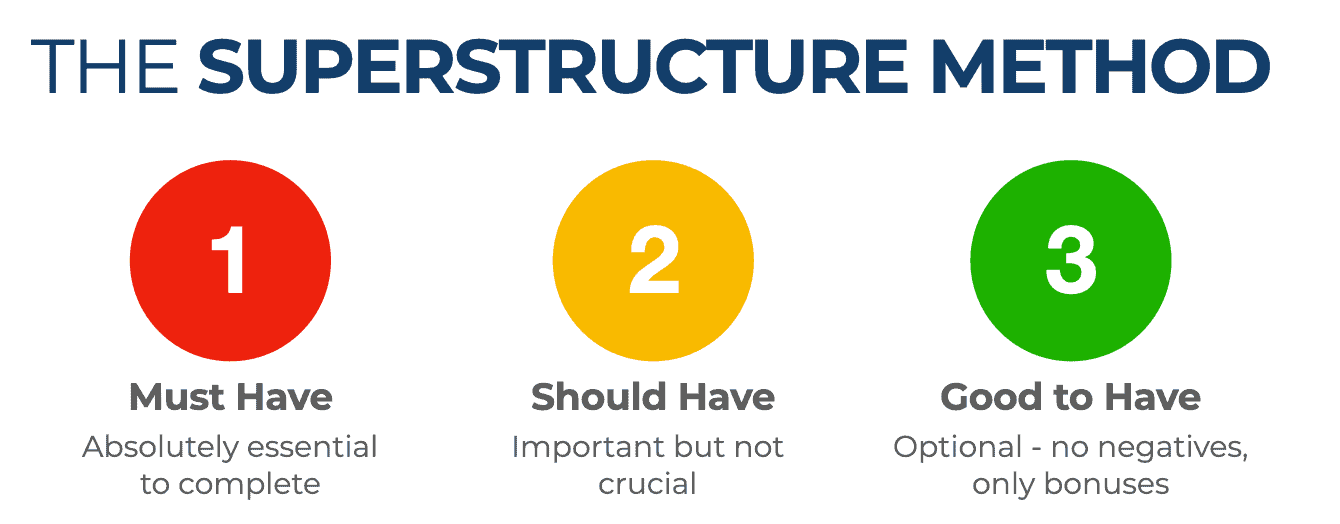
In superstructure, you divide the tasks and possibilities into three distinct categories:

  • Must have
  • Should have
  • Good to have

Must Have

These are the things you can’t do without. You absolutely need to have them. It could be a task or an important raw material requirement that you need to have, otherwise, the results you want to achieve are unachievable.

Should Have

A little less critical than “must have”, the should-haves are important too, just not game-changing. These are actions and possibilities that fall in the middle tier where having them would be great and could have really positive effects on your outcomes.

Good to Have

If you want to have a visual representation of this, imagine a nonchalant shrug. It’s nice if you could have them. If you had all the resources in the world and an abundance of time, then sure!

But since you don’t, you realize that having these good-to-haves might have been nice, but that not having them is not going to have a negative effect. They’re just bonuses with no negative repercussions if you don’t have them.

And that’s it! Let’s walk you through implementing the superstructure method in making your next decision.

Here’s what you do:

  1. You start with the right intention. Be clear and positive about what you want. For a while, let the negative thoughts and ‘what-ifs‘ fly out the window. Let your analysis in the end do the talking. Lifehack’s detailed guide on setting intentions will get you geared up with the right intention in no time.
  2. List out, as thoroughly as you can, all the actions needed and the possibilities. Remember, be thorough. The more thorough you are, the clearer the picture will be for you.
  3. Now, here’s the part we’ve all been waiting for. It is time to unveil the Superstructure Method and let it do the sifting to simplify the decision making process.

Categorize all the thoroughly listed possibilities into the three superstructure categories.

Benefits of the Superstructure Method

1. Clarity

When you have everything laid out in front of you, you can be sure that you’re not missing out on anything.

It doesn’t keep you guessing, and you can steer clear of falling into the warp of ‘what-ifs’. Your priorities are ironed out, and as you categorize your possibilities and actions, you start to get a clear picture of the outcome as well.

It’s amazing how undertaking the superstructure method for decision making can act like a freeze-frame for your thoughts. No more muddled jumble of words inside your head! You get to ‘see’ everything before you achieve it in all its tabular glory!

2. Resource-Saving

The Superstructure Method is time and cost-effective because it helps you to stay organized.

You allot a specific amount of time to listing and categorization, and then you can progress to execution. It’s as though you take care of one aspect of decision making and then everything begins to fall into place.

With the visuals of “must have“, “should have“, and “good to have“, you can easily pick and choose the actions with the highest critical factor and begin working. You can deploy your energies to the possibilities that need immediate action to get started right away.

And, you can plan on delegating the tasks in the ‘good-to-have‘ section without wasting your precious time and resources on time-consuming things which should rather be done by someone else.

3. Productive

Simplicity is powerful. It is a complex maze of ideas and thoughts in our everyday lives that leaves us confused and unfulfilled.

With the superstructure method, you have a strategic approach to solving problems of decision making in every area of your life. Be it moving, planning for your new year’s party, scoring well in a subject, or getting things done better in a business meeting, superstructure works for all.

The key to achieving productivity is that you use your resources optimally. This is based on the concept of opportunity cost that you can read more about in our previous blog post.

When you invest the maximum amount of energy, resources and time on the important vs the non-important, you’re immediately headed towards a productive start.

How to Apply the Superstructure Method in Everyday Life

I’d like to share with you a few examples on how to apply the Superstructure Method in our everyday lives. I’m sharing a little more in the scenario of moving home because I have recently moved my home to Canada and have a recent first-hand experience on how to use the Superstructure Method!

Scenario 1: Moving Home

Moving home is no easy task. The Superstructure Method can simplify decision making for you when you’re likely juggling a number of tasks at the same time.

While moving, you’re caught up in what to pack and move into your new home. But in the midst of all this, there are so many other factors to consider.

So, first off, start by listing everything you need to do or get done. For example:

  • Cancel/transfer memberships
  • Gather health records
  • Update insurance policies
  • Get quotes from moving companies
  • Sort through your stuff
  • Start gathering up all of your moving supplies
  • Pack infrequently used items
  • Update address and have mail held
  • Cancel/transfer utilities
  • Plan meals to avoid waste
  • Confirm date and time with movers
  • Measure large furniture
  • Refill prescriptions
  • Final thorough cleaning, etc.

Awesome! Now, let’s get down to brass tacks and begin the categorization.

Must Have

If you’re planning to use the services of a moving company, one of the foremost things you need to do is to get quotes from moving companies. This is to plan ahead financially in terms of budgeting, and set the dates for moving and then planning and packing accordingly.

And though it may seem a little redundant, you have to make sure that you follow up with the movers occasionally till the day of your moving. So, you have to include confirming date and time with movers in your list of must-haves.

Then there’s the no-brainer: you have to start gathering up all of your moving supplies. Whatever you may choose to use, whether it’s just the common cardboard boxes, tape, and sharpies, etc. gather up your supplies at least a month in advance.

And while you’re at it, you need to sort through your stuff to decide what you’re keeping and what you’re finally discarding to make way for important and useful things to be moved easily. Through this, you’ll make sure that you have the supplies available with you in time to pack your things whenever you have the time to devote to packing.

Then, there’s refill prescriptions. If anyone in your household, whether that’s you, family members, or pets, requires any kind of prescription medications get them filled immediately. Because in the chaos of moving, it could be one of those things that falls through the cracks, and you don’t want to be without it.

So, your must have column is going to look something like this:

  • Get quotes from moving companies
  • Sort through stuff
  • Start gathering up all of the moving supplies
  • Confirm date and time with movers
  • Refill prescriptions

Should Have

Measuring large furniture, though not a deal-breaker, is a great way to avoid any future problems while moving. Also, looking into canceling or transferring memberships will make things smoother down the road. Gathering health records, updating insurance policies, etc., all constitute planning ahead to make your life after moving easier and better organized without a hitch.

Your should have list would showcase a similar breakdown:

  • Cancel/transfer memberships
  • Gather health records
  • Update insurance policies
  • Pack infrequently used items
  • Update address and have mail held
  • Cancel/transfer utilities
  • Measure large furniture

Good to Have

So far, you’ve taken care of the absolute necessities. You’ve also outlined the necessary tasks which, though not deal-breakers, are still an important inclusion in your moving plan.

Now, ask yourself, what are you left with?

These would be the ‘good-to-haves’. These are the sorts of tasks that you take care of if you have the remaining time and resources at hand. Otherwise, you get someone else to take care of them. Or, in some cases, you might let go of these altogether. Your call!

Good to have list:

  • Plan meals to avoid waste
  • Final thorough cleaning, etc.

Scenario 2: Choosing a Job

When choosing a job, it’s great to have the Superstructure Method handy to help you choose the best job possible given your requirements.

Must Have

  • Commute no longer than 40 minutes so I can spend more time with my family
  • Saturdays off
  • Over $[amount] in salary
  • Paid sick leaves
  • Healthy work environment

Should Have

  • Company lunch so I wouldn’t have to prepare lunch every day
  • At least [number] annual vacation days
  • Attractive performance incentives

Good to Have

  • Includes the use of [specific] technologies
  • Hybrid model with [number] work-from-home days allowed

Scenario 3: Help with Prioritization

Here’s a quick overview of implementing the Superstructure Method in an everyday situation.

It’s a busy day and you have a mounting to-do list. As you sit down on your work desk to start, you are already daunted by the seemingly never-ending list.

This is the time you implement superstructure, kick fear and anxiety to the curb, and start crushing your goals.

  • Make a table of “must have“, “should have“, and “good to have“.
  • Enlist all the tasks in “must have” that are crucial to be done today (not doing them today would cost you).
  • Once you’re done with grouping these in the first column, you peruse the list for everything that is important still. Write them down in the “should have”.
  • Now, everything else you’re left with falls in the category of “good to have”.

Bottom Line

The Superstructure Method simplifies decision making by getting your priorities straightened out. It acts as a freeze-frame for your thoughts. The key takeaway is simply to use superstructure method as often as you can in your daily life!

You will find it to be an indispensable tool that will make your life so much better and more organized. So go ahead and share with us an example where you’d like to use the superstructure method to up your decision making power in daily life.

Featured photo credit: Soundtrap via unsplash.com

Reference

[1] As a Business Analyst: How to do a MoSCoW Analysis?

The post How to Simplify Decision Making With the Superstructure Method appeared first on Lifehack.


Tuesday, 23 August 2022

9 Tips on Leading With Integrity And Building Trust

Integrity in the workplace is foundational for building a trusting and productive team that can function during good times and bad times. Why is this? Because integrity involves honesty, respect, and vulnerability. These three traits are essential ingredients in maximizing engagement and productivity.

When you choose to lead with integrity, you intentionally set yourself up for success by allowing yourself to be open to change and feedback.

As a result, you expose your actual state of thinking and facilitate others to do the same. When leaders can actively engage their team, they instill purpose in their mission and outcomes.

Here are some tips on building trust and leading with integrity.

How to Lead With Integrity

Leading with integrity isn’t for the faint of heart. It involves emotion, critical thinking, and the willingness to be exposed to the opinions of others for the benefit of the team.

High-level leaders with integrity understand these fundamental ingredients for success and actively choose to use them in their day-to-day communications.

To lead with integrity, today’s leaders must be aware of their actions and respect their team members’ perspectives. It isn’t rocket science, but it does take intention and follow-through to make it happen.

1. Have Hard Conversations Early

Set the tone early to establish trust and, more importantly, show respect. Hard conversations are inevitable in the workplace, so good luck trying to escape them.

They’re essential because businesses solve problems, and where there are problems, human emotions and feelings get involved.

Those who lead with integrity understand this concept and choose to own it every single step along the way. They frame discussions by asking questions, taking inventory of the importance of the conversation, and trying to approach the topic from a neutral perspective.[1]

As they work through the discussion, they utilize emotional intelligence to understand both viewpoints and create solutions to move forward. Keeping it simple is the recipe for success, especially when it’s a conversation that you don’t want to have but need to.

2. Clear is Kind When It Comes to Communication

Whether cultivating a relationship in the office or with your partner, this concept can pay dividends for a lifetime.

In Kim Scott’s book, Radical Candor, she describes the concept of using “clear is kind” in communication with peers and colleagues.[2] In her experience, muddled communication and a lack of clarity caused more problems. This is why she supports the phrase “caring personally and challenging directly.”

Specifically, when most leaders attempt to provide feedback, they try to be kind and shelter the individual receiving feedback to soften the blow.

The problem with this approach is that it doesn’t help either party and, in the long run, could cause more problems. If peers don’t receive the necessary feedback about their job performance or expectations, they will continue to operate at the same level of inefficiency.

Furthermore, this could hurt the team or inhibit their chances of making the needed improvements to enhance their ability to execute. There’s a difference between being a jerk and being clear. Those with integrity in their leadership know the difference and confidently walk this line.

3. Be Transparent

Your peers and colleagues pick up a lot more than just your words. Body language, subtle nuances, and processing things you didn’t say can significantly affect your ability to lead with integrity and build trust with your team.

To lead with integrity, you must be aware of your actions and be transparent with your motives. If you don’t know the answer to a question, be honest.

For example, are you having a bad day because of external factors outside the office? Tell your colleagues within reason. Or maybe you’re struggling with a new role and don’t feel fully equipped to tackle it on your own? Ask for help.

This transparency can be crucial for success and team building because it shows that you’re human, open to feedback, and willing to be vulnerable to improve. Your team will be able to relate to these aspects and be more open to doing the same.[3]

Being transparent is worth the investment!

4. Recognize Mistakes, Then Move On

We all make mistakes. It’s just whether or not you choose to acknowledge them. Businesses exist to solve problems, and where there are problems, there will be miscalculations.

But a mistake is only a label; what matters is what you do with it. Many of the greatest inventions throughout the world came about as mistakes and turned into massively successful companies and initiatives.[4]

Trial and error is a beautiful thing, especially in the business world. Unfortunately, traditional schools teach us that making mistakes is wrong, so we rarely challenge this dogma. But in business, taking calculated risks and making mistakes is the secret to success because it allows a company to learn quickly.

Mistakes are a part of the journey, so embrace them. Regardless of who makes a mistake, be open about it and the subsequent learning opportunities that arise from it.

Embracing this philosophy will destigmatize the mistake-making process and create a trustworthy haven for trying new things. Innovation doesn’t happen in an echo chamber; It happens with intentional and repeated trial and error. Learning from those mistakes is where the actual value is created.

5. Show Vulnerability

Perfection is a fallacy. Yet, those who try to portray it usually shoot themselves in the foot.

Vulnerability doesn’t mean being weak or predictive. It merely means being your genuine self, with no strings attached. Brene Brown’s research has shown that vulnerability and being your authentic self is the underlying root of human connection.[5]

Forming authentic relationships with your peers can create ripple effects that could last far longer than your tenure. Plus, when you get to know someone, you will get the best out of them, as both parties are willing to work harder to help the team grow and prosper.

Being honest and genuine won’t cost you any money, but it could make you a fortune in the long run.

6. Say “I Don’t Know” When You Don’t

The “fake it til you make it” mentality may work in some situations, but not when you’re working within a team and having to make decisions.

Saying “I don’t know” can be one of the most empowering phrases in your playbook because it shows that you’re open and willing to hear other perspectives. It also shows that you’re human. And while that may seem scary, it’s the reality.

We’re imperfect beings, so why do we work so hard to act like we’re not? This whole movement of perfection throughout social media and glorifying those who either aesthetically or financially accomplish significant tasks is overrated.

Influencers post their best photos, not their worst.A nd those who brag about their finances rarely post their checking or savings accounts, so how can we take them for face value?

Actively deciding to lead with integrity involves the willingness to know. And that will allow you to know who to trust and seek answers from in the future.

7. Ask For Feedback; Then Give It

When you actively ask for honest feedback from a coworker, you open up a dialogue of discussion that can facilitate high-level conversations and discussions. By asking first for feedback, you allow reciprocity for your colleague to be open to feedback, creating a give-and-take relationship.

Feedback is inevitable, especially in business. Businesses solve problems, which is why continuous and authentic feedback is crucial for success. Those who can receive feedback but also give it are the ones who accomplish incredible feats. They’re able to work together with others to achieve goals that are greater than themselves.

And when the ego is involved, we must find ways to work around our emotions. Integrity in a leader is shown when you are willing to put your ego on the line to create a stronger bond. These bonds can make or break a team.

8. Listen to Understand, Not to Respond

How many of us make this mistake over and over again? We find ourselves sitting next to someone, engaged in a conversation, when they suddenly ask us, “what do you think?” and we have no response. It’s embarrassing and, more importantly, downright disrespectful.

Sadly, this happens more often than most of us admit. A majority of our population is distracted. And even when we’re engaged, we’re not that engaged.[6]

Being physically present looks and feels very different than being mentally and emotionally present. Choosing to lead with integrity involves active listening and understanding.

It requires intention and cognitive processing behind the words and phrases we communicate with colleagues, and it is needed to create trusting relationships.

Active listening comes through our body language and lack of interruptions. To seek to understand, you should be able to repeat to them what they stated, with a thoughtful response that answers the question or problem they posed.

Building trust takes time, just like a thoughtful conversation. Choose your actions wisely and watch your relationships flourish through active listening.

9. Begin With the End in Mind

Leadership is an ever-evolving wheel of investing time, energy, and resources into a relationship. But if you don’t know where you want to go, you will have no idea whether or not you will get there.

When Stephen Covey wrote his NY Times Bestseller, The 7 Habits of Highly Effective People, he laid out the foundation for success and achievement in life.[7]

Interestingly, the second of the seven habits was “begin with the end in mind.”

Not because it sounded cool but because he realized it was essential for success.

As you choose to lead with integrity, you will realize that your actions today have consequences tomorrow. Every day matters. And when you decide to begin with the end in mind, you can reverse engineer what you want the final result to be and work backward to create it.

Success looks different for everyone. It doesn’t always come down to financial goals for each individual.

For example, each person might require a different approach to getting there, which is why individuality matters. Using this approach, you can facilitate a high-level success roadmap and ensure the path to getting there.

How to Build Trust and Lead With Integrity

6 Actions
Have hard conversations early to avoid mistakes in the long run. Frame discussions by asking questions, take inventory of the importance of the conversation, and trying to approach the topic from a neutral perspective.
Be transparent and ask for help when needed, and be transparent about not knowing everything. 
Recognize mistakes, then move on. There will always be problems along the way, and we learn and grow from them.
Show vulnerability. There’s no such thing as perfect, and being vulnerable doesn’t mean you’re weak. It just means that you’re like everyone else – human.
Listen to understand, not to respond. Just as you are human, so are those around you. Actively listen to them so that you can form better connections.
Begin with the end in mind. It’s just good sense. If you know where you’re going, more often than not, you’ll get there!

Final Thoughts

Leading with integrity starts with small daily habits. They will eventually turn into tremendous outcomes and the accomplishment of lofty goals. And Barry O’Reilly states “think big, but start small.”

This process will allow you to lead with integrity and create trusting relationships with your colleagues and peers. Those who have been successful in business or life will tell you that it’s all about the people. So as you establish your dream team, make sure you intentionally invest in them.

It’s the best investment you can make in business.

Featured photo credit: Amy Hirschi via unsplash.com

Reference

[1] Center for Creative Leadership: 5 Steps for Tackling Difficult Conversations
[2] RadicalCandor.com: Radical Candor
[3] University of Florida HR: Creating a Culture of Transparency
[4] Business Collective: Why Making Mistakes Is Actually Good for Business
[5] Harvard Business Review: What Bosses Gain by Being Vulnerable
[6] Forbes: 10 Are You Really Listening Or Just Waiting To Talk? There’s A Difference
[7] Franklin Covey: Habit 2: Begin With the End in Mind

The post 9 Tips on Leading With Integrity And Building Trust appeared first on Lifehack.