Wednesday, 5 April 2023

Why You Feel Unproductive And What To Dot

Feeling unproductive is an all-too-common experience that can leave you feeling frustrated and guilty. It’s as if you’re stuck in quicksand—the more you try to get out, the deeper you sink. As the day comes to an end, you’re left with a nagging sense of regret, wondering where all the time went and why you weren’t able to accomplish more.

But it’s not just about feeling unproductive. The true danger of unproductivity is the cycle of time poverty it creates. When you’re unproductive, it’s difficult to manage your time effectively, resulting in a state of constant overwhelm. With seemingly too many things to do in too little time, you’re left with a sense of urgency that never quite goes away.

According to VoucherCloud research,[1] the average office worker is only productive for two hours and 23 minutes per day. Assuming an eight-hour workday, office workers waste an average of five hours and 37 minutes per day, which is more than half of the working hour. This represents a significant daily loss of time!

If you’re tired of feeling stuck in this unproductive rut, you’re not alone.

In this article, we’ll look at the causes of unproductivity and offer actionable steps you can take to reclaim your time and increase your productivity. You’ll find valuable insights and strategies to help you overcome the barriers that are holding you back, whether you’re a busy professional or simply someone looking to make the most of each day.

Why Do You Feel Unproductive?

Feeling unproductive is a complex experience influenced by a variety of factors. Let’s look at some of the most common reasons why you might be feeling unproductive and what might be contributing to this difficult state:

Overwhelmed by Tasks

The overwhelming sense of having too much to do is one of the main reasons people feel unproductive.

It’s easy to feel overwhelmed when your to-do list grows by the minute and you have a plethora of responsibilities to juggle. This sense of overwhelm can lead to decision fatigue, causing you to postpone action or become stuck in analysis paralysis.

The mental strain of juggling multiple tasks can lead to feelings of helplessness and lower overall productivity.

Lack of Distraction Management Skills

Distractions are everywhere in today’s hyper-connected world, from smartphones and social media to emails and notifications.

Without a strategy for dealing with distractions, it’s easy to become sidetracked from your intended tasks, resulting in fragmented focus and decreased efficiency. For example, you might find yourself constantly bombarded by emails, instant messages, and impromptu meetings, making it difficult to complete your core tasks and resulting in decreased productivity.

Wanting to Have Complete Control

Perfectionism and the desire to have complete control over every detail can stifle productivity. Pursuit of perfection can result in excessive time spent on minor details, ultimately delaying completion and preventing forward progress.

For instance, a writer who obsessively revises and rewrites every sentence may struggle to finish a draft, missing deadlines and feeling unproductive as a result.

To take meaningful action, you may need to let go of the need for total control.

A Lack of Clear Direction

Maintaining motivation and focus is difficult without a clear sense of direction or specific goals. Ambiguity about the desired outcome can result in ineffective efforts and disengagement.

I recall one of our editors telling me that he was feeling unproductive despite the fact that he was constantly researching new content ideas, editing articles, and communicating with writers. It turns out he wasn’t clear on his role’s objective with our new content direction. He was pursuing multiple ideas at the same time without making significant progress in any of them.

Clearly defined goals provide you with a sense of purpose as well as a road map to follow, allowing you to stay on track and avoid pointless effort.

Absence of Prioritization

Ineffective task prioritization can lead to unproductive behaviors. When everything seems equally important, you may find yourself jumping from one task to the next without making significant progress on any of them.

Think of a salesperson who spends too much time on administrative tasks while ignoring high-value activities such as building client relationships. They may struggle to meet their sales targets.

Short of Energy

To accomplish anything meaningful, both time and energy are required. If you arrive at work exhausted, you will be unable to perform to your full potential and will end up frustrating yourself by attempting to make up time. However, if you’re energized and alert, you’ll be able to work more efficiently and effectively.

So when you’re tired, burned out, or under chronic stress, your ability to concentrate and perform at your best suffers.

Today’s long shifts without adequate rest and self-care are an example of what leads to burnout in healthcare workers, which affects their ability to focus and deliver high-quality care and even results in medical errors.

Loss of Motivation

It is difficult to stay engaged and committed to your tasks when you lack motivation. Aside from internal factors like goal clarity and energy level, external factors like these can have an impact on your motivation:

  • Lack of recognition: Do your efforts and contributions go unnoticed or unacknowledged? Feeling unappreciated can lead to decreased engagement and effort.
  • Inadequate or unfair compensation: Compensation is an external reward, and when it is perceived to be lacking, it may reduce one’s motivation to perform well.
  • Limited growth opportunities: A lack of opportunities for career advancement, skill development, or personal growth can lead to decreased motivation, as we are often motivated by the prospect of achieving our career goals and growing professionally.

What To Do When You Feel Unproductive

Feeling unproductive can be frustrating, but there are practical steps you can take to regain your sense of productivity and get back on track.

If you believe that your unproductivity is being caused by external motivation factors, it’s time to reflect and consider whether you should continue doing what you’re doing. You might find this article helpful: Signs You Need a Career Change

But if you believe you are unproductive for other reasons, here are 7 strategies to help you break free from the cycle of unproductivity:

1. Reflect on Your Goal

Spend some time reflecting on your goal or what you want to accomplish. A lack of clarity can have a negative impact on your motivation and productivity.

Consider why and what is truly important to you. Then, set a specific, measurable goal that is in line with your values and aspirations.

For instance, if you’re a freelance writer, think about your long-term objectives. Do you want to write for a major publication, write a book, or start a successful blog? Clarifying your ultimate goal will provide you with direction and purpose, allowing you to stay motivated as you work toward it.

If coming up with long-term goals is too difficult for you right now, try setting a daily goal or weekly goal. These goals can motivate you to kickstart working on something meaningful.

The Ultimate Guide to Goal Setting & Goal Achieving will teach you how to get back on track.

Reflect on Your Goal

3 Actions
Consider why and what is truly important to you.
Try setting a daily goal or weekly goal if you find it diificult to come up with a long-term goal for now.
Read The Ultimate Guide to Goal Setting & Goal Achieving and learn how to set a SMARTer goal.

2. Break Down Your Goal into Smaller Tasks

Large and difficult tasks can be intimidating, resulting in procrastination. So, break your goal down into smaller, more manageable tasks that you can complete one step at a time. Focusing on smaller tasks can help you in gaining momentum and making progress.

To effectively break down tasks, I use the Rewind & Reduce Method. Let me show you how I used it when I was launching a new online productivity course:

Step 1. Rewind

I began by determining the project’s ultimate goal: Launch an online productivity course with at least 1,000 enrolled students within the first month.

With this goal in mind, I worked backward to identify the key milestones required to achieve it:

  • Milestone 1: Develop the course curriculum and content.
  • Milestone 2: Produce high-quality course videos and materials.
  • Milestone 3: Market and promote the course to attract students.
  • Milestone 4: Monitor enrollment and gather feedback for course improvement.

Step 2. Reduce

Next, I broke down each milestone into bite-sized actions that could be completed in an hour:

For example, for Milestone 1:

  • Task 1: Research and outline the key topics for the course curriculum.
  • Task 2: Write detailed lesson plans for each module of the course.

Step 3. Summarize

Finally, I added up all of my estimates for each milestone to arrive at a reasonably accurate timeline.

Milestone 1 was expected to take four hours, Milestone 2 five hours, and so on. I had a clear timeline for the project after adding the estimated times for all milestones.

By using the Rewind and Reduce Method, I was able to break down my project into manageable tasks and create a realistic timeline to achieve my goal.

You can learn more about how to use the Rewind & Reduce Method here.

Break Down Your Goal into Small Tasks

3 Actions
Break your goal down into smaller, more manageable tasks that you can complete one step at a time.
Focus on smaller tasks to help you gain momentum and make progress.
Read How to Break Down a Large Project into Manageable Tasks to learn how to apply the Rewind & Reduce Method further.

3. Prioritize with the Superstructure Method

Prioritization is essential to avoid feeling overwhelmed when multiple tasks compete for your attention. You can use the Superstructure Method to intelligently prioritize tasks.

The Superstructure Method allows you to categorize tasks as “Must-Haves,” “Should-Haves,” or “Good-to-Haves,” and then schedule them based on their alignment with your goal.

Let me show you how the Superstructure Method works:

Imagine yourself as a project manager balancing a number of tasks. Using the Superstructure Method, you could categorize tasks as follows:

  • Must-Haves: Finalizing the project plan, securing stakeholder approvals.
  • Should-Haves: Scheduling team meetings, updating the project management tool.
  • Good-to-Haves: Organizing team-building activities, exploring additional resources.

To ensure the project’s success, prioritize the “Must-Haves.” This is how you avoid becoming overwhelmed by multiple tasks.

Prioritize

3 Actions
Use the Superstructure Method to categorize tasks into 3 groups: Must-Haves, Should-Haves, and Good-to-Haves.
Prioritize the must-haves and schedule other tasks in accordance with your goals.

4. Use the Pomodoro Technique

The Pomodoro Technique involves working for 25 minutes (a “Pomodoro” session) followed by a 5-minute break. This technique allows you to maintain mental energy by keeping you focused during each session while allowing for regular breaks.

For instance, a marketing professional working on a campaign proposal can structure their workday into focused intervals like this:

  • Pomodoro #1: Draft the campaign objectives and target audience.
    Break: Stand up, stretch, and refill their water bottle.
  • Pomodoro #2: Create a list of potential marketing channels and tactics.
    Break: Take a brief walk around the office or step outside for fresh air.
  • Pomodoro #3: Develop the budget and timeline for the campaign.
    Break: Take a moment to relax and do some deep breathing exercises.
  • Pomodoro #4: Review and edit the proposal for clarity and coherence.

Continue in this pattern to stay focused, increase productivity, and avoid burnout. Remember to take a longer break after completing 4 Pomodoros in a row.

I go over how to use the Pomodoro Technique in more detail in The Pomodoro Technique: What It Is & How It Boosts Productivity

Use the Pomodoro Technique

3 Actions
Structure your workday info focused intervals with different Pomodor sessions: work for 25 minutes (a “Pomodoro” session), then followed by a 5-minute break.
Take a longer break after completing 4 Pomodoros in a row.
​

5. Eliminate Distractions

The number one productivity killer is distraction. Distractions are classified into two types: internal distractions and external distractions.

Internal distractions are negative thoughts and emotions brought on by a difficult or overwhelming task. These negative emotions cause you to want to avoid the task at hand and do something else that will make you feel better. Breaking down a difficult task is a good way to deal with this type of distraction. Simply go over the second strategy again “Break Down Your Goal Into Smaller Tasks” for details.

External distractions, on the other hand, come from outside of ourselves. Phone calls, notifications, social media, and noise are among them. When you need to focus, remove yourself from obvious sources of interruption by turning off smartphone notifications, closing social media tabs, and wearing noise-canceling headphones.

Training your focus muscle can also assist you in remaining productive in the long run. Here’s how it’s done: How to Focus & Stay Sharp – A Comprehensive Guide

Eliminate Distractions

3 Actions
Eliminate internal distractions by breaking overwhelming tasks into manageable ones.
Remove yourself from obvious sources of distractions such as phone notifications and social media when you need to focus.
Read How to Focus & Stay Sharp – A Comprehensive Guide and learn how to boost your focus.

6. Learn to Calm Your Mind

Meditation and mindfulness practices can help to calm an overactive mind while also improving focus and decreasing stress. Make daily meditation a part of your routine. You can use guided meditation apps or simply do deep breathing exercises for 10-15 minutes each day.

Also, learn to let go of what you can’t control and focus on what you can. For instance, when my team member was concerned about a delayed shipment, I encouraged her to focus on communicating with customers and finding solutions rather than dwelling on the delay itself. The article How to Learn to Let Go of What You Can’t Control will inspire you.

Calm Your Mind

3 Actions
Make daily meditation a part of your routine.
Use guided meditation apps or do deep breathing exercises for 10-15 minutes each day

7. Balance Your Energy Meter

Our energy levels fluctuate throughout the day, and certain activities can either increase or decrease our energy levels. Writing a proposal, for example, requires more mental energy than responding to emails.

It’s ideal to group together all of the important tasks, such as brainstorming ideas, writing proposals, and preparing for a presentation. However, with all of these energy-draining tasks crammed together, we will all be exhausted and our productivity will suffer.

In order to maintain a balanced energy level throughout, try to schedule activities and tasks based on the energy they require. Also, take regular breaks and engage in activities that recharge you, such as exercise, reading, or spending time outside.

Learn more about how to maintain your energy by reading Why Am I So Tired & How To Boost My Energy.

By implementing the above strategies, you can overcome inefficiency, increase focus, and improve overall performance.

Balance Your Energy Meter

4 Actions
Identify which activities give you energy and which drain it.
Schedule activities and tasks based on the energy they require and balance your energy level throughout.
Take regular breaks and engage in activities that recharge you, such as exercise, reading, or spending time outside.
Read Why Am I So Tired & How To Boost My Energy for more energy boosting tips.

Final Thoughts

Unproductivity is a challenge that many of us face from time to time, but it is not an insurmountable barrier.

Understanding the underlying causes of unproductivity—from feeling overwhelmed by tasks to external distractions, lack of motivation, and burnout—allows us to take proactive steps to address these barriers and reclaim our productivity.

Remember that productivity is a journey, and that small, consistent steps can lead to significant gains over time. While it is natural to have periods of unproductivity, the key is to not let these periods define you. Instead, use them to reassess, recalibrate, and regain control of your time and efforts.

So, as you go forward, I encourage you to take action and put the strategies outlined in this article into practice. With a positive attitude and a dedication to self-improvement, you can overcome the barriers to productivity and realize your full potential.

Featured photo credit: Remy_Loz via unsplash.com

Reference

The post Why You Feel Unproductive And What To Dot appeared first on Lifehack.


Saturday, 4 March 2023

How to Work Remotely (Your Complete Guide)

Remote working has become a popular trend in the workplace in recent years, and it’s easy to see why. With the rise of digital communication tools and the need for flexible working arrangements, more and more companies are embracing the concept of working remotely.

While there are numerous advantages to remote work, such as increased flexibility and reduced commuting time, there are also drawbacks including social isolation, difficulty separating work from personal life, and the need for self-discipline and motivation.

LifeHack is a distributed team with members from Canada, the United States, the United Kingdom, Hong Kong, and Singapore working remotely. With years of experience working remotely, I’d like to share with you how to work productively and maintain good work performance while working remotely.

Whether you are considering remote work or are already working remotely and looking for ways to overcome the challenges, this article is your complete guide to working remotely.

The Hardest Parts of Working Remotely

Working remotely comes with a unique set of challenges. Here are some of the most difficult and challenging aspects of working remotely:

Managing Distractions and Interruptions

Working remotely can present a variety of distractions, including family members and pets, as well as household chores and personal obligations. These distractions can wreak havoc on workflow and productivity, resulting in missed deadlines and increased stress.

Motivation Issues

Employees in a traditional office setting may receive feedback and recognition from their supervisors or coworkers, which can help motivate them to keep working hard and achieving their goals. Receiving this type of feedback and recognition, on the other hand, can be more difficult in a remote setting, affecting motivation and engagement.

Additionally, remote workers may struggle with self-discipline and self-motivation. It can be tempting to procrastinate or lose focus without the structure and routine of a traditional office environment. To stay motivated, remote workers may need to take a more proactive approach to time management and task prioritization.

Maintaining Work-Life Balance is Difficult

It can be difficult to separate your work and personal life when they are in the same place. Remote workers may find themselves working longer hours, having difficulty disconnecting from work, and feeling as if they are always “on call.” In fact, 22% of remote workers find it difficult to unplug after work.[1]

Furthermore, working outside of regular hours to accommodate team members in other time zones can lead to burnout and decreased productivity.

Dealing with Different Time Zones

Addressing different time zones can be a significant challenge for remote workers, especially for multi-time zone teams.

It can be challenging to plan meetings and effectively collaborate when team members are spread out across the globe. As previously stated, the time difference can also make maintaining work-life balance more difficult.

Communication and Collaboration Challenges

When members of a team are not in the same physical location, they rely heavily on digital communication tools to stay in touch.

Miscommunications and misunderstandings occur when communication is not clear, timely, or effective, resulting in delays, mistakes, and frustration. This can be detrimental to team cohesion and productivity.

Social Isolation

Unlike office workers who have regular social interaction with coworkers, remote workers often work alone or in a small team. According to a study conducted by the Next Web, more than half of remote workers experience recurring loneliness.[2]This lack of face-to-face interaction can lead to feelings of disconnection, and isolation, all of which can be harmful to one’s mental health and well-being.

How to Work Remotely

Since my team began working remotely in 2020, I’ve learned a few tricks for staying productive. Whether you’re a seasoned remote worker or just getting started, the following Time Mastery Framework-based tips can help you make the most of your remote work experience.

1. Set Regular Goals

Working remotely without the structure of a traditional office environment can make it challenging to stay on track and maintain momentum. Regular goal-setting can provide a sense of direction and purpose, allowing you to stay motivated and focused on achieving your objectives.

By defining specific goals and objectives, you can create a road map for your work and focus your efforts on the most important tasks. This can help to reduce distractions and ensure that you are making progress toward your key objectives.

Furthermore, by breaking down larger projects into smaller goals and establishing clear success metrics, you can track your progress and evaluate your performance over time. Along the way, you can feel a sense of progress and accomplishment and adjust your approach as needed.

Learn more about how to set goals in What Is Goal Setting And Why Is It Important?

Set Regular Goals

2 Actions
Read What Is Goal Setting And Why Is It Important? and learn how to set a specific goal. 
Break down your goals into small milestones and tasks.

2. Create an Ideal Work Space

Working remotely can make it difficult to maintain the same level of routine and support as in a traditional office setting. By designing an ideal work environment, you can create an environment that supports your work and allows you to perform at your best.

To have a dedicated work space that promotes productivity and focus, you may need to create a quiet, distraction-free environment that is comfortable, well-lit, and organized. You can more easily enter the flow state (a.k.a. being “in the zone”) if you create an environment that minimizes distractions and allows for focus.

In addition, setting up the necessary tools and equipment to support remote work is part of creating an ideal work environment. This could include high-speed internet access, a dependable computer, and other technology and software tools that allow for remote work. You can ensure that you are able to perform your work efficiently and effectively by investing in the proper tools and equipment.

Create an Ideal Work Space

2 Actions
Create a comfortable, well-lit, and organized environment that is quiet and distraction-free.
Set up the necessary tools and equipment including high-speed internet access, a dependable computer and productivity software.

3. Create a Routine

One key benefit of creating a routine is that it helps to establish a sense of predictability and control. Establishing consistent patterns of behavior throughout the day can provide structure and routine, increasing control over your work and life and reducing stress and anxiety.

For instance, by establishing regular work hours, you can signal to your brain that it’s time to focus on work and create a sense of routine that promotes focus. Likewise, taking regular breaks throughout the day can help you maintain energy.

Setting regular work hours and clear boundaries between work and personal life also helps you prioritize your well-being and avoid burnout. This could include establishing boundaries around communication with colleagues and clients, as well as engaging in self-care activities that promote well-being.

Take inspiration from these routine examples and design your own.

Create a Routine

3 Actions
Establish regular work hours and distinct boundaries between work and personal life.
Schedule regular breaks throughout the day.
Take reference of these routine examples and create your own.

4. Prioritize Tasks By Energy First, Then By Time

Energy fluctuates and requires rest from time to time. Some tasks require significantly more mental or physical energy than others. For example, mundane tasks such as data entry or file organization require a different amount of energy than writing a proposal or conducting a live training session.

Energy-intensive tasks demand more of your attention. As a result, it makes no difference how well you manage your time if you can’t focus.

To stay productive, sort tasks by energy first. You can make a list of the tasks or activities you want to complete over the next week. One week is a good logical unit of planning because it is long enough to allow for balance while not being too short that you cannot complete goals.

With each of your tasks, assign two values:

  1. Energy Rating — A number representing how much energy this action gives you or takes away. For example, a +3 for something that’s really refreshing, or a -5 for a super energy draining activity.
  2. Time Cost — How much time you think it will actually take in terms of hours.

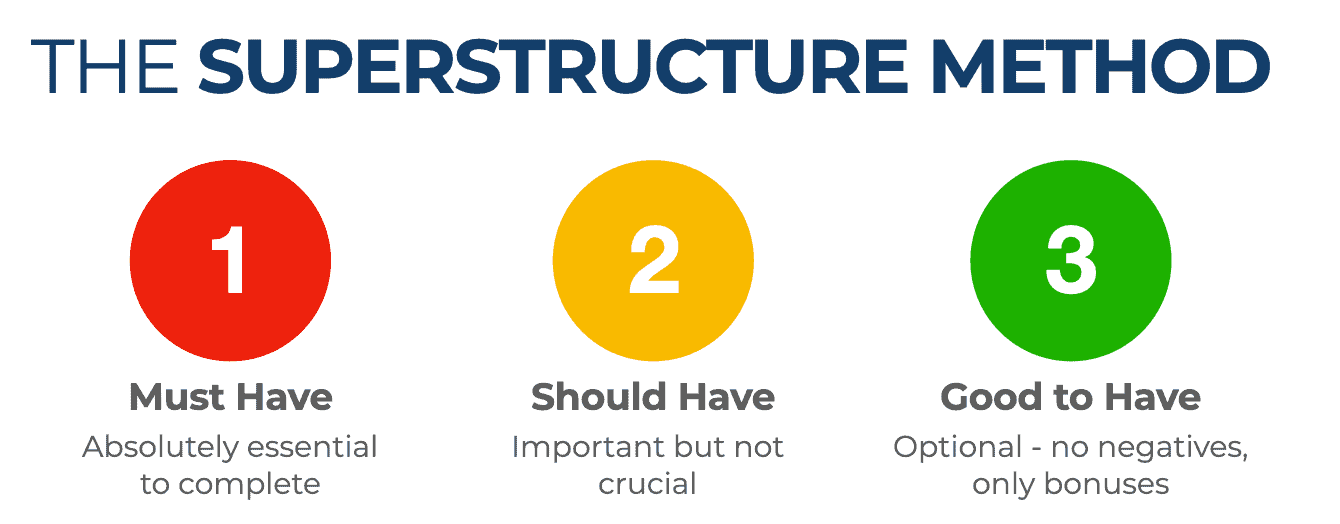
To prioritize your actual activities, use the Superstructure Method, It’s a quick and easy way to divide actions into three priority categories:

  • Must Haves – Items that are absolutely necessary for completion.
  • Should Haves – Items that are useful but not critical to achieving your goal.
  • Good to Haves – Items that are optional, meaning there are no negative consequences if they’re not included. Good-to-haves are purely optional advantages.

superstructure method

The goal of your plan now is to hit all of the Must Haves and Should Haves first, while also making sure you don’t run out of energy at the end of the day. You can then create your schedule based on the plan.

Prioritize Tasks by Energy First

4 Actions
Make a list of the tasks or activities you want to complete in the coming week.
Assign Energy Rating and Time Cost to each task, and prioritize them by energy level required first.
Categorize the tasks into 3 groups: Must Haves, Should Haves, and Good-to-Haves.
Make sure you finish all of the Must Haves and Should Haves first, and that you don’t run out of energy at the end of the day.

5. Use Asynchronous Communication

Asynchronous communication refers to communication methods that do not require the presence or engagement of all parties at the same time. It is a powerful tool for promoting productivity, collaboration, and work-life balance in a remote work environment.

Because it does not require everyone to be present or engaged at the same time, asynchronous communication not only allows you to work on your own schedules and focus on deep work without constant interruptions or distractions, but it also supports collaboration and teamwork across different time zones or schedules.

Moreover, the flexibility and autonomy that asynchronous communication fosters allows you to take greater control of your work and schedules. This promotes work-life balance by allowing you to prioritize your personal needs and responsibilities while still meeting work obligations.

You can easily implement asynchronous communication with colleagues and clients by using tools such as email, instant messaging, or project management software.

Asynchronous Communication

1 Action
Start using tools like project management software, instant messaging, and email.

6. Leverage Project Management Tools

Utilizing project management tools has numerous advantages for remote workers. These tools provide a centralized platform for team members to collaborate, communicate, and track project progress:

  • Clear and organized communication – Project management tools allow you to create tasks, assign them to team members, and set deadlines. This ensures that everyone understands their responsibilities and what is expected of them.
  • Transparency of projects – Team members can see which tasks have been completed, which are in progress, and which are scheduled. This can help to avoid misunderstandings and keep everyone on the same page.
  • A centralized platform where all project information can be stored – Remote workers can easily store and share files, leave comments, and ask questions using project management tools. This can help the team stay organized, reduce the need for lengthy email chains, and ensure that everyone has the most up-to-date information.

At LifeHack, we use Basecamp to track the progress of tasks and projects, make team announcements, and check in with one another. We find Basecamp to be a very useful tool for keeping everyone on the team up to date on project plans and progress.

Leverage Project Management Tools

2 Actions
Choose project managmenet tools that fit your needs.
Choose a tool that allows the team to have clear communication, maintain transparency of projects and progress, and store project information in an organized way.

7. Create Clear Communication Protocols

As a remote worker, you must communicate your availability and preferred communication channels to coworkers in other time zones. This can help to reduce delays and miscommunications and ensure that everyone on the team is on the same page.

Another approach is to create a shared calendar or scheduling tool to help coordinate meetings and deadlines across time zones. Our LifeHack team members typically use Calendly to make meeting scheduling easier.

Communication Protocols

2 Actions
Communicate your availability and preferred communication channels clearly.
Use a shared calendar or scheduling tool to coodrinate meetings and deadlines.

8. Find Your Community

Finding a community to help you feel more connected and supported is an important aspect of remote work.

You can try to make social connections using digital tools. Regular video calls, instant messaging, and virtual team building exercises can help you feel more connected to your coworkers.

Joining online communities or forums related to your industry or profession can also provide social interaction and support. Communities such as Remote Work Community, Digital Nomads World and NomadList facilitate in-person connections between digital nomads and virtual workers.

Make use of co-working spaces and local networking events as well. These opportunities allow you to collaborate with other remote workers, meet new people, and form relationships.

Find Your Community

3 Actions
Use digital tools such as regular video calls, instant messaging and virtual team building exercises to connect with coworkers.
Join online communities or forums related to your industry or profession.
Make use of co-working spaces and local networking events.

Bottom Line

Working remotely is becoming more common, but as a remote worker, you may face difficulties in staying motivated, managing time effectively, and maintaining work-life balance.

The good news is that you can overcome these challenges by setting regular goals, creating an ideal work environment, establishing a routine, using asynchronous communication, leveraging project management tools, establishing communication protocols, and finding a community.

With the right strategies and tools, you can maintain your productivity and performance while also reaping the benefits of remote work.

Featured photo credit: Persnickety Prints via unsplash.com

Reference

The post How to Work Remotely (Your Complete Guide) appeared first on Lifehack.


Friday, 20 January 2023

The Forgotten Emotional Aspects of Productivity

One of the most overlooked causes of being unproductive is emotions. Our productivity and performance are greatly influenced by how we feel about ourselves and what we are capable of.

According to research done by Atlassian, a team’s productivity and the expression of positive emotions are positively correlated, This means that teams are more productive when they are happy with the work they are doing together:[1]

High-performing teams tend to experience twice as many positive emotions compared to low-performing teams. Happy teams get work done.

One way to promote positive emotions is to have a clear direction. Why? As humans, we are wired to prefer things to be under our control because it makes us feel secure and safe.[2] Since we feel more certain about our lives when we have a clear direction, we are less likely to feel depressed.

At LifeHack, we always strive to help our team members set goals and milestones so they know how to move forward and can track their progress along the way. However, not every company would take this step.

A few years ago, my cousin who had just graduated from college began working for a large company. I was overjoyed for him, but then he told me that he was frustrated with the company after only a few months…

He was eager to make a good first impression and establish himself in his new position. However, after a few weeks on the job, he became lost and frustrated. He had no idea what his role entailed, what his goals and objectives were, or how his work fit into the company’s overall goals.

He struggled to focus his attention and energy on his work because he lacked clear direction. He found himself easily distracted, procrastinating, and unmotivated to get started.

He put in a lot of effort to understand the company’s structure and culture, but he didn’t feel like he was making much progress. He couldn’t find motivation to work toward his goals and felt he wasn’t making any significant contributions to the company or his team. He was unsure how to overcome his role’s challenges and improve his performance.

His lack of direction also made making decisions and taking action difficult. He began to question his judgment and feel unsure of what to do. He didn’t know what to prioritize or how to allocate his time and energy effectively.

As a result, his productivity suffered significantly….

How a Lack of Direction Affects Productivity

We can become significantly less productive when we lack direction. It can be difficult to focus our efforts and make progress when we don’t know what we want to achieve. This can lead to feelings of frustration, demotivation, and a sense of being stuck.

Let me go into more detail about this:

1. Loss of Motivation

It can be challenging for people to understand the value and purpose of their work when there is no clear direction. Imagine not knowing what you want to achieve; it can be difficult to find motivation to work towards your goals. This results in a loss of motivation to work hard and persevere in the face of obstacles and challenges.

2. Loss of Focus

Someone who does not have a clear goal in mind will struggle to prioritize their work and focus their attention on the most important tasks. They may struggle to decide which task to tackle first and how to allocate their time and energy. This can leave them feeling disorganized and unfocused, making it difficult to progress on any given task or goal.

3. Loss of Confidence

Insecurity and doubt about one’s choices and even abilities are other effects of a lack of direction. Imagine yourself getting lost in the sea without a compass; you’ll probably question every decision you make about where to find land or where to go next!

Similarly, people who don’t know what they want to accomplish will be plagued by self-doubt. They may be constantly doubting their decisions, the worth of their work, and the impact it will have. They may therefore choose to put things off simply to avoid failing or making any mistakes.

So, what can you do to overcome the difficulties associated with a lack of direction?

Keep reading the following chapters to learn how my cousin used these strategies to get his motivation and focus back to excel at work!

Featured photo credit: Hannah Wei via unsplash.com

Reference

The post The Forgotten Emotional Aspects of Productivity appeared first on Lifehack.